
Sul pavimento dell’abside, un mosaico romanico del XII secolo raffigura un arciere moresco privo del piede destro, sostenuto da una protesi ortopedica: un dettaglio che evoca la Reconquista spagnola a cui il vescovo committente aveva partecipato. Dal Quattrocento, la cattedrale divenne la necropoli dei re e delle regine di Navarra — tra loro, i nonni di Enrico IV di Francia.
At a glance
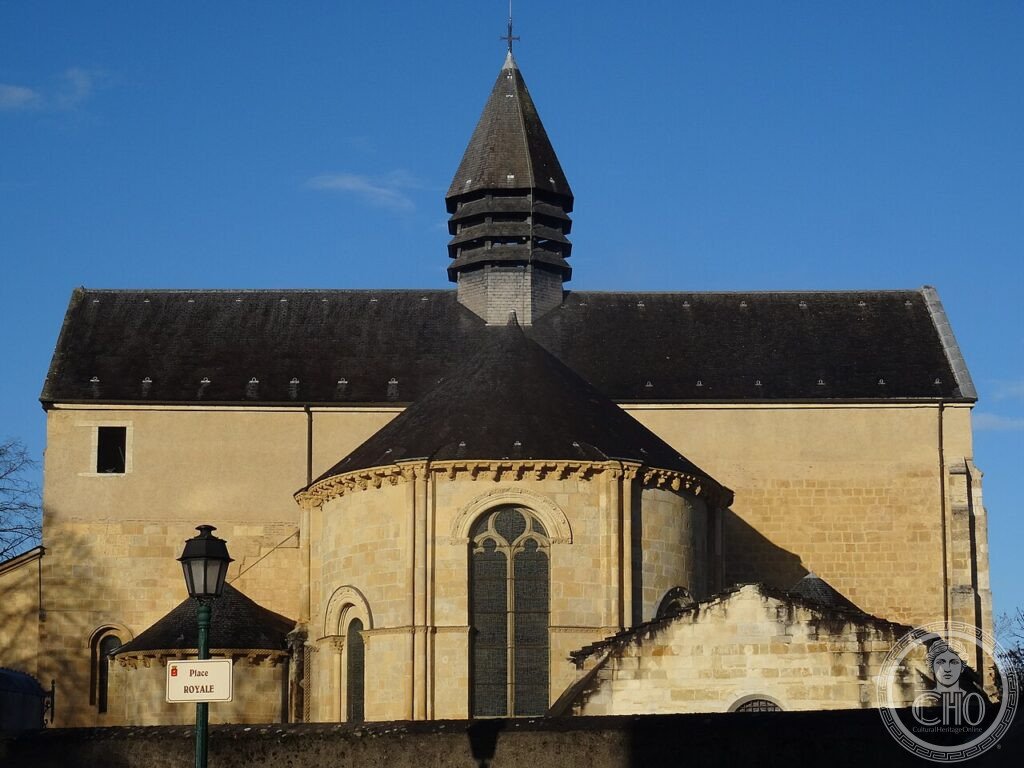
Lescar Cathedral (Cathédrale Notre-Dame-de-l’Assomption) stands on the site of the episcopal seat of Beneharnum, founded by Saint Julian and documented from the 5th century, though the original cathedral in the lower town was destroyed by Norman raiders in 841, prompting the community’s relocation to the more defensible hilltop site under Duke William Sancho of Gascony. The present building was constructed from 1120 under Bishop Guy de Lons and consecrated in 1145, serving both as cathedral and as the seat of a community of Augustinian canons. Its most celebrated artistic feature is a Romanesque floor mosaic in the apse, created during Guy de Lons’s episcopate (1115-1141) as confirmed by a surviving Latin dedication inscription at its edge: the mosaic depicts hunting scenes, including a boar hunt and a gazelle attacked by lions under the watch of birds of prey, alongside a striking and still art-historically puzzling detail — a Moorish archer missing his right foot, moving with the aid of an orthopaedic prosthesis fixed beneath his knee, widely interpreted as evoking the Spanish prosthetic devices Guy de Lons would have observed during his own participation in the Reconquista. From the late 15th century, the cathedral became the necropolis of the Kings of Navarre, replacing Pamplona’s Santa María Cathedral in this role, with burials including François Phébus (1483) and, notably, Henri II d’Albret and Margaret of Angoulême — the grandparents of King Henri IV of France.
Key facts
- Episcopal origins: seat of Beneharnum founded by Saint Julian, documented from the 5th century; original lower-town cathedral destroyed by Norman raiders in 841
- Present cathedral: begun 1120 under Bishop Guy de Lons, consecrated 1145; served as cathedral and seat of a community of Augustinian canons
- Romanesque mosaic: apse floor mosaic from Guy de Lons’s episcopate (1115-1141), confirmed by a Latin dedication inscription; depicts hunting scenes including a boar hunt and a Moorish archer with an orthopaedic leg prosthesis, evoking the Spanish Reconquista
- Necropolis of Navarre: from the late 15th century, replacing Pamplona’s cathedral in this role; burials include François Phébus (1483), Catherine of Navarre, Jean d’Albret, Henri II d’Albret, and Margaret of Angoulême
- Royal connection: Henri II d’Albret and Margaret of Angoulême, buried at Lescar, were the grandparents of King Henri IV of France
History
Lescar’s relocation from its original lower-town site to the more defensible hilltop position, undertaken under Duke William Sancho of Gascony following the 841 Norman destruction of the earlier cathedral, reflects a broader medieval pattern of settlements retreating to more easily fortified ground in response to repeated raiding — a pattern documented at numerous sites across France’s Atlantic-facing and river-accessible regions during the Viking Age. Bishop Guy de Lons’s specific personal history, including his participation in the Iberian Reconquista, gives the apse mosaic’s puzzling Moorish-archer-with-prosthesis imagery a plausible biographical explanation: having witnessed Spanish prosthetic medical technology firsthand during his own campaigning, Guy de Lons may well have commissioned imagery reflecting this personal experience, though art historians continue to debate the mosaic’s precise intended meaning and the reasons for including such an unusual, specific figure within an otherwise conventional hunting-scene decorative programme.
The cathedral’s transformation into the necropolis of the Kings of Navarre from the late 15th century reflects the specific political geography of the Navarrese kingdom during this period, when the Béarn region (including Lescar and the nearby town of Pau) had become closely tied to Navarrese royal authority even as the kingdom’s original Pamplona-based territory faced increasing pressure from Castile and Aragon; relocating royal burial practice from Pamplona to Lescar mirrored this broader northward shift in the practical centre of Navarrese royal power. The presence of Henri II d’Albret and Margaret of Angoulême among the Lescar burials gives the cathedral a direct genealogical connection to the French Bourbon monarchy, since their grandson Henri IV would go on to unite the French crown with his own inherited claim to Navarre, making Lescar’s royal necropolis a documented physical link in the dynastic chain leading to one of France’s most significant royal houses.
What you see
The apse mosaic is the cathedral’s essential single artwork, its hunting scenes and the enigmatic Moorish archer figure rewarding close, unhurried viewing directly on the choir floor where the mosaic has remained in its original position since the 12th century. The Romanesque capitals throughout the building, including a notable Christ-and-five-apostles capital, add further sculptural interest to the nave and choir. The royal tombs of the Navarrese sovereigns, though modified and in some cases relocated over the centuries, give the building a continuing physical connection to the dynastic history linking medieval Navarre to the later French Bourbon monarchy.
Practical information
- Opening hours: generally open daily, check current hours before visiting; free admission
- Address: Place Royale, 64230 Lescar
Getting there
Lescar is a short distance from Pau, itself served by direct rail connections from Bordeaux (approximately 2 hours) and Toulouse (approximately 2 hours), and by its own airport (Pau-Pyrénées). Lescar is reachable from Pau by local bus or a short drive, approximately 10-15 minutes. GPS: 43.3330° N, -0.4334° E.
Nearby
- Lescar medieval old town — surrounding the cathedral; a well-preserved fortified hilltop town with surviving ramparts and gates
- Château de Pau — approximately 15 minutes away; the birthplace of King Henri IV, with extensive royal collections
- Pau historic centre — approximately 15 minutes away; a scenic town overlooking the Pyrenees, with a celebrated promenade
Sources
- Ville de Lescar — official heritage information (lescar.fr)
- Grand Sud Insolite et Secret — “Lescar et sa Cathédrale, nécropole des Rois et Reines de Navarre” (grandsudinsolite.fr)
- Tourisme Pau — “Lescar, cité médiévale” (tourismepau.com)
- Wikipedia — “Cathédrale Notre-Dame-de-l’Assomption de Lescar” (fr.wikipedia.org)
Find it on the map
See this place and what’s around it →📷 Become a Cultural Heritage Online photographer
Share your photos of places: they stay published under your name as the author. The more they're seen, the more you get noticed — and soon a contest will reward the most appreciated photos.
Log in or sign up free to add a photoIs this page about you?
This page is read by travellers and heritage enthusiasts who find it on Google. Tell us how you are connected to this place and we will take it from there.