
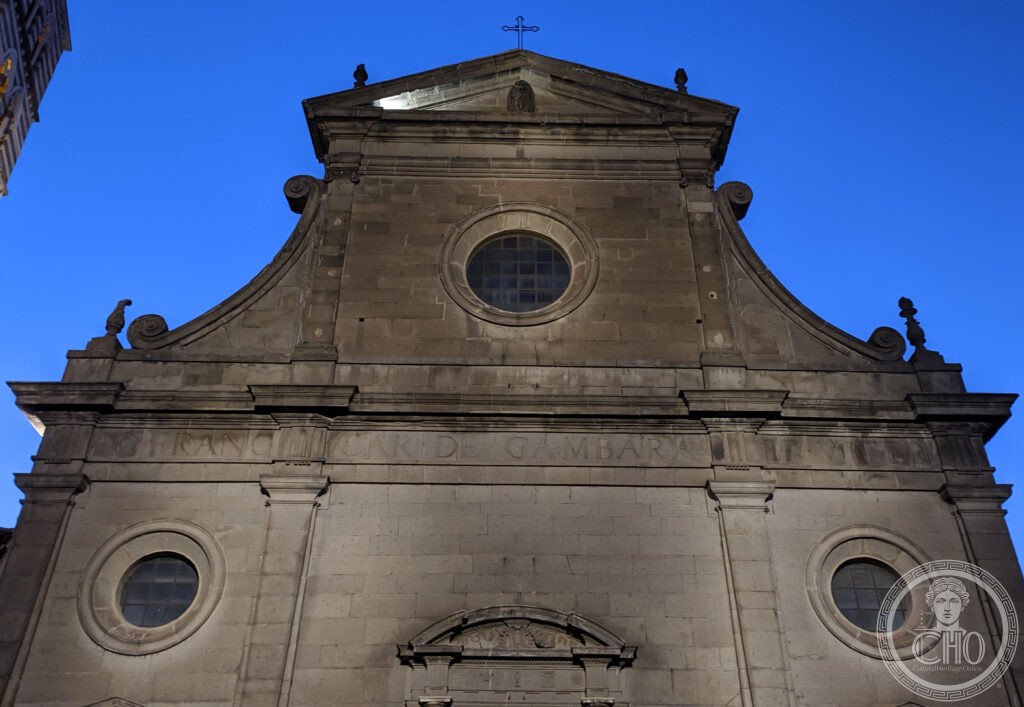
Accanto al Palazzo dei Papi, la Cattedrale di San Lorenzo affianca un campanile gotico a strisce bicolori a una facciata rinascimentale voluta da un cardinale: due secoli di rifacimenti su un impianto romanico sorto sui resti di un tempio romano.
At a glance
The Cathedral of San Lorenzo stands on Viterbo’s cathedral hill, on ground with a documented history stretching back to a 7th-century church built over the remains of a Roman temple to Hercules. The present building was erected toward the end of the 12th century, and the city’s elevation to a diocese by Pope Celestino III in 1192 made San Lorenzo the bishop’s seat. Viterbo’s second half of the 13th century as a papal residence left the cathedral permanently linked to the neighbouring Palazzo dei Papi, built to host Pope Alexander IV and site of the conclave of 1268-1271, remembered as the longest in the history of the papacy. A Gothic bell tower followed in 1369; a Renaissance facade replaced the medieval front in 1570. Severely damaged by Allied bombing in 1944, the interior was rebuilt after the war to approximate its presumed Romanesque appearance.
Key facts
- Dedication: San Lorenzo Martire (Saint Lawrence); erected toward the end of the 12th century over a 7th-century church, itself built on the ruins of a Roman temple to Hercules
- Diocese: established 1192 by Pope Celestino III, making San Lorenzo the episcopal seat
- Bell tower: completed 1369, Gothic, with the alternating travertine-and-basalt banding typical of the period
- Facade: rebuilt in Renaissance style in 1570, directed by Cardinal Giovan Francesco Gambara (1533-1587), bishop of Viterbo 1568-1580
- Interior: three naves on columns, with a Cosmatesque floor
- Burials: Pope John XXI, who died in Viterbo in 1277; the remains of Pope Alexander IV, whose original tomb location is lost
- Status: elevated to minor basilica in March 1940 by Pope Pius XII; heavily damaged by bombing in 1944, with eight side chapels sealed during postwar reconstruction
History
A church dedicated to San Lorenzo already stood on this hill in the 7th century, raised over the remains of a Roman temple to Hercules. The present cathedral replaced it toward the end of the 12th century, and its standing rose sharply in 1192, when Pope Celestino III elevated Viterbo and its territory to a diocese, making San Lorenzo the bishop’s seat. The building’s most consequential decades came in the second half of the 13th century, when Viterbo served as a papal residence: the adjoining Palazzo dei Papi was built to host Pope Alexander IV, and it was there, not in the cathedral itself, that cardinals sealed themselves in for the conclave of 1268-1271 — nearly three years of deadlock remembered as the longest papal election in history.
The cathedral kept developing on its own terms after the papal court moved on. Its Gothic bell tower, banded in alternating travertine and basalt, was finished in 1369. Two centuries later, in 1570, Cardinal Giovan Francesco Gambara, bishop of Viterbo from 1568 to 1580, directed the replacement of the medieval facade with the Renaissance front still standing today, a change that leaves the building’s front and flank reading as two different centuries side by side. Pope Pius XII raised the church to the rank of minor basilica in March 1940.
The heaviest blow came in 1944, when Allied bombing badly damaged the building during the campaign to retake central Italy. Postwar restoration chose to reconstruct the interior toward its presumed Romanesque state rather than rebuild the Baroque-era decoration lost in the raid, sealing eight side chapels in the process. The choice is why the nave today reads as more austere than most Lazio cathedrals that kept their post-Tridentine refitting intact.
What you see
The facade is the building’s clearest lesson in layered history: a smooth, symmetrical Renaissance front from 1570 fronts a body that is otherwise Romanesque and Gothic, most visibly in the bell tower rising beside it, banded in alternating pale travertine and dark basalt in the polychrome manner common to 14th-century Lazio and Tuscia towers. Inside, three naves run on columns toward the apse, floored in Cosmatesque inlay — geometric mosaic work in coloured stone and glass, a technique shared with Rome’s greatest medieval basilicas.
The postwar rebuild kept the apse frescoes by the Roman painter Giuseppe Passeri, depicting the Last Judgment and the Cardinal Virtues, alongside a canvas by Romanelli showing San Lorenzo in glory and Gerolamo da Cremona’s 1472 altarpiece of Christ blessing among saints. The 12th-century Madonna della Carbonara and a 1470 baptismal font are among the older furnishings that survived both the bombing and the subsequent rebuilding.
Practical information
- Opening hours (Polo Monumentale Colle del Duomo): winter 10:00-13:00 and 15:00-18:00; summer 10:00-13:00 and 15:00-19:00; August 10:00-13:00 and 15:00-20:00; closed Mondays and 24-25 December
- Tickets: combined ticket around €8, covering the cathedral sacristy, the Palazzo dei Papi and the Museo Colle del Duomo
- Time needed: 45-60 minutes for the cathedral and adjoining museum complex
Getting there
Viterbo Porta Romana station, on the FL3 regional line, connects to Roma Ostiense and Roma Tiburtina in around two hours; Cotral buses also run from Rome. By car, Viterbo is reached via the Via Cassia (SS2) or by taking the A1 motorway to the Orte exit and continuing on the SS204, roughly 100 kilometres and 1.5 hours from Rome. The cathedral, in Piazza San Lorenzo, is a short walk from the historic centre’s main gates. GPS: 42.41522, 12.10099.
Nearby
- Palazzo dei Papi — adjoining the cathedral in the same piazza; the Loggia delle Benedizioni and the Sala del Conclave, seat of the 1268-1271 papal election
- Quartiere San Pellegrino — medieval district of stone houses linked by external staircases called profferli, among the best-preserved of its kind in Italy
- Terme dei Papi — thermal springs a few kilometres from the centre, in use since Roman times
Sources
- Wikipedia — “Duomo di Viterbo” (it.wikipedia.org)
- Comune di Viterbo — official municipal heritage page (comune.viterbo.it)
- Italia.it — official Italian national tourism portal, Lazio/Viterbo section
- Museo Colle del Duomo — official visitor information (museocolledelduomo.com)
- OpenStreetMap Nominatim — coordinate verification
Find it on the map
See this place and what’s around it →📷 Become a Cultural Heritage Online photographer
Share your photos of places: they stay published under your name as the author. The more they're seen, the more you get noticed — and soon a contest will reward the most appreciated photos.
Log in or sign up free to add a photoIs this page about you?
This page is read by travellers and heritage enthusiasts who find it on Google. Tell us how you are connected to this place and we will take it from there.