
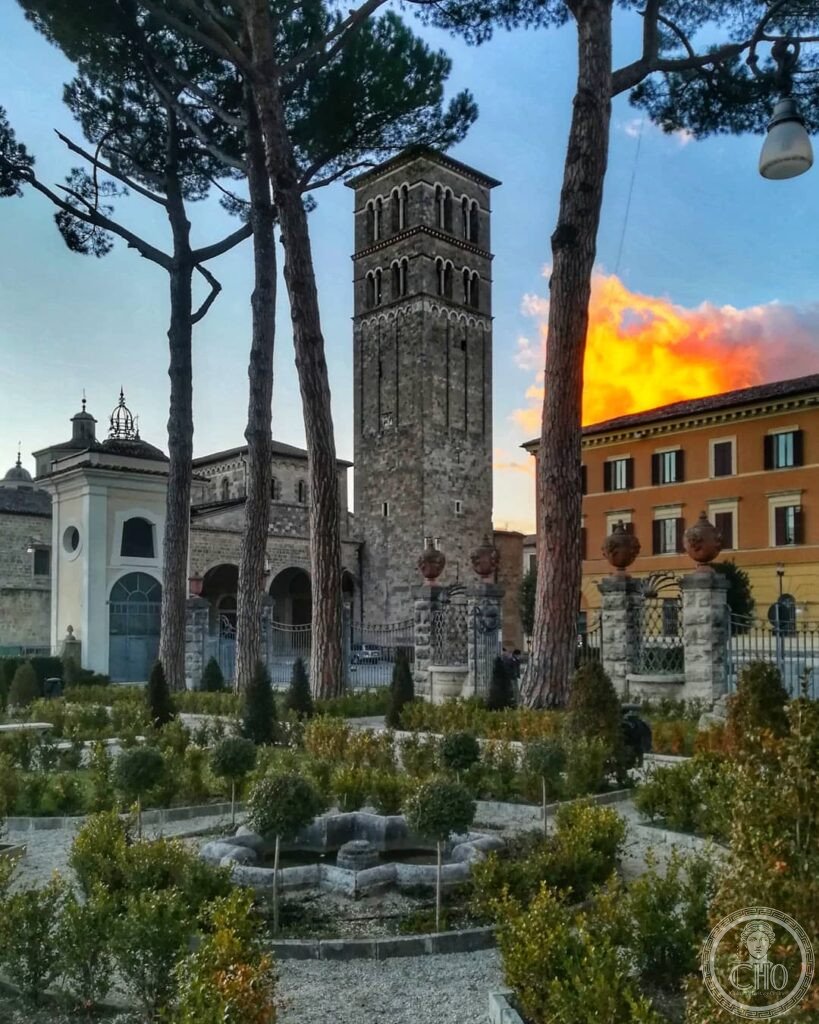
Beneath the Baroque cathedral of Rieti sleeps a twelfth-century Romanesque crypt, carried on sixteen columns: two buildings, two centuries, a single white facade above the sacred valley of Francis of Assisi.
At a glance
The Cathedral of Santa Maria Assunta stands on the raised side of Rieti’s historic centre, overlooking the valley the Franciscans called their Valle Santa, the Sacred Valley. Foundations went in on 27 April 1109. The lower basilica, effectively a full second church built as a crypt beneath the main one, was finished first and consecrated in 1157; the upper church took nearly seventy years longer, consecrated in 1225 by Pope Honorius III. The result carries two distinct identities. Outside and below, it is Romanesque: pale stone, a square 39-metre bell tower raised by Lombard master builders in 1253, and a crypt of nine short aisles on sixteen columns. Inside the upper church, centuries of Baroque refitting covered the older Latin-cross structure in stucco and gilding.
Key facts
- Dedication: Santa Maria Assunta; construction begun 27 April 1109
- Crypt (lower basilica): consecrated 1 September 1157 by Bishop Dodone; nine short aisles on 16 columns under ribbed Romanesque vaulting
- Upper church: consecrated 9 September 1225 by Pope Honorius III
- Bell tower: built 1253 by the Lombard master builders Pietro, Andrea and Enrico; approximately 39 metres tall
- Interior: Baroque remodelling over a Romanesque Latin-cross plan, three naves, transept and deep apse
- Baptistery of San Giovanni in Fonte: adjoining structure dating to the 14th century
- Status: raised to minor basilica in September 1841; exterior restoration directed by Francesco Palmegiani in the 1920s-30s
History
Construction began on 27 April 1109. Work proceeded from the ground up: the lower basilica, divided into nine short aisles by sixteen columns under ribbed Romanesque vaulting, was finished first and consecrated on 1 September 1157 by Bishop Dodone. The upper church took nearly seventy years more to complete; Pope Honorius III himself consecrated it on 9 September 1225.
The bell tower came later still, raised in 1253 by three Lombard master builders recorded as Pietro, Andrea and Enrico. At roughly 39 metres, it remains the tallest structure on Rieti’s skyline and one of the clearest Romanesque elements still visible from outside, since the interior was substantially reworked once Baroque taste reached the diocese — a common trajectory for Lazio’s medieval cathedrals after the Council of Trent. The 14th-century Baptistery of San Giovanni in Fonte was built onto the complex as a separate structure. The cathedral’s status was formally raised to that of minor basilica in September 1841, and a 20th-century restoration campaign directed by Francesco Palmegiani in the 1920s and 1930s is largely responsible for how the exterior reads today.
Inside, the fresco Il miracolo della campana, painted by Marcantonio Aquili in 1510, survives alongside sculptural additions the cathedral attributes to Bernini and to the sculptor Ottoni, and a reliquary chapel still closed by carved wooden doors that the woodworker Carlo Porrina finished in 1657. Two organs, built by Fedeli in 1788 and by Zanin in 1973, serve the liturgy performed in the nave above the medieval crypt.
What you see
From outside, the cathedral still reads as its medieval builders left it: pale local stone, a square Romanesque bell tower rising in tiers of mullioned windows, and, entered separately at ground level, the crypt — nine narrow aisles packed under low ribbed vaults, held up by sixteen columns cut for the purpose in the 12th century. The scale is close and low, built for a smaller congregation than the church above it, and the plain, undecorated capitals carry the restraint typical of the period’s Lombard-trained builders, the same masters credited with the bell tower itself.
Climb to the upper church and the mood changes completely. The Latin-cross plan, three naves, transept and deep apse are still Romanesque in their bones, but nearly every surface was reworked in stucco, gilding and coloured marble once Baroque taste reached Rieti. Aquili’s 1510 fresco of the bell miracle survives from an earlier decorative campaign, set among later additions, and the sacristy’s reliquary chapel is still sealed behind Carlo Porrina’s 1657 carved doors.
Practical information
- Opening hours: the cathedral is an active parish church; hours can shift around Mass times (weekday Masses around 8:00 and 18:00, additional celebrations on Sundays) — check cattedrale.chiesadirieti.it before visiting
- Tickets: free entry to the church and crypt
- Time needed: 30-45 minutes, including the crypt
Getting there
Rieti’s train station sits on the Terni-Rieti-L’Aquila line, with connections from Roma Termini via Terni or Orte taking roughly two to two and a half hours; the cathedral is a 15-20 minute uphill walk from the station into the historic centre. By car, Rieti is reached from Rome via the SS4 Salaria, about 80 kilometres and just over an hour’s drive. GPS: 42.40208, 12.85891.
Nearby
- Santuario di Fonte Colombo — in the Rieti Valley near Contigliano; the hermit cave where Francis of Assisi wrote the Franciscan Order’s second Rule in 1223, and where local tradition holds he first received the stigmata
- Santuario di Greccio — about 15 km from Rieti, 665 m elevation; the hillside where Francis staged the world’s first live Nativity scene in December 1223
- Poggio Bustone and La Foresta — the other two sanctuaries completing the Franciscan Sacred Valley circuit around Rieti
Sources
- Wikipedia — “Cattedrale di Santa Maria Assunta (Rieti)” (it.wikipedia.org)
- BeWeb, Conferenza Episcopale Italiana — Chiesa di Santa Maria Assunta, Rieti (beweb.chiesacattolica.it)
- Wikipedia — “Sanctuary of Fonte Colombo” and “Sanctuary of Greccio” (en.wikipedia.org)
- OpenStreetMap Nominatim — coordinate verification
Find it on the map
See this place and what’s around it →📷 Become a Cultural Heritage Online photographer
Share your photos of places: they stay published under your name as the author. The more they're seen, the more you get noticed — and soon a contest will reward the most appreciated photos.
Log in or sign up free to add a photoIs this page about you?
This page is read by travellers and heritage enthusiasts who find it on Google. Tell us how you are connected to this place and we will take it from there.