
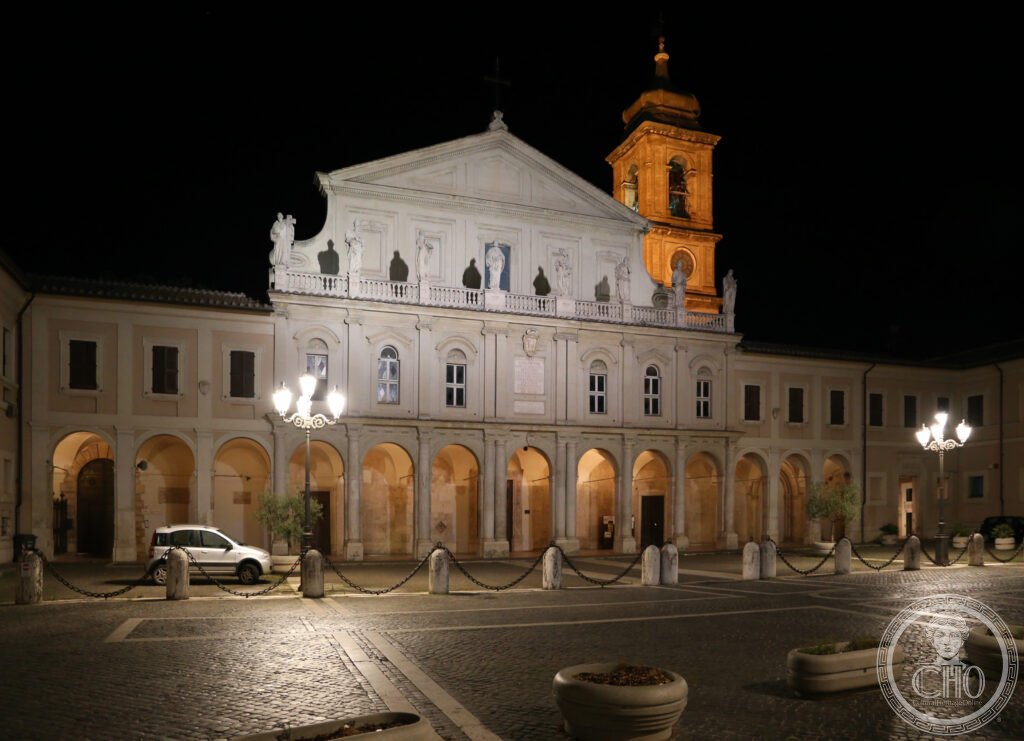
Terni’s mother church holds a Romanesque core behind a seventeenth-century facade, with a Latin-cross interior, Cosmatesque crypt inlay and a high altar conceived by Luigi Vanvitelli. A local tradition, unverified by documents, attributes the overall design to Gian Lorenzo Bernini, while the tomb beneath the apse is linked to Bishop Anastasius.
At a glance
Terni Cathedral, dedicated to Santa Maria Assunta, is the mother church of the Diocese of Terni-Narni-Amelia and stands on Piazza Duomo in the historic centre. Tradition holds that an earlier church rose here around the tomb of Sant’Anastasio, a bishop of the 6th or 7th century. The structure was rebuilt around the 10th and again in the 12th century.
The building seen today is largely the result of a century-long renovation. The tribune and apse were built between 1547 and 1559, the longitudinal body and side chapels were extended from 1565 under a design connected to Sebastiano Flori, a pupil of Giorgio Vasari, and the works concluded in 1653 under Cardinal Francesco Angelo Rapaccioli. A long-standing local tradition credits the design to Gian Lorenzo Bernini, though no document confirms it.
Key facts
- Dedication: Santa Maria Assunta, the Assumption of the Virgin.
- Original foundation: tradition places an early church beside the tomb of Sant’Anastasio, a bishop of the 6th-7th century; the structure was rebuilt around the 10th and again in the 12th century.
- Renaissance-Baroque campaign: tribune and apse 1547-1559; nave and chapels extended from 1565, connected to Sebastiano Flori; works completed in 1653 under Cardinal Francesco Angelo Rapaccioli.
- Facade: a wide portico with a double colonnade shelters three Romanesque-era doors, the main pre-Baroque survival.
- High altar: polychrome marble design conceived by Luigi Vanvitelli and executed by his pupil Carlo Murena in the 18th century.
- 20th-century restoration: Marcello Piacentini reinforced the structure between 1932 and 1937, adding the travertine balustrade and eight statues of bishops on the facade terrace.
History
Local tradition ties the cathedral’s origin to Sant’Anastasio, a bishop who held the see of Terni in the 6th or 7th century and was buried on the site later occupied by the church. Documentary sources describe a rebuilding of that early structure around the 10th century, with further work in the 12th. Little of this pre-Baroque fabric survives above ground beyond the masonry under the entrance porch and the central portal, though the crypt preserves Cosmatesque inlay work from this older phase.
The cathedral’s present appearance is the product of a sustained 16th- and 17th-century campaign. Work on the tribune and apse ran from 1547 to 1559, when the choir was also arranged; from 1565 the longitudinal body was extended and new chapels added to a design connected to Sebastiano Flori, who had trained under Giorgio Vasari. The renovation concluded in 1653, during the episcopate of Cardinal Francesco Angelo Rapaccioli, with the completion of the entrance portico.
A tradition that has circulated locally for generations attributes the overall design to Gian Lorenzo Bernini, but this claim is not supported by any surviving document and is treated by the diocese itself as unverified. In the 20th century, between 1932 and 1937, architect Marcello Piacentini directed structural reinforcement works and added the travertine balustrade with statues of bishops that now crowns the facade terrace.
What you see
The facade presents a broad portico carried on a double colonnade, sheltering three doorways of Romanesque origin, plain survivors of the church that stood here before the 16th-century rebuilding. Behind this screen, the interior opens into a Latin-cross plan with a central nave and two side aisles divided by pilasters, a wide transept, a dome over the crossing, and an apse closing the sequence; the scale reads as distinctly Baroque even where individual elements, like the door surrounds, are centuries older.
At the east end, the high altar carries a polychrome marble design conceived by Luigi Vanvitelli, architect of the royal palace at Caserta, and carried out by his pupil Carlo Murena, whose workshop also produced the reliquary tabernacle nearby. The choir stalls date to 1559, carved under Domenico Corsi, and the baptismal font is dated 1585. Paintings inside include a Noli me tangere attributed to Guido Reni and an Agony in the Garden attributed to Francesco Cincinnato. The cathedral’s organ, built in the 17th century, is popularly but unverifiably linked to Bernini’s circle in the same way as the facade design.
Practical information
- Opening hours: The cathedral is normally open in the morning and late afternoon; check current hours with the Diocese of Terni-Narni-Amelia before visiting.
- Admission: Entry to the nave is free.
- Services: Mass is celebrated on weekdays and Sundays, with times published by the diocese.
Getting there
Terni railway station lies on the Rome-Ancona line via Orte, with direct regional trains from Rome and connections toward Perugia; the cathedral is a short walk north of the station through the historic centre. Perugia San Francesco d’Assisi is the nearest airport and is reached by train to Perugia plus the Airlink bus. By car, Terni sits on the SS3 Via Flaminia and connects to the A1 motorway via Orte and the E45 superstrada.
Nearby
- Basilica di San Valentino — within the city; the 1618 sanctuary built over the tomb of the bishop-martyr venerated worldwide as patron of lovers.
- Anfiteatro Fausto — in the historic centre; a Roman amphitheatre dedicated in 32 AD under Tiberius, older than the Colosseum.
- Cascata delle Marmore — a few kilometres outside the centre; one of Europe’s tallest man-made waterfalls, created by Roman-era hydraulic engineering on the Velino river.
Sources
- Diocesi di Terni-Narni-Amelia — Cattedrale Santa Maria Assunta Terni
- Comune di Terni — Vivi Terni, Cathedral of Santa Maria Assunta
- Wikipedia — Duomo di Terni and Terni Cathedral
- Comune di Terni — Anfiteatro romano
Find it on the map
See this place and what’s around it →📷 Become a Cultural Heritage Online photographer
Share your photos of places: they stay published under your name as the author. The more they're seen, the more you get noticed — and soon a contest will reward the most appreciated photos.
Log in or sign up free to add a photoIs this page about you?
This page is read by travellers and heritage enthusiasts who find it on Google. Tell us how you are connected to this place and we will take it from there.