
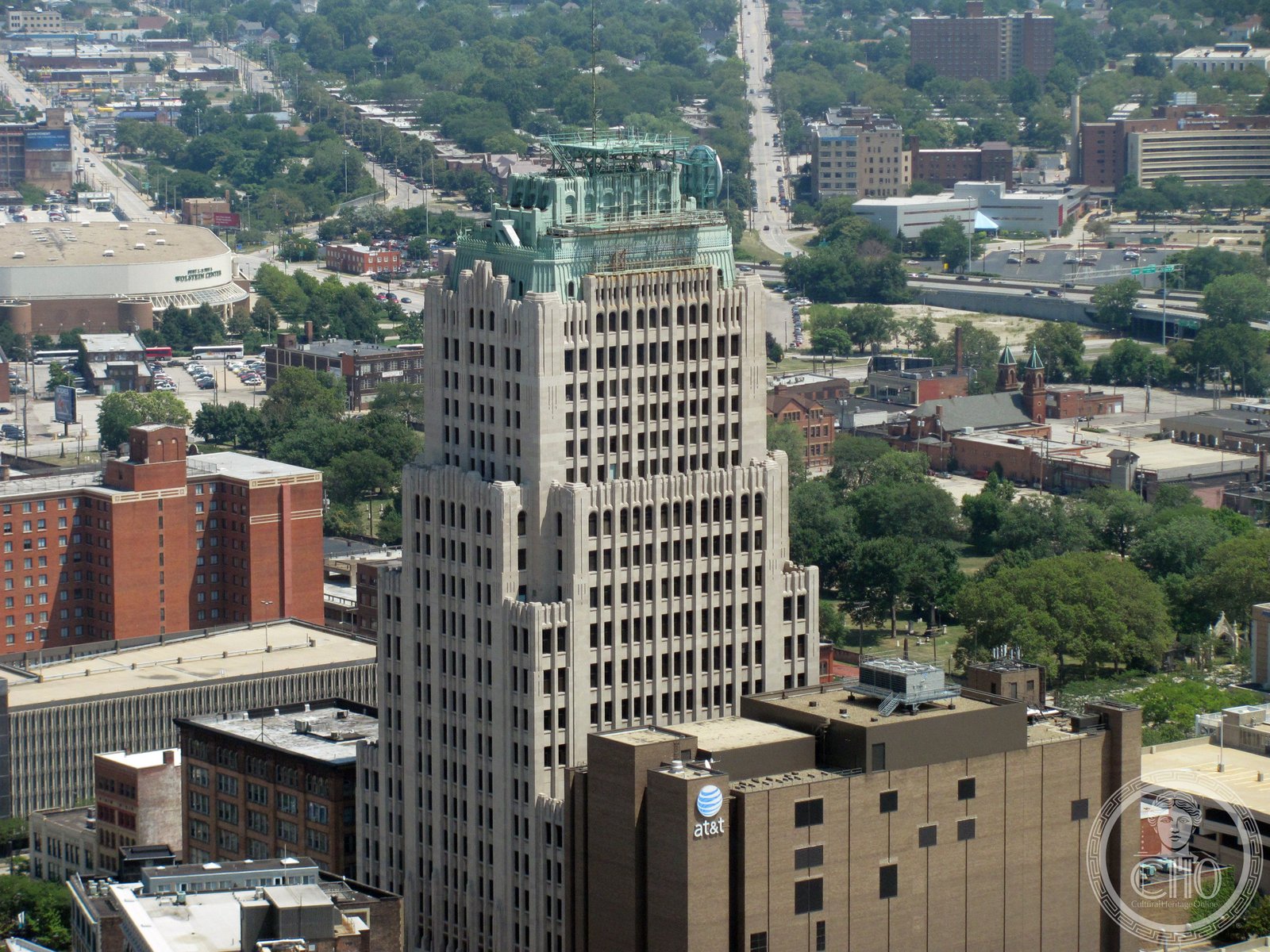
AT&T Huron Road Building
Briefly Cleveland’s tallest building in 1927, the former Ohio Bell headquarters brought Art Deco’s “Modern American Perpendicular Gothic” to the midwest telephone exchange — designed to the influence of Eliel Saarinen’s unrealized Tribune Tower.
At a glance
The AT&T Huron Road Building — built in 1925-1927 as the Ohio Bell Building and for decades one of the most important telephone exchanges in the Midwest — rises 22 stories above downtown Cleveland in the style that architects Hubbell & Benes called “Modern American Perpendicular Gothic.” The $5 million building was briefly the tallest in Cleveland upon completion in 1927; the Terminal Tower surpassed it the following year. Its design drew on Eliel Saarinen’s influential 1922 Tribune Tower submission, which had offered American architects a new way to think about tall buildings. The tower’s current owners claim it as the model for Superman co-creator Joe Shuster’s fictional Daily Planet building — a claim Shuster himself denied — but the building’s actual history as a telecommunications landmark is distinguished in its own right.
Key facts
- Completed: 1927 (construction started 1925)
- Architect: Hubbell & Benes
- Style: Art Deco (“Modern American Perpendicular Gothic”)
- Height: 365 ft (111 m), 22 stories
- Address: 750 Huron Road, Downtown Cleveland, Ohio 44113
- Former names: Ohio Bell Building; SBC Center
- Cost: $5 million
- Briefly tallest in Cleveland; surpassed by Terminal Tower, 1928
History
Ohio Bell had operated its switching center at a Michigan Avenue location since 1890. The construction of the Terminal Tower complex forced the relocation: during the new building’s construction, some 10,000 miles of telephone lines and switches were moved from Michigan Avenue to the Huron Road complex — an infrastructure undertaking as ambitious in its own way as any visible architectural element. Hubbell & Benes designed the tower in their “Modern American Perpendicular Gothic” style, a phrase that combined the machine-age verticalism of the new Art Deco movement with the Gothic vocabulary still understood as appropriate for important buildings in the 1920s. The influence of Eliel Saarinen’s 1922 Tribune Tower submission — which had shown how to organize setbacks and ornament without Gothic or Classical borrowings — was central to the building’s design approach.
The building opened in 1927 as briefly the tallest in Cleveland. When the Terminal Tower surpassed it in 1928, Huron Road settled into its role as infrastructure rather than landmark: one of the largest telephone switching stations in the country, carrying an increasing share of Midwest telecommunications traffic. By 1938 a new switching board had been installed; by 1944 it was handling 25,300 long-distance calls daily on average. Ohio Bell moved its offices to the new Erieview Tower in 1964 while retaining Huron Road as a switching center. In 1983, Ohio Bell relocated to 45 Erieview; the Huron Road building was adapted for DSL service. In 2025 the building was sold.
What you see
The Huron Road Building’s facade reads most clearly from a distance — seen from the Terminal Tower observation deck or from Public Square, where the building’s “Modern American Perpendicular Gothic” vocabulary is fully legible: vertical window registers, the handling of the upper-story setbacks, and a restrained ornamental crown that finishes the tower at the skyline. Up close, the base and lobby carry Art Deco details from the 1927 construction, though the building’s infrastructure function has kept most interior spaces inaccessible to the public.
The design question Hubbell & Benes were answering in 1925 — how to make a tall building look like a tall building rather than a stacked sequence of floors — is the same question Eliel Saarinen had answered differently in his 1922 Tribune Tower submission. The Huron Road tower’s solution, “American Perpendicular Gothic,” sits between Saarinen’s more radical reduction and the decorative Gothic of the actual Tribune Tower built to Howells and Hood’s design. The result is a building that reads as decisively vertical without being either fully modernist or fully historicist.
Practical information
- Active telecommunications infrastructure facility; no general public access to interior
- Exterior freely viewable from Huron Road and from the surrounding blocks
- Best viewed from the Terminal Tower observation deck (third-party ticket required)
- Allow 15–20 minutes for exterior orientation and photography
Getting there
750 Huron Road is in downtown Cleveland near Public Square and the Cuyahoga County Courthouse. Greater Cleveland RTA’s Red, Blue, and Green lines connect at Tower City/Public Square, two blocks north. By car, downtown Cleveland exits from I-90 (West 3rd Street) or I-77 connect to Ontario Street and Huron Road. Cleveland Hopkins International Airport is 13 miles southwest. GPS: 41.4981°N, 81.6864°W.
Nearby
- Terminal Tower (1930) — three blocks northwest, the 52-story tower that surpassed the Huron Road building to become Cleveland’s tallest from 1928 to 1967; observation deck open to the public
- Cuyahoga County Courthouse — one block east, a Beaux Arts civic building from 1912 with significant interior murals
- Cleveland Public Auditorium — five minutes on foot, a 1922 Beaux Arts venue that hosted the 1924 and 1936 Republican National Conventions
Sources
- Wikipedia: AT&T Huron Road Building
- Johannesen, Eric. Cleveland Architecture 1796-1976 (Western Reserve Historical Society, 1979), pp. 149-150
- Toman, J.A. & Cook, D.J. Cleveland’s Towering Treasure: A Landmark Turns 75 (Cleveland Landmark Press, 2005)
- ClevelandSkyscrapers.com: Ohio Bell / AT&T Huron Road Building profile
Find it on the map
See this place and what’s around it →📷 Diventa un fotografo di Cultural Heritage Online
Condividi le tue foto dei luoghi: restano pubblicate con la tua firma come autore. Più vengono viste, più ti fai conoscere — e presto un concorso premierà le foto più apprezzate.
Accedi o registrati gratis per aggiungere una fotoDo you manage this place?
This page is read by travellers and heritage enthusiasts who find it on Google. Keep it accurate — and make it work for you. Free for non-profit heritage institutions.