
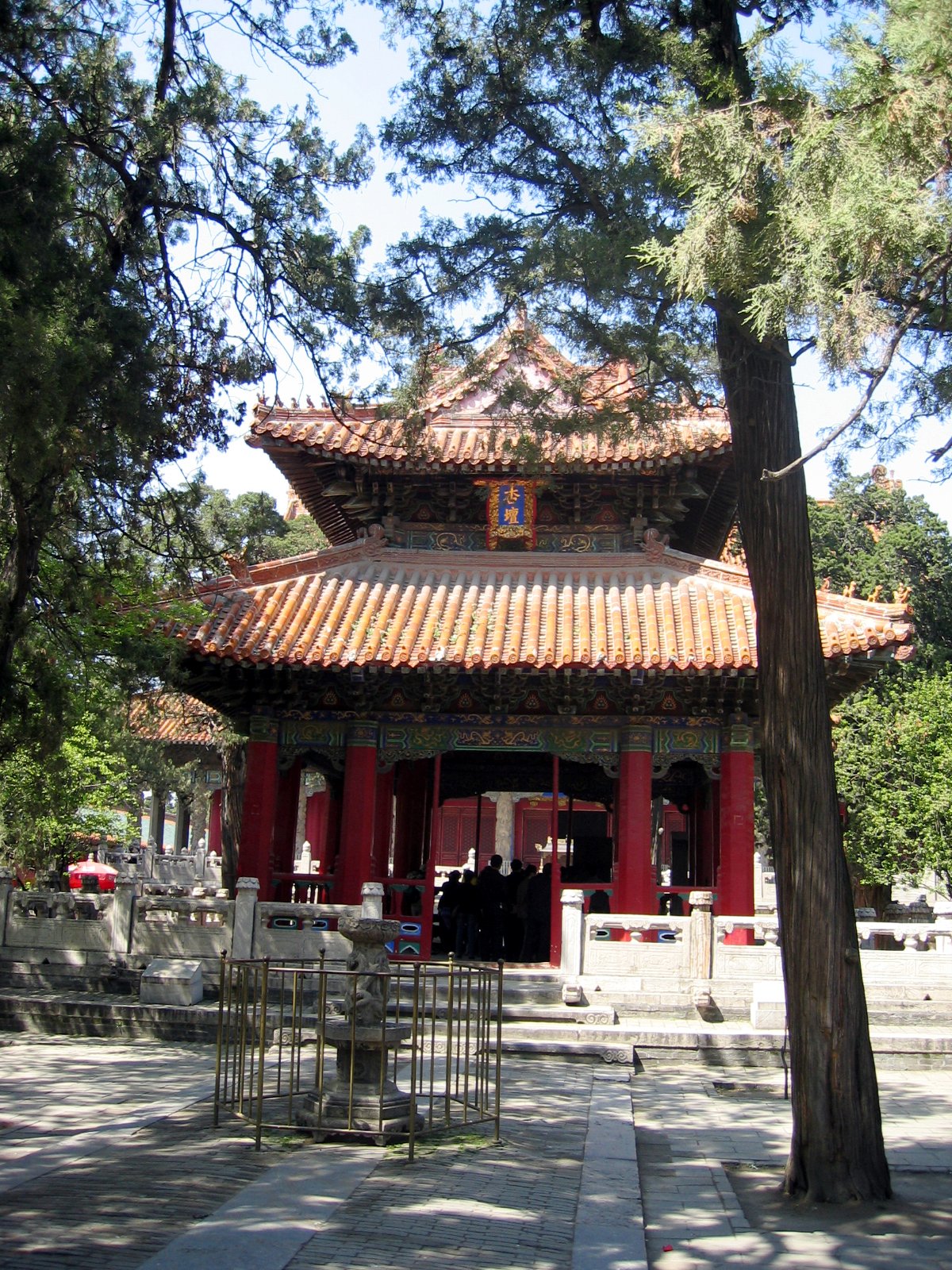
Three interconnected sites in Shandong Province preserve the legacy of Confucius and his descendants across two millennia of Chinese history.
In UNESCO’s words
The temple, cemetery and family mansion of Confucius, the great philosopher, politician and educator of the 6th–5th centuries B.C., are located at Qufu, in Shandong Province. Built to commemorate him in 478 B.C., the temple has been destroyed and reconstructed over the centuries; today it comprises more than 100 buildings. The cemetery contains Confucius' tomb and the remains of more than 100,000 of his descendants. The small house of the Kong family developed into a gigantic aristocratic residence, of which 152 buildings remain. The Qufu complex of monuments has retained its outstanding artistic and historic character due to the devotion of successive Chinese emperors over more than 2,000 years.
At a glance
The UNESCO-protected complex comprises three distinct structures: the Temple of Confucius (Kǒng Miào), the Kong Family Mansion (Kǒng Fǔ), and the Cemetery of Confucius (Kǒng Lín). Together they form San Kong—the “Three Confucian Sites”—each documenting different dimensions of Confucius’s influence on Chinese civilization.
History
Confucius, the foundational philosopher whose teachings shaped East Asian thought, left an enduring mark on his birthplace of Qufu. The cemetery, where Confucius himself was buried, expanded over centuries as his descendants were interred there. The Kong Family Mansion served as the residence of Confucius’s main-line descendants, who maintained administrative and spiritual roles tied to their ancestor’s veneration. The three sites evolved together as pilgrimage destinations and centers of scholarly authority.
What you see
The Temple of Confucius stands as a ceremonial space dedicated to venerating the sage. Several kilometers north lies the Cemetery, containing generations of burials. The Kong Family Mansion functioned as both residence and administrative center for Confucius’s lineage. The physical arrangement of these three sites—spread across Qufu’s landscape—reflects their distinct ceremonial and domestic purposes within a unified cultural system.
Cultural significance
These sites represent the institutional preservation of Confucianism, one of the world’s most influential philosophical traditions. The continuous occupation of the mansion by direct descendants and the maintenance of the cemetery demonstrate an unbroken link to Confucius across more than two thousand years. The complex embodies how Chinese civilization integrated ancestor veneration, philosophical teaching, and family lineage into a cohesive cultural practice.
Key facts
- Location: Qufu, Shandong Province, China
- Coordinates: 35.61°N, 116.98°E
- UNESCO World Heritage Site: Inscribed 1994
- Three components: Temple, Cemetery, Kong Family Mansion
Practical information & getting there
Qufu is accessible by train and bus from major Chinese cities. The three sites are distributed across the city; visitors typically plan a day to tour all three. Local guides and signage assist navigation. Current hours, admission fees, and detailed visitor information are available through local tourism offices and the Qufu city government website.
Sources & resources
- Temple and Cemetery of Confucius and the Kong Family Mansion in Qufu — whc.unesco.org — Temple and Cemetery of Confucius and the Kong Family Mansion in Qufu
- World Heritage List — reference 704 — UNESCO open data, dataset whc001
- UNESCO — official film on this property — on YouTube
- Temple and Cemetery of Confucius and the Kong Family Mansion in Qufu — UNESCO official photograph — Ko Hon Chiu Vincent
- Temple and Cemetery of Confucius and the Kong Family Mansion in Qufu — Wikipedia — consulted as a secondary reference, not as confirmation
- culturalheritageonline.com — our archive and city guides
Find it on the map
See this place and what’s around it →📷 Become a Cultural Heritage Online photographer
Share your photos of places: they stay published under your name as the author. The more they're seen, the more you get noticed — and soon a contest will reward the most appreciated photos.
Log in or sign up free to add a photoIs this page about you?
This page is read by travellers and heritage enthusiasts who find it on Google. Tell us how you are connected to this place and we will take it from there.