
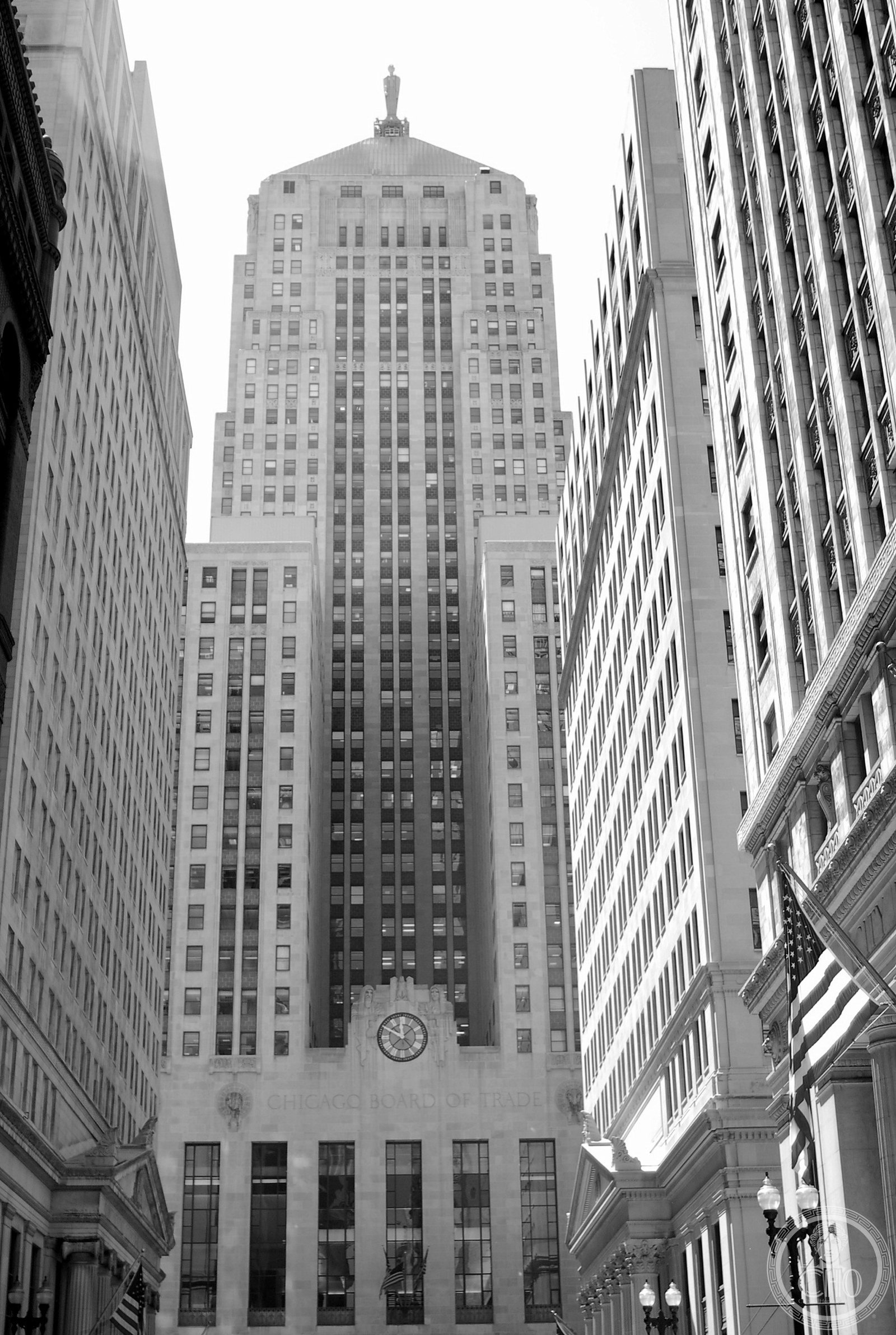
At the foot of the LaSalle Street canyon, the Chicago Board of Trade Building rises as Chicago’s most commanding Art Deco statement — crowned by an aluminum goddess of grain who stands faceless at 600 feet because the architects knew no one looking up from Jackson Boulevard could ever see her expression.
At a glance
The Chicago Board of Trade Building at 141 West Jackson Boulevard was completed in 1930 as the headquarters of one of the world’s oldest commodity futures and options exchanges. Designed by Holabird & Root, it stands at the southern terminus of the LaSalle Street financial corridor — the so-called LaSalle Street canyon — where the building’s stepped Art Deco tower closes the view from the north in a composition that urban designers still cite as a model of street closure. An aluminum statue of Ceres, the Roman goddess of grain, crowns the building’s summit. She has no face: Ceres was designed faceless on the assumption that no one at street level could resolve her features, and a detailed countenance would have been wasted labor. The building is listed on the National Register of Historic Places.
Key facts
- Address: 141 West Jackson Boulevard, Chicago Loop, Chicago, Illinois
- Completed: 1930
- Architects: Holabird & Root
- Style: Art Deco
- Floors: 45 stories (original 1930 structure)
- Current use: Active commodity exchange; office building
- Historic designation: National Register of Historic Places; Chicago Landmark
History
The Chicago Board of Trade was founded in 1848 and is the oldest futures and options exchange in the world. The 1930 building replaced an earlier structure on the same site. Holabird & Root, the Chicago firm that had been instrumental in developing the city’s commercial architectural identity since the 1880s, designed the new building in the Art Deco vocabulary that was then at its peak of prestige in American commercial architecture. The commission presented the firm with an opportunity to create a landmark that would define the southern end of Chicago’s financial district for generations.
The Art Deco program that Holabird & Root applied to the building is both rigorous and inventive. The exterior uses a setback profile that creates the characteristic stepped silhouette of American Art Deco skyscrapers while maintaining a coherent vertical emphasis from base to crown. The ornamental program — geometric reliefs, stylized wheat and agricultural motifs appropriate to a grain exchange, metal work throughout — is applied consistently from street level to the upper stories. The building’s position at the foot of LaSalle Street means that it functions as a terminal perspective for the entire financial district: approaching from the north along LaSalle, the Board of Trade is framed by the flanking office towers and appears to grow larger and more dominant as the viewer advances.
The aluminum Ceres statue was sculpted by John Storrs and stands at the pyramid-capped summit of the building. Storrs was a Chicago-born sculptor who had trained in Paris and was associated with the Art Deco sculptural tradition; his Ceres is a stylized female figure with the angular, streamlined qualities of 1930s Art Deco sculpture. The building was extended with a postmodern addition in 1980, designed by Murphy/Jahn, which attached to the original structure. The original 1930 building and its Ceres statue remain the visual and historical centerpiece of the complex.
What you see
The most famous view of the Board of Trade is from LaSalle Street looking south: the building fills the end of the street like a stage backdrop, its stepped pyramidal crown rising above the flanking buildings in a silhouette that reads with great clarity against the Chicago sky. The base of the building, at street level, presents a formal entrance treatment with carved ornament depicting wheat, corn, and other agricultural subjects appropriate to a commodity exchange. Above, the setbacks of the tower follow the 1923 zoning envelope that shaped Chicago’s skyscraper profile in the mid-century period.
Ceres herself is visible from LaSalle Street as a gleaming metallic form at the pyramid’s apex, though the detail of Storrs’s sculpture is lost at that distance — exactly as intended. On clear days the figure catches the sun in a way that distinguishes the building from its neighbors. The interior trading floor, once among the most active in the world, has been substantially altered by the transition from open-outcry pit trading to electronic trading. The building’s Art Deco lobby and public spaces retain significant original fabric.
Practical information
- Status: Active commodity exchange and office building; lobby accessible during business hours
- Exterior: Freely visible from LaSalle Street and Jackson Boulevard at all times
- Best view: Looking south down LaSalle Street from approximately Quincy Street, where the street closure framing the building is most effective
- Historic designation: National Register of Historic Places; Chicago Landmark
Getting there
The Chicago Board of Trade Building is at 141 West Jackson Boulevard in the Loop, Chicago’s downtown financial district. The nearest CTA stations are LaSalle/Van Buren (Brown, Orange, Pink, Purple lines) one block north on LaSalle Street, and Jackson (Blue Line) one block to the west on Jackson Boulevard. The building is within the Chicago Loop and easily accessible from any direction on foot or transit. From Millennium Park, the walk west along Jackson Boulevard takes about ten minutes.
Nearby
- The Rookery (1888) — one of the great buildings of the early Chicago School, designed by Burnham and Root, at 209 South LaSalle Street, one block north; its interior court was remodeled by Frank Lloyd Wright
- Marquette Building (1895) — another Chicago School landmark, at 140 South Dearborn Street, two blocks northeast, with celebrated mosaic portraits of Marquette’s exploration of the Mississippi
- The Art Institute of Chicago — the encyclopedic art museum at 111 South Michigan Avenue, the largest art museum in the Midwest, about ten minutes east by foot
- Millennium Park — Chicago’s landmark public park on Michigan Avenue, home of Cloud Gate (“The Bean”) and the Jay Pritzker Pavilion, about ten minutes east
Sources
- Wikipedia: Chicago Board of Trade Building
- National Register of Historic Places nomination documentation
- Zukowsky, John, ed., Chicago Architecture 1872–1922: Birth of a Metropolis (Prestel, 1987)
- Chicago Architecture Center building records
Find it on the map
See this place and what’s around it →Record researched and written by Luigi De Marchi for Cultural Heritage Online, 2026.
📷 Become a Cultural Heritage Online photographer
Share your photos of places: they stay published under your name as the author. The more they're seen, the more you get noticed — and soon a contest will reward the most appreciated photos.
Log in or sign up free to add a photoIs this page about you?
This page is read by travellers and heritage enthusiasts who find it on Google. Tell us how you are connected to this place and we will take it from there.