
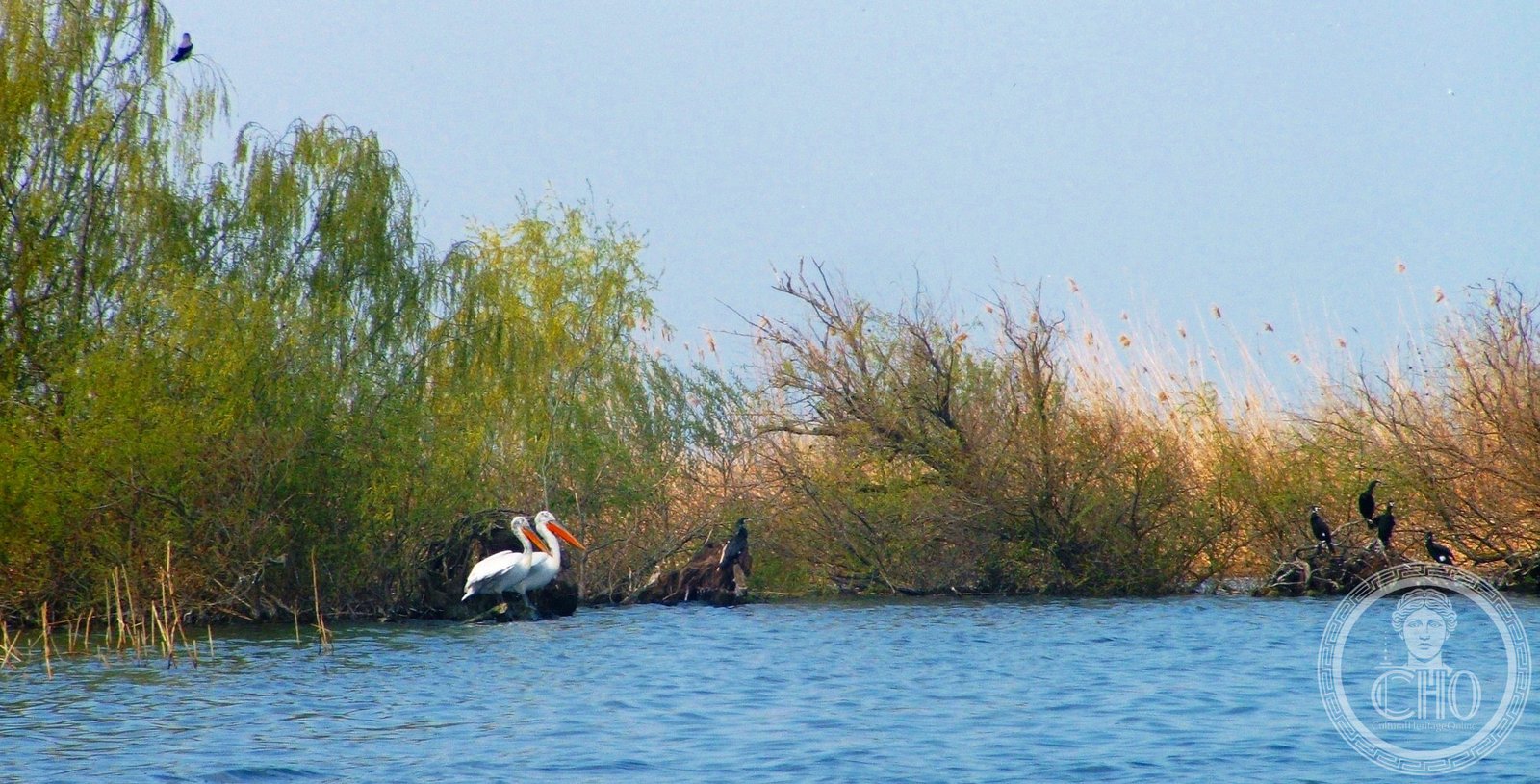
On the Danube floodplain in north-eastern Bulgaria, the Srebarna Nature Reserve is one of Europe’s most important freshwater wetland habitats — a shallow lake fed by Danube backwaters that provides a critical breeding ground for the globally threatened Dalmatian pelican and more than 80 other bird species. Compact in area but exceptional in ecological importance, it was recognised as a UNESCO World Heritage site in 1983. UNESCO 1983.
Significance and overview
Srebarna Nature Reserve covers approximately 600 hectares around the Lake Srebarna — a shallow freshwater lake 2 km from the Danube River near the town of Silistra in north-eastern Bulgaria. UNESCO inscribed it in 1983 (ref. 219) as an outstanding example of a Danube floodplain wetland ecosystem, and for its exceptional importance as a breeding colony for the Dalmatian pelican (Pelecanus crispus) — one of the world’s rarest birds, with a total global population of around 11,000–13,000 individuals. The reserve has been designated as a Ramsar Wetland of International Importance and as a Biosphere Reserve by UNESCO.
The reserve was placed on the UNESCO Danger List in 1992 when a dyke cut off the natural hydraulic connection between the lake and the Danube; restoration work in the 1990s reconnected the hydrology and the pelican colony recovered, leading to delisting in 2003.
Historical background
The Srebarna lake and wetland have been documented since the medieval period, when the region was part of the Bulgarian tsardom and later the Ottoman Empire. The natural connection between the Danube and the lake — which floods seasonally, bringing nutrients and fish — sustained the wetland ecosystem for millennia. Bulgarian scientific interest in Srebarna’s birds began in the early 20th century; the reserve was formally established in 1948 and declared a nature monument in 1966.
The critical turning point came in the 1970s and 1980s, when an embankment was built along the Danube for flood control, cutting off the seasonal flooding that fed the lake. Water levels fell, vegetation changed, and the Dalmatian pelican colony collapsed from over 100 breeding pairs to near zero. International pressure, including UNESCO’s Danger Listing in 1992, prompted the Bulgarian government to restore the hydraulic connection in 1994–1995. The pelican colony recovered dramatically, and by the 2000s Srebarna had returned to ecological health.
Key features
The Dalmatian pelican colony is Srebarna’s centrepiece: one of the few breeding sites in Europe for this magnificent bird, which nests on floating reed islands in the lake and feeds on fish in the Danube. Over 80 bird species breed at Srebarna, including the great white pelican, great cormorant, night heron, squacco heron, purple heron, spoonbill, and several species of tern. The dense reed beds (Phragmites communis) that cover much of the lake are essential habitat for the nesting birds and for the reserve’s rich invertebrate and fish communities.
The surrounding upland landscape, with its steppe grasslands and oak woodlands, adds further biodiversity, and the Danube itself — one of Europe’s great rivers — provides the dynamic flood pulse that drives the ecosystem.
Ecological importance
Srebarna is a critical node on the Via Pontica — one of Europe’s major migratory bird flyways — and provides stopover and wintering habitat for hundreds of thousands of waterfowl and waders each autumn and winter. Its ecological recovery after the 1990s restoration is widely cited in conservation science as a successful example of wetland rehabilitation. The reserve is managed by the Srebarna Nature Reserve administration in cooperation with the Ministry of Environment and Water of Bulgaria.
UNESCO criteria
Srebarna was inscribed under criterion (x) — the biodiversity and threatened species criterion. It contains a globally significant breeding colony of the Dalmatian pelican, one of the world’s rarest birds, and supports a rich assemblage of wetland bird species, many of them rare or threatened at European or global level. The reserve’s importance as a Danube floodplain remnant, in a region where most natural wetlands have been drained, reinforces its Outstanding Universal Value.
Visitor experience
Srebarna is visited primarily by birdwatchers, who come for the pelican colony (best observed from the observation tower on the lake’s eastern shore) and for the spectacle of thousands of migratory birds during spring and autumn passage. The reserve has a small visitor centre and museum in the village of Srebarna. The best time to visit for breeding birds is April to June; for migratory species, October to November. Access is by foot and by guided boat tour on the lake (seasonal).
Getting there
Srebarna village is 16 km west of Silistra, north-eastern Bulgaria. From Sofia, drive north-east via Shumen and Silistra (approximately 4.5 hours) or take the train to Silistra (6 hours) and taxi from there. From Romania, cross the Danube at the Giurgeni–Vadu Oii bridge or from Ostrov (near Silistra). GPS: 44.110° N, 27.070° E.
Nearby context
Silistra (16 km east) is a historic Danubian town with Roman, Byzantine, and Ottoman remains including the Late Roman tomb with frescoes at the Archaeological Museum. The Danube Delta UNESCO site (Romania) — the largest wetland in Europe — begins approximately 100 km to the east. The Dobruja plateau and the Bulgarian Black Sea coast (Varna, Balchik) are within 1–2 hours’ drive.
Find it on the map
See this place and what’s around it →📷 Become a Cultural Heritage Online photographer
Share your photos of places: they stay published under your name as the author. The more they're seen, the more you get noticed — and soon a contest will reward the most appreciated photos.
Log in or sign up free to add a photo