
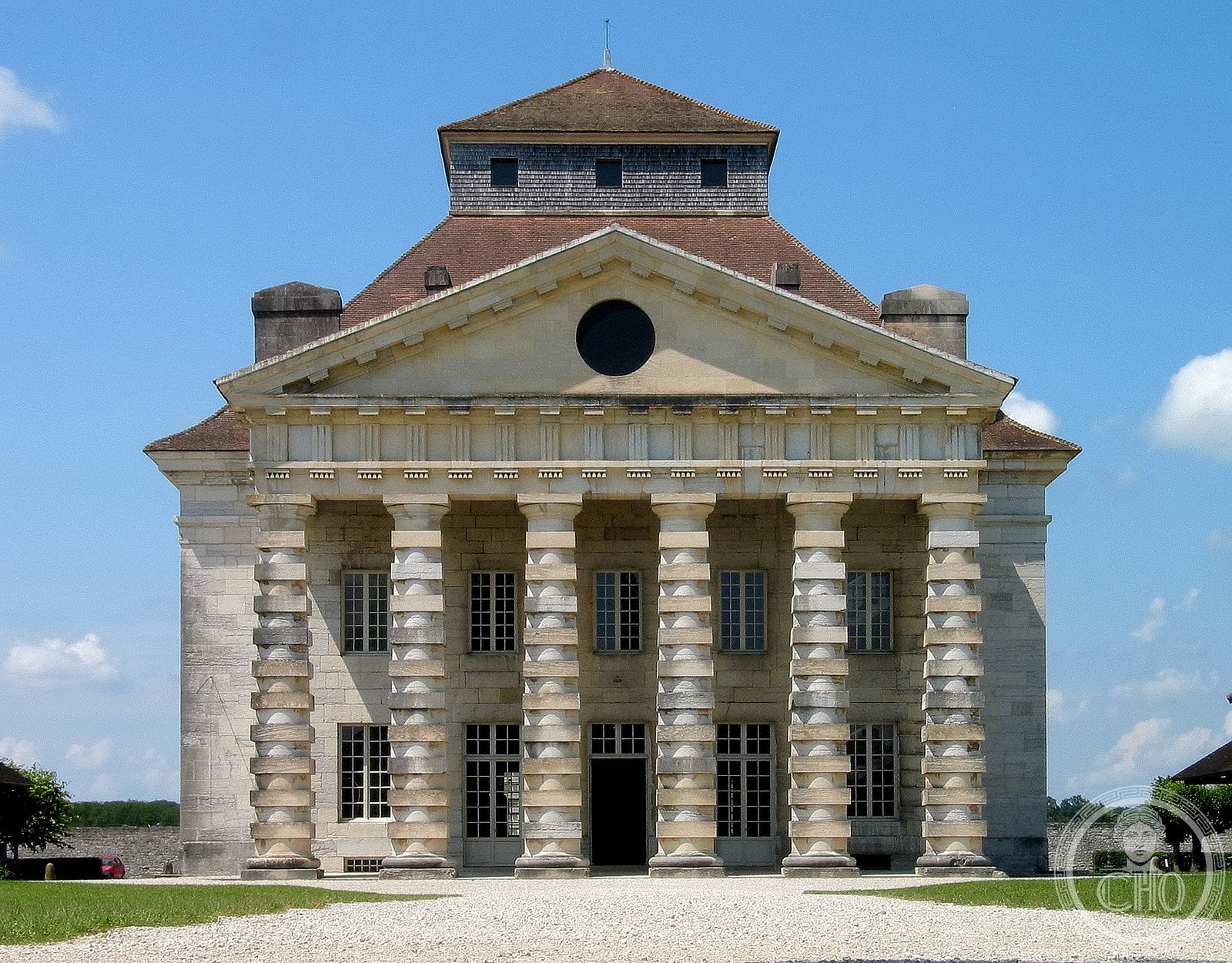
In the Franche-Comté region of eastern France, two extraordinary industrial complexes bracket the history of salt production and Enlightenment architectural vision: the underground brine galleries and evaporation halls of Salins-les-Bains (operating since the 13th century) and the visionary semicircular factory town of Arc-et-Senans, designed by Claude-Nicolas Ledoux in 1775 as a utopian prototype of the ideal industrial city. Together, they form a UNESCO World Heritage site of exceptional significance. UNESCO 1982.
Significance and overview
The Royal Saltworks at Arc-et-Senans (Saline Royale) is one of the most important early examples of planned industrial architecture in Europe — a semicircular complex of Neoclassical buildings designed by the visionary architect Claude-Nicolas Ledoux and constructed between 1775 and 1779 under the patronage of Louis XV. The Great Saltworks of Salins-les-Bains, 21 km away, supplied the brine (conveyed via wooden pipes across the Jura) that was evaporated at Arc-et-Senans. UNESCO originally inscribed Arc-et-Senans alone in 1982; the inscription was extended in 2009 to include Salins-les-Bains, recognising the functional and historical unity of the two sites.
Together they document the complete production cycle of salt — one of the most strategically important commodities in pre-industrial Europe — and the intersection of industrial technology with Enlightenment idealism.
Historical background
Salt production at Salins-les-Bains dates to at least the 13th century, when the town’s brine springs were first exploited on a large scale. By the 18th century, the forests around Salins were being stripped to fuel the evaporation furnaces, prompting the crown to plan a new saltworks at Arc-et-Senans, where the Forest of Chaux could provide a sustainable fuel supply. Ledoux was appointed to design the new facility in 1773. His design went far beyond functional necessity: he conceived a semicircular layout of twelve buildings around a central Director’s House, with the intention (never fully realised) of eventually completing a full circle — a utopian “ideal city” that would house workers, workshops, temples, and public buildings.
The saltworks operated until 1895, when it became unprofitable. The complex was restored in the 20th century and is now a museum and cultural centre, hosting exhibitions on Ledoux and on Enlightenment urbanism.
Key features
The Saline Royale at Arc-et-Senans is instantly recognisable: a semicircle of twelve Neoclassical buildings, their facades decorated with rusticated stone imitating salt crystals and with allegorical friezes evoking fire and water (the elements of salt production). The Director’s House at the centre of the semicircle is the grandest building, flanked symmetrically by the two great evaporation halls (Bernes). The entrance gate, with its columnar portico and grotto-like stone detailing, is one of the masterworks of French Neoclassical architecture.
At Salins-les-Bains, visitors can descend into the underground brine galleries, dating to the medieval period, where brine was collected from natural springs in vaulted stone chambers. The evaporation hall above ground documents the pre-industrial technology of salt making.
Cultural importance
Claude-Nicolas Ledoux (1736–1806) is one of the most radical architects of the Enlightenment, and Arc-et-Senans is his masterwork — the only large-scale realisation of his utopian architectural ideas. His unbuilt projects (including the complete circular city of Chaux, published in his 1804 treatise L’Architecture considérée sous le rapport de l’art, des moeurs et de la législation) were profoundly influential on 19th and 20th-century urban planning theory, anticipating concepts of zoning, green space, and the integration of work and living environments. The Saline Royale is therefore not just an industrial monument but the key material witness to one of the foundational texts of modern urbanism.
UNESCO criteria
The site was inscribed under criteria (i), (ii), and (iv). Criterion (i) recognises the Saline Royale as a masterpiece of human creative genius — Ledoux’s visionary fusion of industrial function and architectural idealism. Criterion (ii) acknowledges the influence of Ledoux’s ideas on later town planning and architectural theory. Criterion (iv) identifies the property as an outstanding example of a type of building illustrating a significant stage in human history — specifically, the Enlightenment’s effort to rationalise and improve the conditions of industrial labour.
Visitor experience
The Saline Royale at Arc-et-Senans is open year-round and hosts a permanent museum on Ledoux and utopian architecture, as well as temporary exhibitions, concerts, and events. The semicircular courtyard is one of the most serene architectural spaces in France — austere, grand, and thought-provoking. Guided tours include the Director’s House and the restored evaporation halls. At Salins-les-Bains, 21 km away, the underground brine gallery tour is a memorable descent into medieval industrial archaeology.
Getting there
Arc-et-Senans is 35 km south-west of Besançon (capital of Franche-Comté), reachable by train from Besançon Franche-Comté TGV (Paris to Besançon in 2 hours, then local train or taxi). By car from Besançon: 35 minutes via D83. Salins-les-Bains is a 20-minute drive east on the D472. GPS (Arc-et-Senans): 46.940° N, 5.880° E.
Nearby context
Besançon, the regional capital, contains a UNESCO-listed Vauban citadel and the birthplace of Victor Hugo. The Jura mountains and the Loue River gorge (one of France’s most beautiful river landscapes) are within 30 minutes. The Pontarlier absinthe distilling tradition and the Comté cheese production facilities of the Jura are further cultural attractions in the region. Burgundy wine country (Beaune) is approximately 90 minutes north-west.
Find it on the map
See this place and what’s around it →📷 Become a Cultural Heritage Online photographer
Share your photos of places: they stay published under your name as the author. The more they're seen, the more you get noticed — and soon a contest will reward the most appreciated photos.
Log in or sign up free to add a photo