
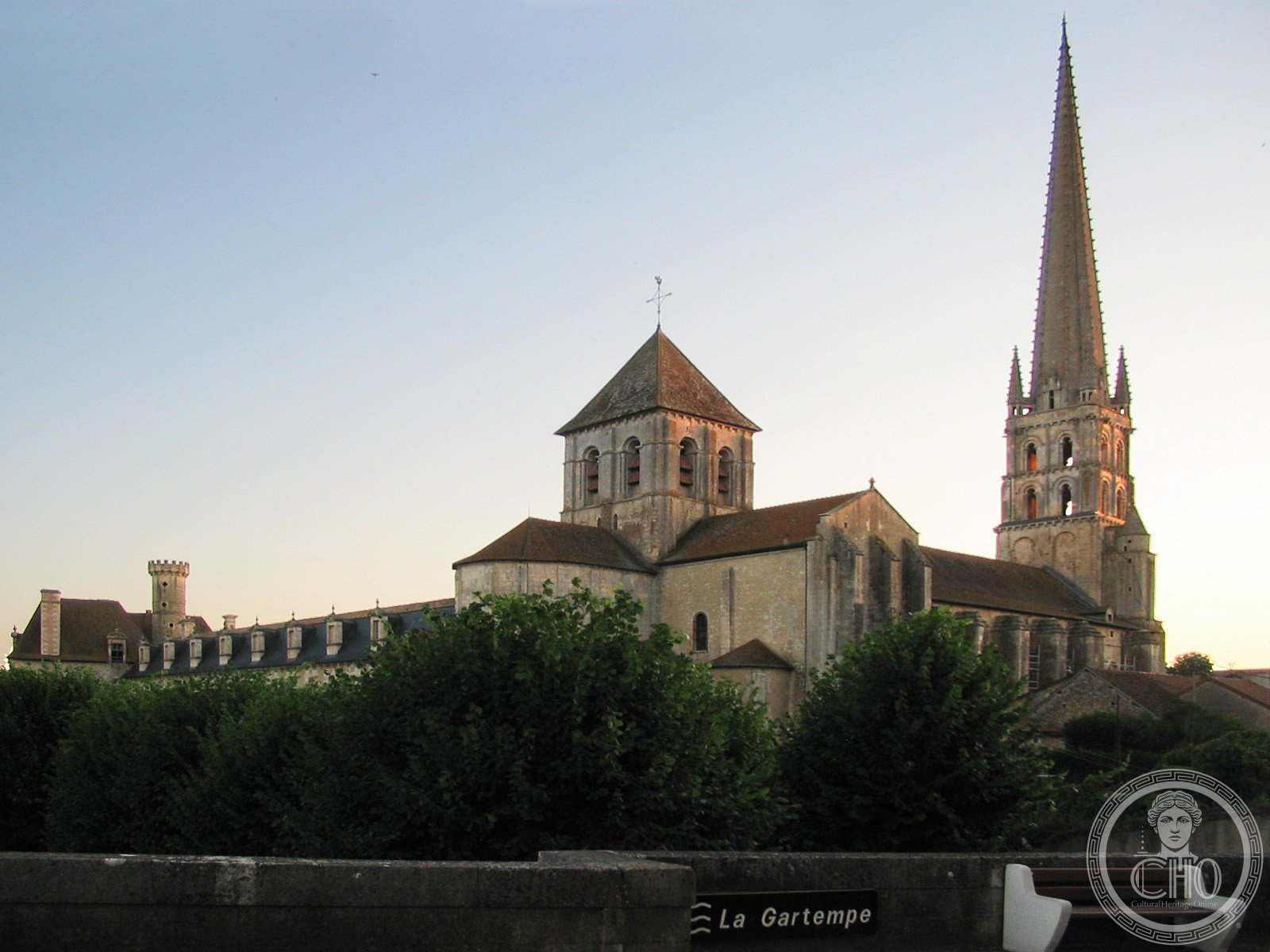
In a quiet village on the banks of the Gartempe River in the Vienne département of western France, the Abbey of Saint-Savin-sur-Gartempe contains what is universally recognised as the finest cycle of Romanesque wall paintings in existence — a vast barrel-vaulted nave covered from floor to ceiling in 11th and 12th-century frescoes of extraordinary freshness and narrative power. Often called the “Romanesque Sistine Chapel,” this abbey is one of the supreme achievements of medieval European art. UNESCO 1983.
Significance and overview
The Abbey Church of Saint-Savin-sur-Gartempe is an 11th-century Benedictine abbey whose interior constitutes the most complete surviving programme of Romanesque fresco painting in the world. The nave, narthex, crypt, and tribune galleries are all painted, creating a total surface of approximately 450 square metres of murals — a pictorial Bible that covers the major narrative cycles of the Old and New Testaments. UNESCO inscribed the church in 1983 (ref. 230) for its outstanding artistic importance and for the exceptional state of preservation of its medieval paintings.
The paintings were executed in the late 11th and early 12th centuries by multiple workshops of anonymous artists working in a fluid, expressive style that uses warm ochres, reds, greens, and blues to create figures of remarkable elegance and movement. The colour palette has survived largely intact because the nave was closed for centuries and the frescoes were protected from light and humidity.
Historical background
According to tradition, the abbey was founded in the 9th century on the site where the martyrs Savin and Cyprian (two brothers from Thessalonica who were put to death in the 4th century) were buried. The present church was built primarily in the 11th century, in the mature Romanesque style of the Poitou region: a long, tall nave with a continuous barrel vault, flanked by narrow aisles and lit by small round-headed windows. The fresco programme was painted shortly after construction, most likely between 1060 and 1120.
The abbey was damaged during the Hundred Years’ War and largely abandoned after the Wars of Religion (16th century). The church became a parish church and the frescoes were forgotten, covered in centuries of grime and limewash. Major restoration campaigns beginning in the 19th century — including work by the architect Paul Abadie, who also restored Notre-Dame de Paris — rediscovered and stabilised the paintings. The church has been classified as a Monument Historique since 1840.
Key features
The nave paintings are the most celebrated: the barrel vault is divided into five registers, each illustrating scenes from the Book of Genesis and Exodus (on the north side) and the life of Moses (south side). The scale is monumental — the vault springs from a height of approximately 17 metres — and the figures are correspondingly large, drawn with confident outlines and filled with flat, luminous colour. The scene of Noah’s Ark, the Tower of Babel, and the Crossing of the Red Sea are among the most frequently reproduced images of Romanesque art.
The narthex (entrance porch) contains scenes from the Apocalypse, painted in a slightly later and more dramatic style. The crypt below the choir houses the relics of Saints Savin and Cyprian and is decorated with scenes from the martyrs’ lives. The tribune galleries above the aisles contain additional painted cycles.
Cultural importance
Saint-Savin is the defining monument of the Poitevin Romanesque school — the regional artistic tradition that produced some of the finest Romanesque sculpture and painting in France. The abbey’s paintings are studied as primary sources for the development of Romanesque iconography and for the techniques of medieval fresco painting. Their influence on subsequent Romanesque art in western France was considerable, and they remain a touchstone for art historians studying the pictorial theology of the 11th-century reform church.
UNESCO criteria
Saint-Savin was inscribed under criteria (i) and (iii). Criterion (i) recognises the nave paintings as a masterpiece of human creative genius — the most complete and finest cycle of Romanesque mural painting in the world. Criterion (iii) acknowledges the church as an outstanding testimony to the Benedictine monastic culture and the theological and artistic programme of the 11th-century church reform movement.
Visitor experience
The abbey church is open daily, with a small admission charge that supports ongoing conservation. The visitor experience begins in the narthex (where the Apocalypse scenes create an overwhelming first impression) and continues into the nave, where the vault paintings can be viewed from the floor or from an elevated walkway. The Centre d’Interprétation des Peintures Murales (adjacent to the church) provides multimedia context and high-resolution reproductions. The church is best visited in morning light, when the nave windows illuminate the paintings from above.
Getting there
Saint-Savin is 43 km east of Poitiers and 43 km south-west of Châtellerault. From Poitiers, take the D749 east (45 minutes by car; no direct bus service). From Paris Montparnasse, TGV to Poitiers (1h30) then car hire. GPS: 46.570° N, 0.857° E.
Nearby context
The Vienne valley between Saint-Savin and Poitiers contains a remarkable concentration of Romanesque churches (Montmorillon, Angles-sur-l’Anglin, Chauvigny). Poitiers itself has two outstanding Romanesque monuments: Notre-Dame-la-Grande (with its painted facade) and the Baptistère Saint-Jean (the oldest standing Christian building in France). The prehistoric caves of the Vézère valley (Lascaux — UNESCO) are approximately 3 hours south.
Find it on the map
See this place and what’s around it →📷 Become a Cultural Heritage Online photographer
Share your photos of places: they stay published under your name as the author. The more they're seen, the more you get noticed — and soon a contest will reward the most appreciated photos.
Log in or sign up free to add a photoIs this page about you?
This page is read by travellers and heritage enthusiasts who find it on Google. Tell us how you are connected to this place and we will take it from there.