
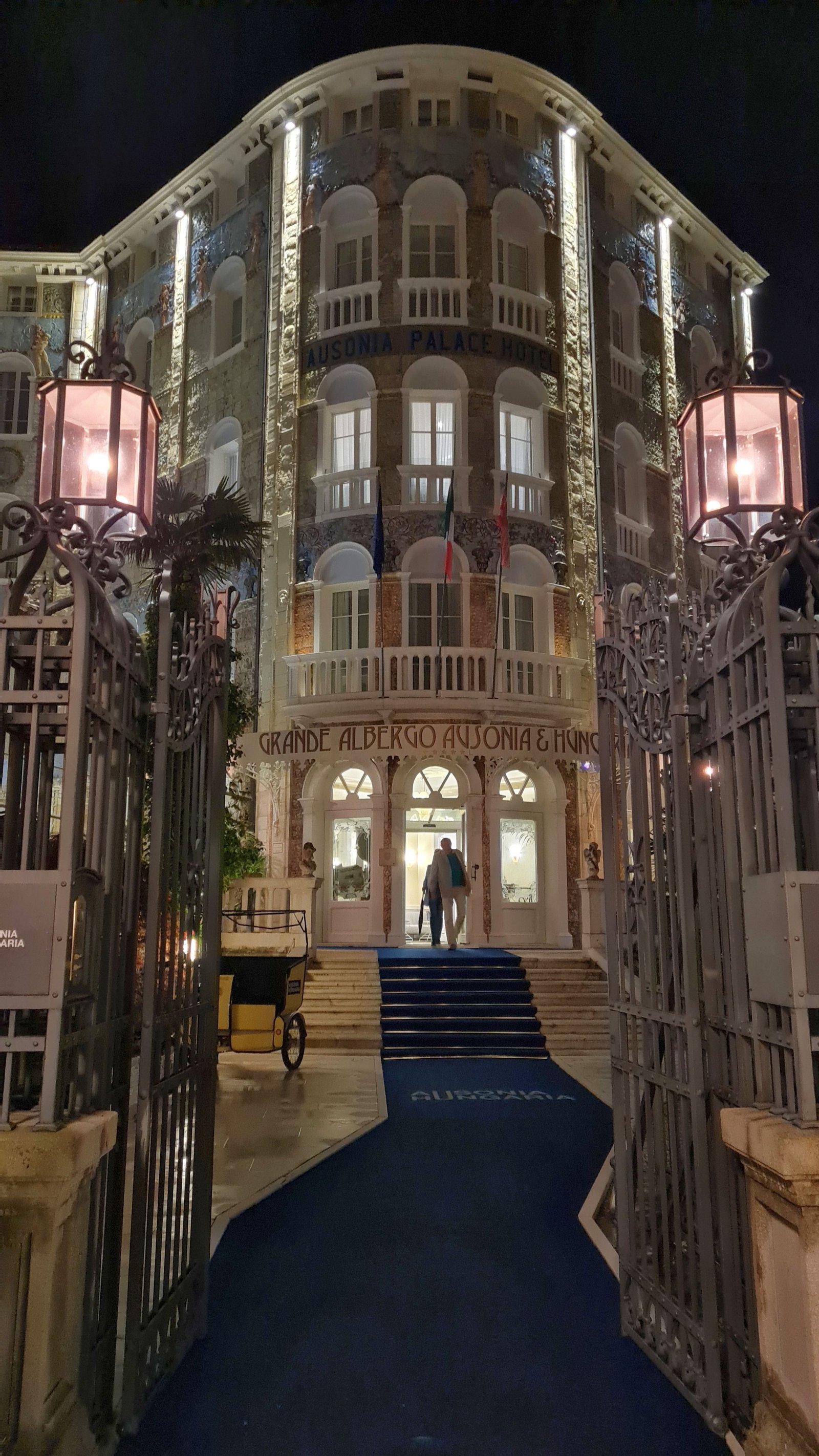
A five-star hotel on the Lido’s main boulevard, its north-east facade sheathed in 800 square metres of polychrome majolica — one of Italy’s largest Liberty ceramic installations.
At a glance
The Grande Albergo Ausonia & Hungaria stands at Gran Viale Santa Maria Elisabetta 28, the historic promenade linking the Lido vaporetto landing to the Adriatic shore. Inaugurated in 1907, it combines a Liberty hotel interior with an extraordinary ceramic exterior completed in 1913 by ceramist Luigi Fabris of Bassano. Still operating as a luxury five-star property today, it is the most visually distinctive building on the Lido and a landmark of the Italian Belle Époque resort era.
Key facts
- Address: Gran Viale Santa Maria Elisabetta 28, 30126 Lido di Venezia.
- Inaugurated: 1907, by entrepreneur Ludovico Fabrizio.
- Architect: Nicolò Piamonte.
- Ceramic facade: 1913, polychrome majolica by Luigi Fabris (workshop, Bassano del Grappa); approximately 800 m².
- Style: Liberty (Italian Art Nouveau) with neo-Renaissance decorative registers.
- Current use: Operating five-star hotel and wellness resort.
- Contact: +39 041 242 0060 • reservations@ausoniahungaria.com.
History
The Lido di Venezia began its transformation into one of Europe’s most fashionable seaside resorts in the final decades of the nineteenth century. By the turn of the twentieth century, the island’s Gran Viale Santa Maria Elisabetta had become a showcase boulevard, lined with grand hotels and Liberty villas. It catered to an international clientele that arrived each summer by vaporetto from Venice.
The building that would become the Grande Albergo Ausonia & Hungaria was inaugurated in 1907, commissioned by Ludovico Fabrizio, a businessman from Friuli. The project was entrusted to architect Nicolò Piamonte, who raised a two-storey Liberty structure on the Gran Viale in what contemporaries described as a remarkably swift construction. The hotel opened under the name Hungaria Palace Hotel, its identity linked to the Austro-Hungarian cultural sphere that dominated much of the Adriatic coast at the time.
The building’s defining transformation came in 1913. The ceramist Luigi Fabris undertook the complete covering of the north-east facade facing the boulevard. Fabris was a native of Bassano del Grappa and was among the most accomplished practitioners of applied ceramic art in the Veneto. Working with his workshop, Fabris applied roughly 800 square metres of polychrome majolica tiles, arranged in horizontal registers of increasing decorative complexity towards the upper storeys. The palette of ochres, water-greens, and cream whites brought the facade to vivid life: garlands of fruit and flowers wound between bas-relief female figures representing Venice and Hungary, while gilded putti populated the upper zones.
The hotel closed during the First World War. When it reopened in 1920, the name “Hungaria” was joined by “Ausonia,” the poetic Latin name for Italy. “Hungaria” had been too closely associated with Austria-Hungary, the defeated empire. This gave the hotel the double identity it has carried ever since. The interwar years brought a glamorous second chapter: the 1920s saw the hotel host the “Follies Dancing” club and a clientele drawn by the Venice Film Festival, which was established nearby in 1932.
The Second World War left its mark on the facade: retreating German forces in April 1945 used the life-size female figures near the roofline for target practice. Some damage from that episode is still visible on close inspection. A major restoration was completed in 2011. In 2018 the English artist Joe Tilson added a contemporary counterpoint by covering the south-east facade with 3,358 hand-made Murano glass tiles, extending the building’s dialogue between Venetian craft traditions and international art.
What you see
Standing on the Gran Viale and looking north-east, the visitor confronts the full sweep of the 1913 ceramic installation. The majolica is laid in five horizontal bands, each more ornate than the one below.
The ground-floor register is relatively restrained, with flat geometric framing. The upper storeys are thick with modelled fruit, sinuous plant stems, and three-dimensional female busts that project from the wall plane.
Run a hand across the surface — the glaze is still brilliant more than a century on, the individual tiles tessellated with a precision that absorbs afternoon light differently at each hour.
The colours read from the street as warm ochre punctuated by deep water-green, the combination unmistakably Venetian in its balance of opulence and restraint.
The south-east flank, which faces a quieter side street, received Joe Tilson’s 2018 addition: rectangular panels of blown Murano glass in blues and golds, referencing Byzantine mosaic without imitating it. Together, the two facades make the Ausonia Hungaria an open-air gallery spanning more than a century of Venetian decorative craftsmanship. The interior retains pieces of Liberty furnishing — including items originally commissioned for the 1907 Paris exhibition by designer Eugenio Quarti — though the hotel has been modernised for contemporary guests.
Practical information
- Status: Operating five-star hotel; guests and non-guests may photograph the exterior freely from the public pavement.
- Vaporetto: Line 5.1 / 5.2 / 6 — stop Lido S.M.E., approximately 4 minutes’ walk.
- Best time to visit: Morning or late afternoon for raking light on the majolica.
- Recommended time: 15–30 minutes for exterior viewing; longer for hotel guests.
Getting there
From Venice, take the vaporetto to Lido S.M.E. This stop is served by Lines 1, 5.1, 5.2 or 6 from Piazzale Roma, Ferrovia, or San Marco. On arrival at the Lido landing stage, walk straight ahead along the Gran Viale Santa Maria Elisabetta for approximately 350 metres; the hotel facade is visible on the right-hand side at number 28. The journey from San Marco takes around 25 minutes door to door.
Nearby
- Liberty Venezia — the broader landscape of Art Nouveau in the Venetian lagoon.
- Grand Hôtel des Bains — another historic Lido landmark, setting for Thomas Mann’s Death in Venice, a short walk north.
- Lido Adriatic beachfront — the public beach and Casino complex, 5 minutes’ walk east.
- Venice Film Festival venues — the Palazzo del Cinema and Palazzo del Casino, 10 minutes’ walk.
See the place
Sources
- Hotel Ausonia Hungaria official history: ausoniahungaria.com.
- Historic Hotels of the World — Then & Now: historichotelsthenandnow.com.
- Visit Lido — The Ancient Splendour of the Lido: visitlido.it.
- Atlas Obscura — Grande Albergo Ausonia & Hungaria: atlasobscura.com.
- Wikimedia Commons, Category:Ausonia Palace Hotel (Venice): commons.wikimedia.org.
Find it on the map
See this place and what’s around it →Record researched and written by Carla Szathvary for Cultural Heritage Online, 2026.
📷 Become a Cultural Heritage Online photographer
Share your photos of places: they stay published under your name as the author. The more they're seen, the more you get noticed — and soon a contest will reward the most appreciated photos.
Log in or sign up free to add a photoIs this page about you?
This page is read by travellers and heritage enthusiasts who find it on Google. Tell us how you are connected to this place and we will take it from there.