
Sepolto nelle dune sabbiose a pochi chilometri da Nuseirat, nella Striscia di Gaza, Tell Umm el-’Amr è il sito di uno dei monumenti cristiani più antichi e significativi del Medio Oriente: il monastero fondato attorno al 329 d.C. da Sant’Ilarione di Gaza, il “padre del monachesimo in Palestina”. Prima ancora che il movimento monastico si diffondesse in Egitto, Siria e Costantinopoli, questa comunità vicino a Gaza aveva già adottato la vita ascetica comunitaria. Il sito — chiese, battisteri, bagni, tombe e celle monastiche — fu abbandonato nell’VIII secolo dopo la conquista islamica e riscoperto dagli archeologi nel 1999. Patrimonio UNESCO dal 2023. Oggi è in zona di conflitto.
At a glance
Tell Umm el-’Amr (also known as the Monastery of Saint Hilarion or Umm Amer) is an archaeological site in the central Gaza Strip (Nuseirat, near Deir el-Balah). UNESCO inscribed it in 2023 (ref. 1749) as the oldest known monastic community in the Middle East and one of the most important early Christian archaeological sites outside the traditional Holy Land pilgrim circuit. The site contains the ruins of multiple superimposed church buildings (4th–7th centuries), a baptistery, a mausoleum complex, a bath complex with marble floors, and monastic cells — all partially preserved beneath sand dunes and partially exposed through ongoing excavations since 1999 by a team of Belgian, Palestinian and French archaeologists.
Key facts
- UNESCO: World Heritage since 2023 (Tell Umm el-’Amr, ref. 1749)
- Founded: c. 329 AD by Saint Hilarion of Gaza (291–371 AD)
- Saint Hilarion: born near Gaza; disciple of Saint Anthony of Egypt; credited with introducing Antonian monasticism to Palestine and Syria
- Period: active approximately 329–732 AD (Byzantine period); abandoned after the Umayyad conquest
- Structures: three superimposed churches; baptistery; mausoleum (possibly Hilarion’s burial); bath complex with marble floors; monastic cells
- Current status: the site is in the Gaza Strip; excavation was suspended in October 2023 due to the outbreak of armed conflict
History
Saint Hilarion was born around 291 AD near Gaza to pagan parents. He travelled to Egypt around 306 AD and became a disciple of Saint Anthony, the hermit of the Thebaid desert who had pioneered the eremitic life. Returning to Gaza around 307 AD, Hilarion established a hermitage near his birthplace on the Mediterranean coast. Within his lifetime, this hermitage grew into a community of disciples, then a formal monastery with multiple buildings. Jerome of Stridon — the scholar who translated the Bible into Latin — wrote Hilarion’s biography c. 390 AD, which became one of the most widely read hagiographies of the Middle Ages.
The monastery flourished through the Byzantine period and was enriched by successive building phases (4th, 5th and 6th centuries), each adding churches, a baptistery, and service buildings. After the Arab conquest of Gaza in 637 AD, the monastery continued to operate for about a century before being definitively abandoned around 732 AD. The site was buried by sand dunes and forgotten until systematic excavation began in 1999 under René Elter (University of Lille). UNESCO inscription was prepared for years and finally achieved in 2023 — the same year that armed conflict erupted in Gaza.
What you see
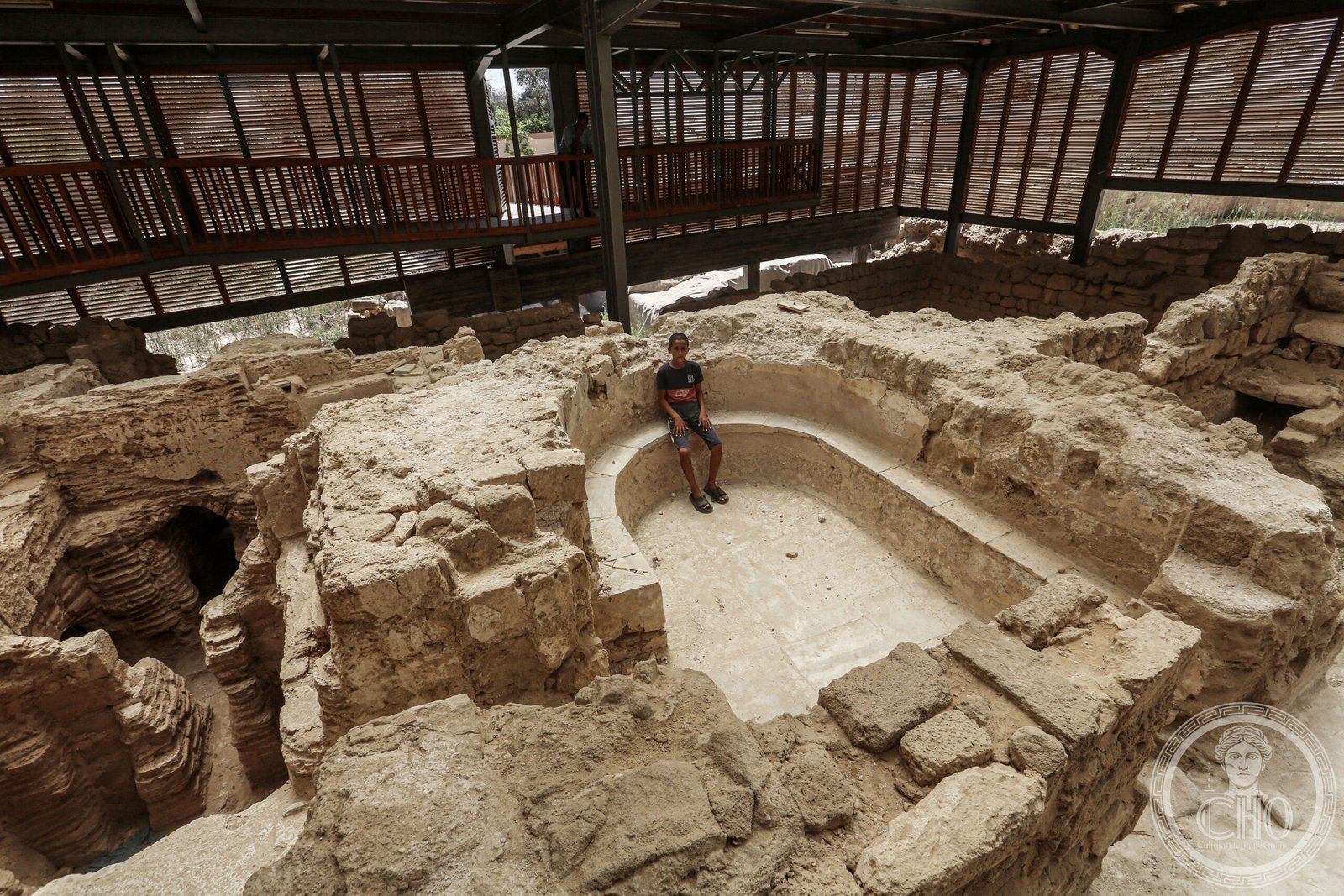
The excavated areas show successive superimposed church floors — mosaics in opus tessellatum from different periods, marble column bases, apsed walls of alternating brick and stone. The bath complex is particularly well-preserved: an apsidal hot room (caldarium) with its original marble bench and floor, several warm rooms (tepidaria) and a cold plunge pool. The mausoleum contains multiple burial chambers cut into the bedrock; one is traditionally identified as the tomb of Hilarion himself.
The site is on level sandy ground; the dunes — 3–5 m high — have protected much of the unexcavated areas from later construction and encroachment.
Practical information
- Current status: the Gaza Strip has been in a state of armed conflict since October 2023; the site is inaccessible to visitors
- Historical access: prior to 2023, the site was accessible by road from Gaza City via the coastal route (15 km south); guided tours were organised through the Palestinian Ministry of Tourism
- Documentation: the full archaeological archive of the site is maintained by the University of Lille and the Franco-Palestinian Archaeological Mission at Gaza (MAPG)
Getting there
Located near Nuseirat, Gaza Strip, approximately 15 km south of Gaza City and 3 km from the coast. GPS: 31.45° N, 34.37° E.
Nearby
- Gaza City — the historic capital of the Gaza Strip; the Great Mosque of Gaza (al-Omari) built over a Byzantine cathedral; Tel es-Sakan (ancient Gaza) archaeological park
- Ashkelon National Park (Israel) — Philistine and Crusader ruins 20 km north
- Bethlehem (UNESCO) — the Nativity of Jesus site, 80 km north-east via the West Bank
Sources
- UNESCO World Heritage Centre — “Tell Umm el-’Amr” (ref. 1749)
- Elter, René — Mission Archéologique Franco-Palestinienne à Gaza (MAPG), reports 1999–2023
- Jerome of Stridon — “Life of Saint Hilarion” (c. 390 AD)
Find it on the map
See this place and what’s around it →📷 Become a Cultural Heritage Online photographer
Share your photos of places: they stay published under your name as the author. The more they're seen, the more you get noticed — and soon a contest will reward the most appreciated photos.
Log in or sign up free to add a photo