Mauritania has 2 UNESCO World Heritage Sites: one stretching along the Atlantic coast where migrating birds outnumber people, and one dissolving into the Sahara across four ancient caravan cities. They tell two different stories about the same vast country — but together they span the full range of what the World Heritage Convention was designed to protect. From Cultural Heritage Online.
Why Mauritania’s list looks the way it does
With just two inscribed sites, Mauritania holds one of the shorter World Heritage lists on the African continent. The country’s geographic reality partly explains this: much of its territory is Saharan desert, sparsely populated and remote from the infrastructure that makes archaeological documentation and nomination dossiers possible. UNESCO inscriptions require sustained institutional investment, and Mauritania has focused its efforts carefully rather than broadly.
The two sites that did make the list represent genuinely distinct categories of outstanding universal value. One is ecological and coastal; the other is cultural and continental. Between them, they bracket the country’s environmental and historical identity — the Atlantic shore that sustained pre-Saharan trade, and the desert interior where that trade left its most legible mark.
The first inscriptions
Mauritania’s first UNESCO recognition came in 1989, followed by its second seven years later. Both sites remain on the list without modification:
- Banc d’Arguin National Park (1989) — natural site, Atlantic coast
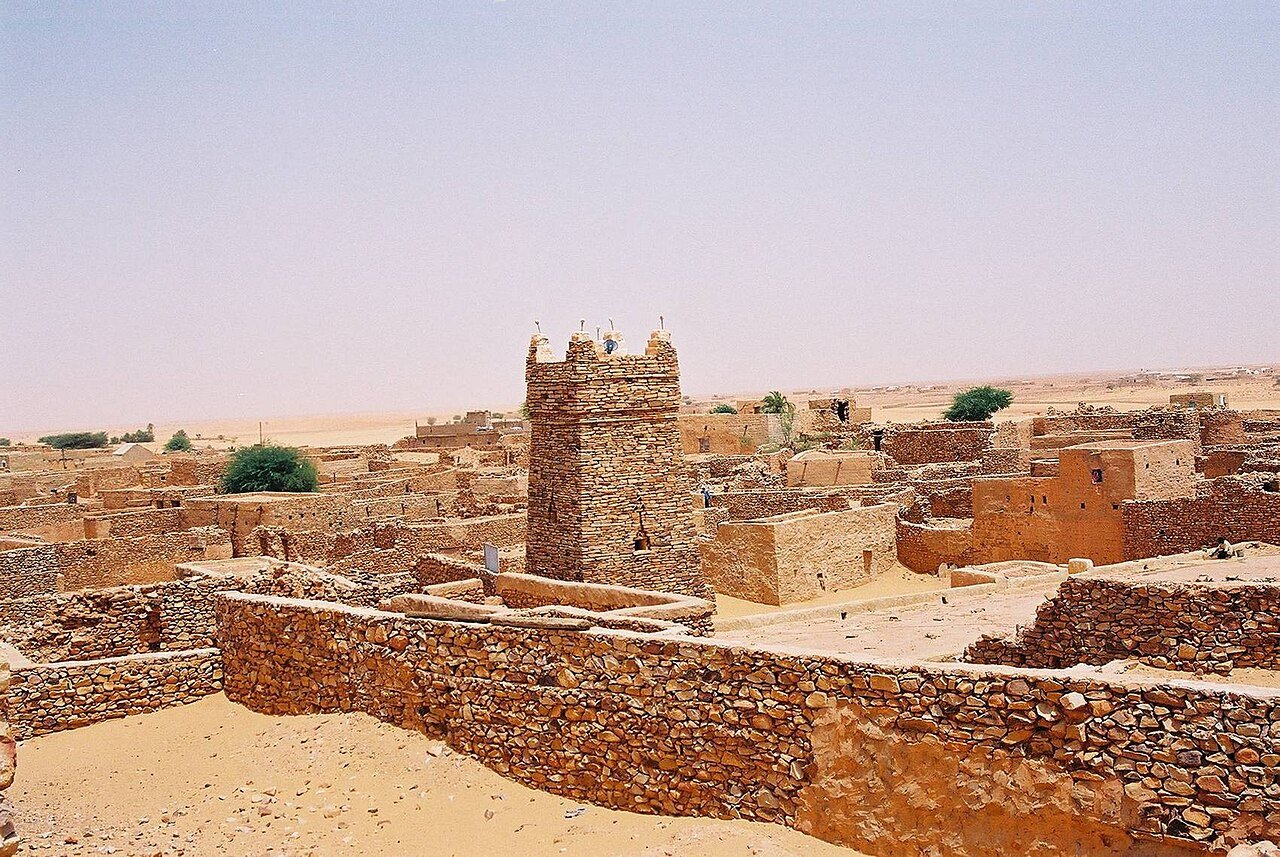
- Ancient Ksour of Ouadane, Chinguetti, Tichitt and Oualata (1996) — cultural site, Saharan interior, serial inscription across four towns
The Banc d’Arguin inscription, one of the earliest for West Africa, signalled international recognition of the park’s importance for migratory waterbirds along the East Atlantic Flyway. The Ancient Ksour inscription followed in 1996, grouping four historic settlements under a single serial nomination — an approach that acknowledged how their significance was collective rather than individual.
The most visited — and the alternatives
Chinguetti is the name that appears most often in accounts of Mauritanian heritage travel. The city was once considered the seventh holiest site in Islam, and its old quarter still gathers around a mosque with a square minaret that has become the visual shorthand for the entire inscription. Private libraries in the town preserve tens of thousands of ancient manuscripts, many dating to the medieval period of trans-Saharan scholarship.
The three other towns in the serial inscription each offer something distinct. Ouadane, further north in the Adrar region, developed as a stopover on routes connecting sub-Saharan Africa to the Maghreb, and its ruined upper city climbs a rocky escarpment above a functioning oasis. Tichitt, in the Tagant region, is among the oldest of the four — its stone architecture follows a grid that archaeologists have traced to at least the thirteenth century. Oualata, near the border with Mali, was a terminal point of the western trans-Saharan trade and is noted for the decorative wall paintings applied to the interiors and doorways of its houses, a tradition maintained by women of the community.
Natural and shared sites
Banc d’Arguin National Park occupies roughly 12,000 square kilometres of coast and shallow sea between Nouakchott and the Tropic of Cancer. Its landscape shifts between sand dunes, coastal swamps, small islands, and tidal flats — an unusual combination that supports one of the most significant concentrations of nesting and wintering waterbirds in the world. Fish populations in the coastal shallows sustain both the birds and the Imraguen fishing communities whose traditional net-fishing practices have continued in the park for generations.
Mauritania has no transnational World Heritage Sites at present. The country’s two inscriptions are wholly within its own borders, though the Saharan context of the Ancient Ksour links them culturally to related urban heritage across Mali, Morocco, and Algeria. Several sites appear on Mauritania’s Tentative List — including the Kumbi Saleh archaeological site, which may represent the capital of the Ghana Empire — but none have reached the nomination stage as of 2025.
How to find them
Both of Mauritania’s World Heritage Sites are remote by any standard. Banc d’Arguin is accessible from Nouakchott by road, though most visits involve guided arrangements through the national park authority. The four Ancient Ksour towns require travel into the Adrar and Tagant regions, with Chinguetti and Ouadane the most practically reached from Atar. Travel conditions and security situations in northern Mauritania change; up-to-date guidance from official sources is essential before planning visits.
Mauritania’s World Heritage sites sit alongside thousands of other places on CHO’s interactive map, with GPS and sourced editorial history for each. See also our guides to Italy’s and France’s UNESCO sites, and our piece on cultural travel beyond mass tourism.
Frequently Asked Questions
How many UNESCO World Heritage Sites does Mauritania have?
Mauritania has 2 UNESCO World Heritage Sites as of 2025. One is the natural site of Banc d’Arguin National Park, inscribed in 1989, and the other is the cultural serial site of the Ancient Ksour of Ouadane, Chinguetti, Tichitt and Oualata, inscribed in 1996.
What was Mauritania’s first UNESCO World Heritage Site?
Banc d’Arguin National Park, inscribed in 1989, was Mauritania’s first UNESCO World Heritage Site. It was recognised as a natural site of outstanding universal value for its coastal ecosystems and importance as habitat for migratory waterbirds along the East Atlantic Flyway.
What are the four towns in the Ancient Ksour inscription?
The serial inscription covers Ouadane, Chinguetti, Tichitt, and Oualata — four historic trading and religious centres in the Saharan interior that developed along trans-Saharan caravan routes. Each town preserves distinct architectural traditions, and Oualata is particularly noted for its decorative interior wall paintings.
Does Mauritania have any natural UNESCO World Heritage Sites?
Yes. Banc d’Arguin National Park is Mauritania’s only natural World Heritage Site. It protects a stretch of Atlantic coast and shallow sea notable for its diversity of habitats — including dunes, islands, and tidal flats — and supports one of the largest concentrations of wintering waterbirds in the world.
Sources used in this article
- UNESCO — State Party Mauritania — World Heritage list.
- UNESCO — Mauritania: World Heritage Sites.
- CHO magazine — What is a World Heritage Site?
- CHO — Interactive map of heritage sites.