Niger has three UNESCO World Heritage Sites: one cultural, two natural, and one of those shared across three nations in a sprawling transnational reserve system. Together they span an extraordinary range of terrain and history, from the ancient Saharan trade capital of Agadez to the vast, wind-sculpted emptiness of the Ténéré Desert and the wildlife-rich floodplains of the W National Park complex along the Niger River. From Cultural Heritage Online.
Why Niger’s list looks the way it does
Niger ratified the UNESCO World Heritage Convention in December 1974, yet its inscribed list remains one of the smallest on the African continent. The country’s geography offers a compelling reason: Niger is overwhelmingly landlocked desert and semi-arid Sahel, with concentrated zones of exceptional biodiversity and cultural significance rather than a broad distribution of heritage-rich urban centres. UNESCO inscriptions reflect that reality, rewarding two enormous natural landscapes and a single, irreplaceable urban site.
Scarcity on the list also reflects the difficulty of long-term site management under persistent security pressure and limited state resources. The Aïr and Ténéré Natural Reserves have carried endangered status since 1992, just one year after their inscription — a reminder that inscription is a recognition of outstanding universal value, not a guarantee of preservation.
The first inscriptions
Niger’s entry onto the World Heritage map began in 1991, when UNESCO recognised two sites in the same year:
- Aïr and Ténéré Natural Reserves (1991) — a combined protected area covering roughly 7.7 million hectares of mountain massif, volcanic plateau, and the Ténéré Desert, one of the most remote and visually dramatic stretches of the Sahara.
- W National Park (1996, later absorbed into the W–Arly–Pendjari Complex) — the core Niger section of a transnational reserve on the banks of the Niger River, inscribed separately before the broader complex was recognised.
The 1991 inscription of the Aïr and Ténéré reserves was, at the time, one of the largest single World Heritage designations ever made. That scale was a deliberate choice: the landscape only makes ecological and geological sense at a vast resolution, where ancient rock art, Tuareg cultural corridors, and rare desert fauna coexist within a territory larger than many European countries.
The most visited — and the alternatives
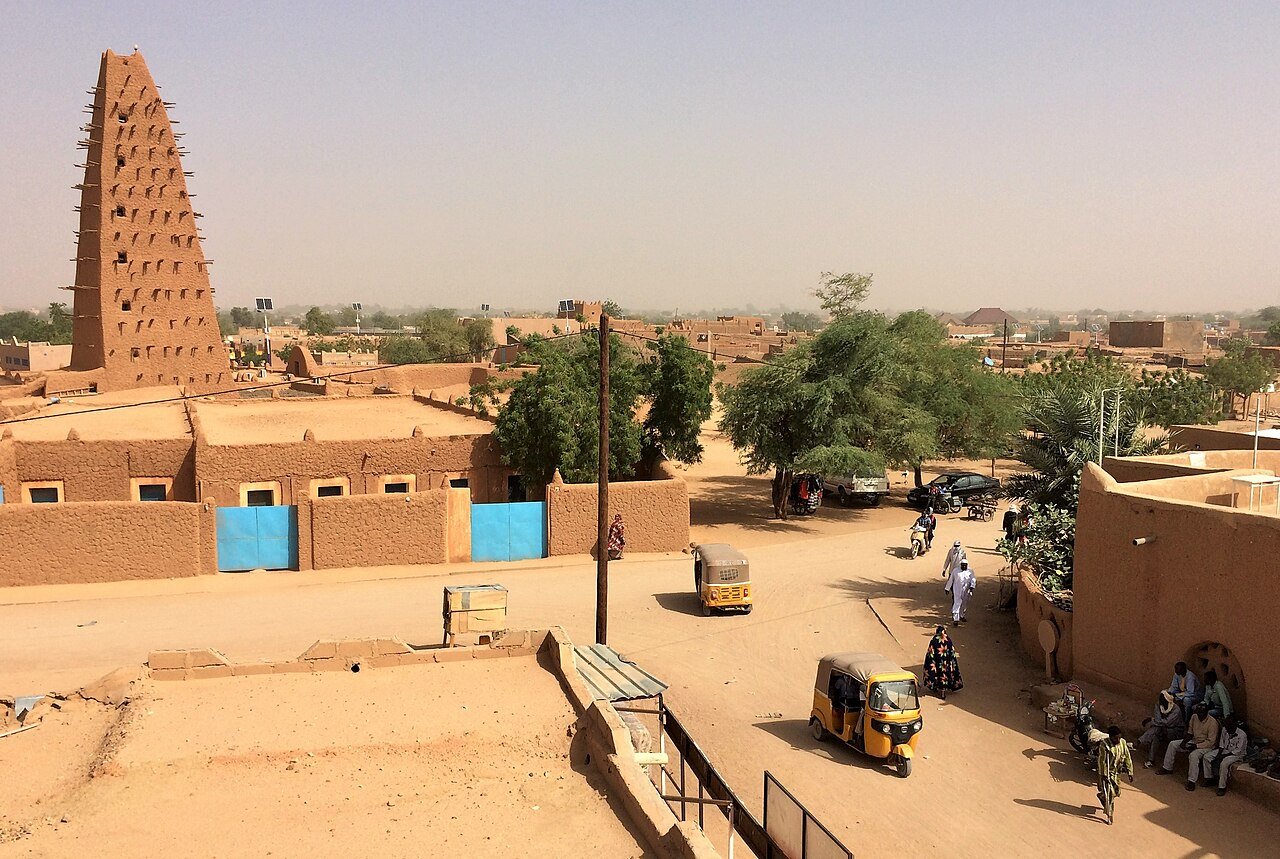
The Historic Centre of Agadez, inscribed in 2013, is Niger’s sole cultural World Heritage Site and the most internationally recognised name on the list. The city served as a major crossroads of trans-Saharan trade from the fifteenth century, and its distinctive earthen architecture — above all the Grand Mosque’s minaret, widely described as the tallest mudbrick structure in the world — draws researchers, architects, and overland travellers. The inscription covers the old city’s urban fabric, its neighbourhood mosques, and the Sultan’s palace complex.
Beyond Agadez, two natural designations offer a very different kind of encounter. The Aïr Massif, embedded within the Aïr and Ténéré reserves, contains thousands of prehistoric engravings and paintings on its rock faces — a Saharan archive documenting animals and human figures from periods when the region was far wetter than it is today. The W–Arly–Pendjari Complex, shared with Benin and Burkina Faso and expanded in 2017, protects one of the last large intact savannah ecosystems in West Africa, with elephants, lions, and hippopotamuses moving freely across borders that the reserve effectively dissolves.
Natural and shared sites
Both of Niger’s World Heritage inscriptions by natural criteria involve landscapes of superlative scale. The Aïr and Ténéré Natural Reserves together form a protected corridor across the central Sahara, where the volcanic peaks of the Aïr rise sharply above a sea of sand. The Ténéré section includes the Tenere Tree — a single acacia that was, before its destruction in 1973, considered the most isolated tree on Earth — a detail that captures the reserve’s defining quality: the extremity of its isolation.
The W–Arly–Pendjari Complex is a transnational serial site, with Niger contributing the W National Park at the heart of the designation. The “W” refers to the double bend the Niger River makes through this landscape, a geographic quirk that shapes the hydrology and habitat variety of the entire complex. The partnership with Benin and Burkina Faso represents one of the more successful examples of cross-border conservation management in the region, with coordinated anti-poaching operations and shared monitoring across a combined area of nearly three million hectares.
How to find them
All three inscribed sites present access challenges that require careful advance planning. The Historic Centre of Agadez is the most accessible, though travel advisories for northern Niger have restricted tourism significantly in recent years. The natural reserves demand specialist logistical support and, for the Aïr and Ténéré complex, coordination with local authorities given the site’s endangered status. Travellers with a serious interest in West African heritage should consult up-to-date foreign ministry advisories before planning any visit.
Niger’s World Heritage sites sit alongside thousands of other places on CHO’s interactive map, with GPS and sourced editorial history for each. See also our guides to Italy’s and France’s UNESCO sites, and our piece on cultural travel beyond mass tourism.
Frequently Asked Questions
How many UNESCO World Heritage Sites does Niger have?
Niger has three UNESCO World Heritage Sites as of 2026: the Aïr and Ténéré Natural Reserves (1991), the W–Arly–Pendjari Complex (1996, expanded 2017), and the Historic Centre of Agadez (2013). Two are natural designations and one is cultural.
What was Niger’s first UNESCO World Heritage Site?
The Aïr and Ténéré Natural Reserves were Niger’s first UNESCO inscription, recognised in 1991. Covering approximately 7.7 million hectares of Saharan desert and volcanic mountain terrain, the site also carries endangered status, awarded in 1992 due to regional instability and management challenges.
What is notable about the Historic Centre of Agadez?
Agadez was a major hub of trans-Saharan commerce from the fifteenth century onward, and its earthen architecture represents a distinct Sahelian building tradition. The Grand Mosque’s minaret is widely considered the tallest mudbrick structure in the world, and the inscribed area includes the Sultan’s palace and the city’s network of historic neighbourhood mosques.
Is the W National Park shared with other countries?
Yes. Niger’s W National Park forms part of the W–Arly–Pendjari Complex, a transnational World Heritage Site shared with Benin and Burkina Faso. The broader complex was expanded in 2017 and covers nearly three million hectares of West African savannah, protecting one of the region’s last large intact ecosystems.
Sources used in this article
- UNESCO — State Party Niger — World Heritage list.
- UNESCO — Niger: World Heritage Sites.
- CHO magazine — What is a World Heritage Site?
- CHO — Interactive map of heritage sites.
Sources
- S1 — Decalo, Samuel. Historical Dictionary of Niger. Scarecrow Press, 1997. ISBN 978-0-8108-3136-0.
- S2 — Bernus, Edmond. Touaregs nigériens: Unité culturelle et diversité régionale d'un peuple pasteur. Éditions de l'ORSTOM, 1981. ISBN 978-2-7099-0603-6.
Spotted an error? Write to editorial@culturalheritageonline.com and we correct it the same day.