Serbia has five UNESCO World Heritage Sites, every one of them cultural, spanning late Roman palace complexes, medieval monasteries and a shared transnational field of carved stone tombstones. The list is compact but covers roughly fifteen centuries of built history across a territory that once formed the crossroads between Byzantine civilization and the Latin West. From Cultural Heritage Online.
Why Serbia’s list looks the way it does
Serbia’s five inscriptions are all cultural designations: no natural site appears on the list, which reflects both the country’s relatively late engagement with the World Heritage Convention and the particular density of its medieval monastic landscape. The Balkans as a whole tend to be underrepresented on the World Heritage list relative to their architectural richness, partly because political transitions throughout the 1990s and 2000s delayed the preparation of nomination dossiers that require sustained state capacity to assemble.
The Kosovo entries add a further layer of complexity. The four medieval monuments inscribed in 2004 and expanded in 2006 were placed on the List of World Heritage in Danger the same year as the expansion, a status they retain today due to the unresolved political situation in the territory. UNESCO lists them under Serbia, while also acknowledging the contested jurisdictional context — making them unique in the World Heritage system.
The first inscriptions
Serbia entered the World Heritage list early, at the 3rd session of the World Heritage Committee in 1979, with two nominations inscribed simultaneously:
- Stari Ras and Sopoćani (1979) — the ruins of medieval Serbia’s first capital, Stari Ras, paired with the 13th-century Sopoćani Monastery, whose frescoes are among the finest examples of Byzantine painting in the region.
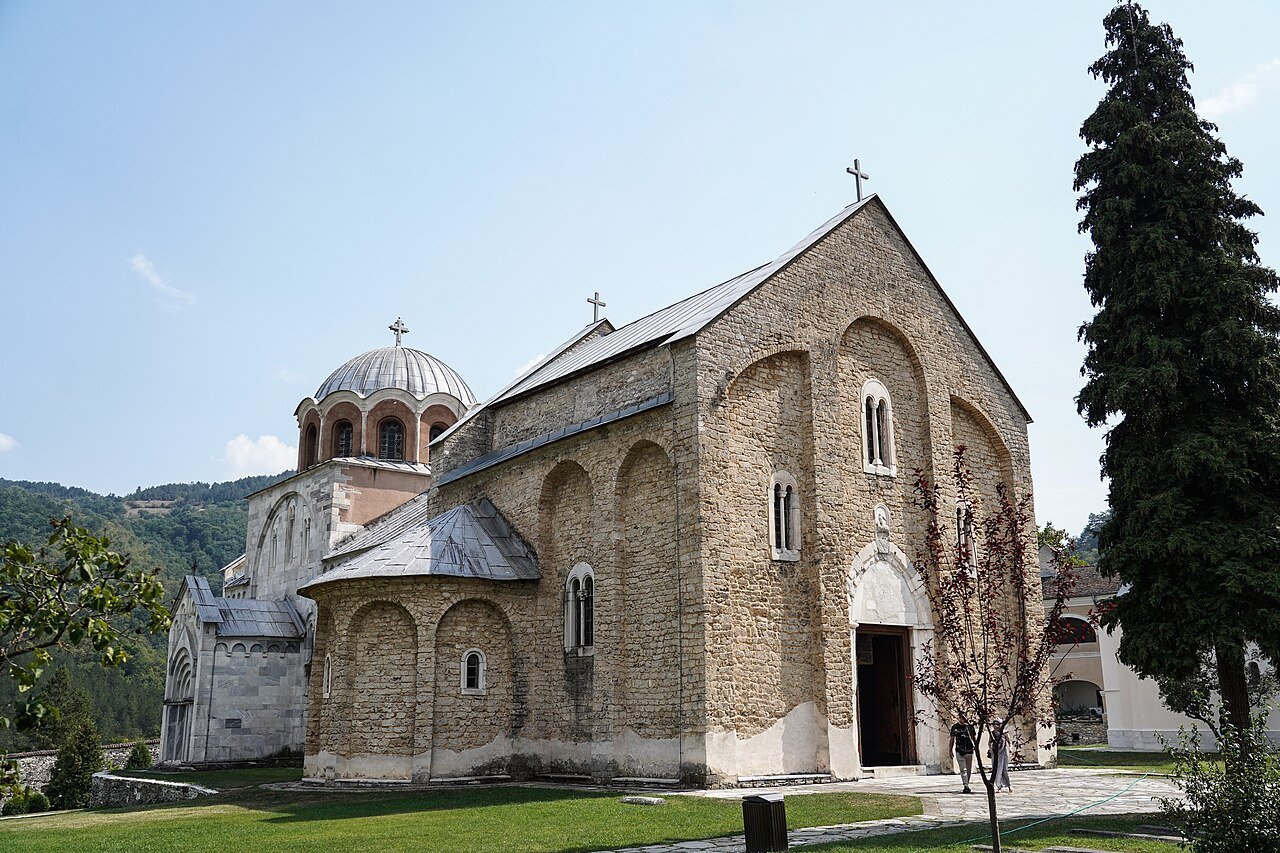
- Studenica Monastery (1986) — founded in the late 12th century by Stefan Nemanja, founder of the medieval Serb state; its two principal churches preserve exceptional Romanesque-influenced white marble decoration and a cycle of Byzantine frescoes.
Stari Ras and Sopoćani were in fact inscribed in 1979, and Studenica followed in 1986, making it Serbia’s second inscription rather than a simultaneous entry. The 1979 inscription placed Serbia among the earliest Balkan signatories to achieve World Heritage recognition.
The most visited — and the alternatives
Studenica Monastery draws the largest number of visitors among Serbia’s inscribed properties, partly because of its accessibility from Belgrade and its status as a national symbol. Stari Ras, on the edge of the town of Novi Pazar in south-west Serbia, is less trafficked despite its dual inscription: the earthwork fortifications of the old capital survive alongside a cluster of medieval churches, with the Sopoćani frescoes considered by art historians to rank among the great achievements of 13th-century painting anywhere in Europe.
Two less-visited entries reward attention. Gamzigrad-Romuliana, inscribed in 2007, is a late Roman fortified palace and mausoleum complex commissioned by Emperor Galerius in the late 3rd and early 4th centuries near the town of Zaječar in eastern Serbia; the site includes tetrapylon gates, temples and imperial portrait medallions largely intact beneath the soil until modern excavation. The medieval monuments in Kosovo — comprising Dečani Monastery, the Patriarchate of Peć, Our Lady of Ljeviš church and Gračanica Monastery — represent a distinct regional synthesis of Byzantine and Romanesque ecclesiastical architecture, with an exceptional tradition of wall painting that developed between the 13th and 17th centuries.
Natural and shared sites
Serbia has no purely natural or mixed World Heritage inscriptions as of 2026. The country does participate in one transnational serial inscription: the Stećci Medieval Tombstones Graveyards, added in 2016 alongside Bosnia and Herzegovina, Croatia and Montenegro. The stećci are a corpus of monumental medieval tombstones found across a large area of the western Balkans, carved between the 12th and 16th centuries with figural reliefs, geometric ornament and inscriptions in the Cyrillic and Glagolitic scripts. Serbia’s component of the serial inscription covers a selection of graveyards within its borders.
The absence of natural sites is not permanent by definition: Serbia has proposed natural areas for tentative lists in the past, and the Balkans contain landscapes — karst terrain, river gorges, old-growth forest remnants — that could meet the criteria for natural inscription. Whether any proceed to nomination depends on national conservation frameworks and political will at a given moment.
How to find them
Serbia’s five UNESCO sites are spread across the country’s geography: Studenica and Stari Ras in the south-west, Gamzigrad-Romuliana in the east, the Kosovo monuments in the south, and the Stećci component sites distributed across multiple municipalities. Reaching all of them by public transport requires planning; car travel or organised tours remain the practical option for most visitors combining two or more sites in a single journey.
Serbia’s World Heritage sites sit alongside thousands of other places on CHO’s interactive map, with GPS and sourced editorial history for each. See also our guides to Italy’s and France’s UNESCO sites, and our piece on cultural travel beyond mass tourism.
Frequently Asked Questions
How many UNESCO World Heritage Sites does Serbia have?
As of 2026, Serbia has five UNESCO World Heritage Sites. All five are designated as cultural heritage properties; the country has no natural or mixed inscriptions on the list.
What was Serbia’s first UNESCO World Heritage Site?
Serbia’s first inscription was Stari Ras and Sopoćani, added to the World Heritage list in 1979 at the 3rd session of the World Heritage Committee. The site combines the ruins of medieval Serbia’s first capital with a 13th-century monastery celebrated for its Byzantine frescoes.
Which Serbian World Heritage Site is currently on the Danger List?
The Medieval Monuments in Kosovo — comprising four ecclesiastical properties — have been on the List of World Heritage in Danger since 2006. Their endangered status reflects the management difficulties arising from the unresolved political situation in the territory.
What is the most recent UNESCO inscription involving Serbia?
The most recent inscription involving Serbia is the Stećci Medieval Tombstones Graveyards, a transnational serial site added in 2016. Serbia shares the inscription with Bosnia and Herzegovina, Croatia and Montenegro; the stećci are medieval carved tombstones distributed across the western Balkans.
Sources used in this article
- UNESCO — State Party Serbia — World Heritage list.
- UNESCO — Serbia: World Heritage Sites.
- CHO magazine — What is a World Heritage Site?
- CHO — Interactive map of heritage sites.