Bolivia has 7 UNESCO World Heritage Sites — six cultural and one natural — inscribed across four decades of international recognition. From the silver-laden colonial city of Potosí high on the Altiplano, to a pre-Columbian highway stretching the length of the Andes, Bolivia’s list spans an extraordinary range of civilisations, landscapes, and architectural traditions. From Cultural Heritage Online.
Why Bolivia’s list looks the way it does
Bolivia’s World Heritage portfolio reflects the country’s deep pre-Columbian history and the long shadow of Spanish colonialism. The Inca Empire and its predecessors left behind road systems, ceremonial centres, and a material culture that predates European contact by many centuries. When the Spanish arrived in the sixteenth century, they grafted a new urbanism onto that substrate — most dramatically at Potosí, where silver extraction funded an entire empire.
The list remains modest in size — seven sites as of 2026 — partly because Bolivia’s nomination capacity has been limited relative to the scale of its heritage. The single natural site, Noel Kempff Mercado National Park, represents the country’s Amazonian lowlands; the rest are concentrated on cultural and archaeological evidence of Andean civilisation and colonial urbanism.
The first inscriptions
Bolivia entered the World Heritage List in 1987 with its first inscription, and added a second the following year. Both are colonial urban sites whose scale and state of preservation warranted immediate recognition by the World Heritage Committee.
- City of Potosí (1987) — once among the largest cities in the world, built on the wealth of the Cerro Rico silver mountain at 4,090 metres above sea level.
- Sucre (1991) — Bolivia’s constitutional capital, whose whitewashed colonial centre embodies Spanish urbanism adapted to the Andean setting.
- Jesuit Missions of Chiquitos (1990) — a chain of six mission towns in the lowland east, distinguished by large churches with distinctive double-sloping roofs, a Jesuit architectural form found nowhere else at this scale.
The most visited — and the alternatives
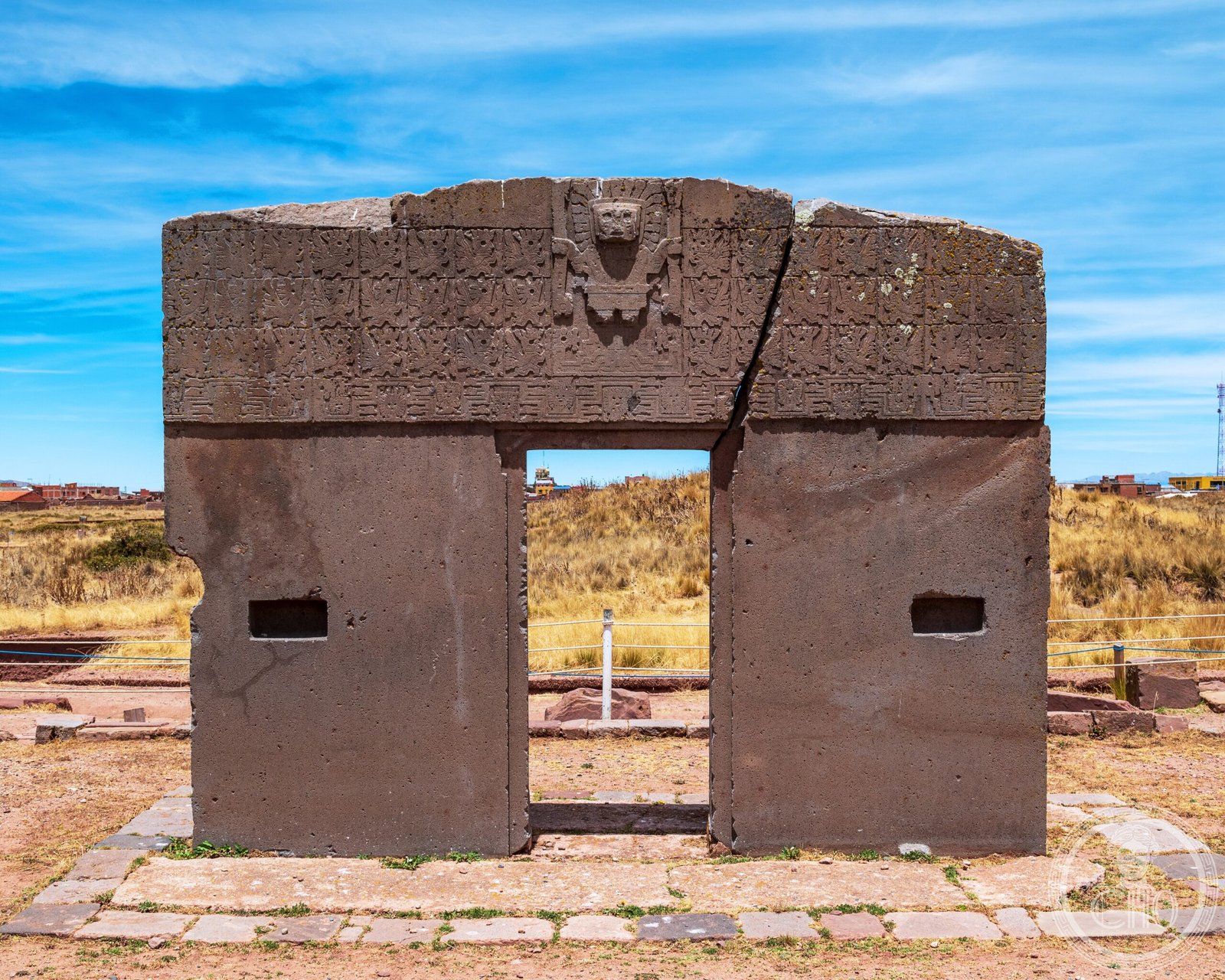
Tiwanaku draws the most international attention among Bolivia’s inscribed sites. A pre-Inca ceremonial complex on the Altiplano near Lake Titicaca, it was inscribed in 2000 and represents a civilisation that flourished between roughly 400 and 900 CE. The Gate of the Sun, carved from a single block of andesite, is its most reproduced image. Potosí, inscribed 1987 and placed on the List of World Heritage in Danger in 2014 due to mining pressures, is the other site most likely to appear on a Bolivia itinerary.
Visitors who venture beyond these two will find sites of comparable significance. Fuerte de Samaipata, inscribed 1998, is a large sandstone formation on the eastern Andean slopes whose carved surfaces served both ceremonial and administrative functions for pre-Inca cultures — and later as an Inca outpost. The Jesuit Missions of Chiquitos, inscribed 1990, require a long journey into the lowlands but reward it with a remarkably intact baroque ecclesiastical landscape. Sucre, inscribed 1991, is a functioning city whose colonial architecture remains largely unaltered, making it one of the better-preserved Spanish-American urban ensembles on the continent.
Natural and shared sites
Bolivia’s single natural World Heritage Site, Noel Kempff Mercado National Park, was inscribed in 2000. Located in the northeastern Santa Cruz department on the Brazilian border, the park encompasses tropical rainforests, gallery forests, savannahs, swamps, and semi-deciduous dry forests — a mosaic of Amazonian habitats of exceptional biodiversity. It is one of the largest and best-protected expanses of Amazonian wilderness with World Heritage status in South America.
Bolivia is also a participant in the Qhapaq Ñan, Andean Road System, inscribed in 2014 as a transnational serial site shared with Argentina, Chile, Colombia, Ecuador, and Peru. The system covers over 30,000 kilometres of pre-Columbian and Inca roads, making it one of the largest infrastructure networks ever inscribed by UNESCO. Bolivia’s sections cross the high Altiplano and connect to the larger Andean network that once linked Cusco to the furthest reaches of Tawantinsuyu.
How to find them
Bolivia’s inscribed sites are spread across very different geographies: the high Altiplano, the colonial valleys, the eastern Andean slopes, and the Amazonian lowlands. Most cultural sites can be reached from La Paz or Sucre, while Noel Kempff Mercado National Park requires travel to Santa Cruz and onward by small aircraft or river. The Jesuit Missions circuit in Chiquitos is best approached from Santa Cruz by rail or road.
Bolivia’s World Heritage sites sit alongside thousands of other places on CHO’s interactive map, with GPS and sourced editorial history for each. See also our guides to Italy’s and France’s UNESCO sites, and our piece on cultural travel beyond mass tourism.
Frequently Asked Questions
How many UNESCO World Heritage Sites does Bolivia have?
Bolivia has 7 UNESCO World Heritage Sites as of 2026. Six are classified as cultural sites and one — Noel Kempff Mercado National Park — is a natural site. The Qhapaq Ñan, Andean Road System is a transnational inscription shared with five other South American countries.
What was Bolivia’s first UNESCO World Heritage Site?
The City of Potosí was Bolivia’s first UNESCO World Heritage Site, inscribed in 1987. Built around the silver-rich Cerro Rico mountain at over 4,000 metres altitude, it was once one of the most populous cities in the Americas. Potosí was later placed on the List of World Heritage in Danger in 2014 due to ongoing mining activity undermining its historic fabric.
What is the most recent site inscribed in Bolivia?
The most recently inscribed site connected to Bolivia is Qhapaq Ñan, the Andean Road System, which received World Heritage status in 2014. This vast pre-Columbian and Inca road network spans over 30,000 kilometres and is shared with Argentina, Chile, Colombia, Ecuador, and Peru. Bolivia’s sections cross the Altiplano and link to the wider Andean network centred on the Inca capital Cusco.
What is Fuerte de Samaipata?
Fuerte de Samaipata is a UNESCO-inscribed archaeological site in the eastern Andean foothills of Bolivia, recognised in 1998. Its centrepiece is a large carved sandstone formation that served ritual and administrative purposes for pre-Inca cultures before being incorporated into the Inca Empire. The site’s combination of natural rock sculpture and pre-Columbian occupation makes it one of the more unusual entries on Bolivia’s World Heritage list.
Sources used in this article
- UNESCO — State Party Bolivia — World Heritage list.
- UNESCO — Bolivia: World Heritage Sites.
- CHO magazine — What is a World Heritage Site?
- CHO — Interactive map of heritage sites.