
When the great wave of Art Nouveau swept across Europe at the turn of the twentieth century, it arrived in Milan wearing a different name. The Italians called it Liberty — after the London department store whose imported fabrics had made the style fashionable — and in the hands of Giuseppe Sommaruga and his contemporaries, it became something distinctly its own: heavier, more sculptural, less florid than its Viennese or Parisian cousins. The densest evidence of that transformation survives today in the Porta Venezia district, where a short walk connects buildings that changed what Italian architecture thought it could be.
Sommaruga and the Public Face of Liberty
No building announces the arrival of Milanese Liberty more boldly than Palazzo Castiglioni on Corso Venezia. Giuseppe Sommaruga completed it around 1903–1904, and the result was a provocation as much as a residence. Stand in front of the façade and the sheer mass of the thing is the first impression: rusticated stone at the base giving way to polychrome surfaces above, the whole composition coiling with organic relief work that refuses to settle into any historical style. Where the French architects of the same period reached for sinuous line, Sommaruga reached for weight. He was not decorating a building. He was arguing for a new one.
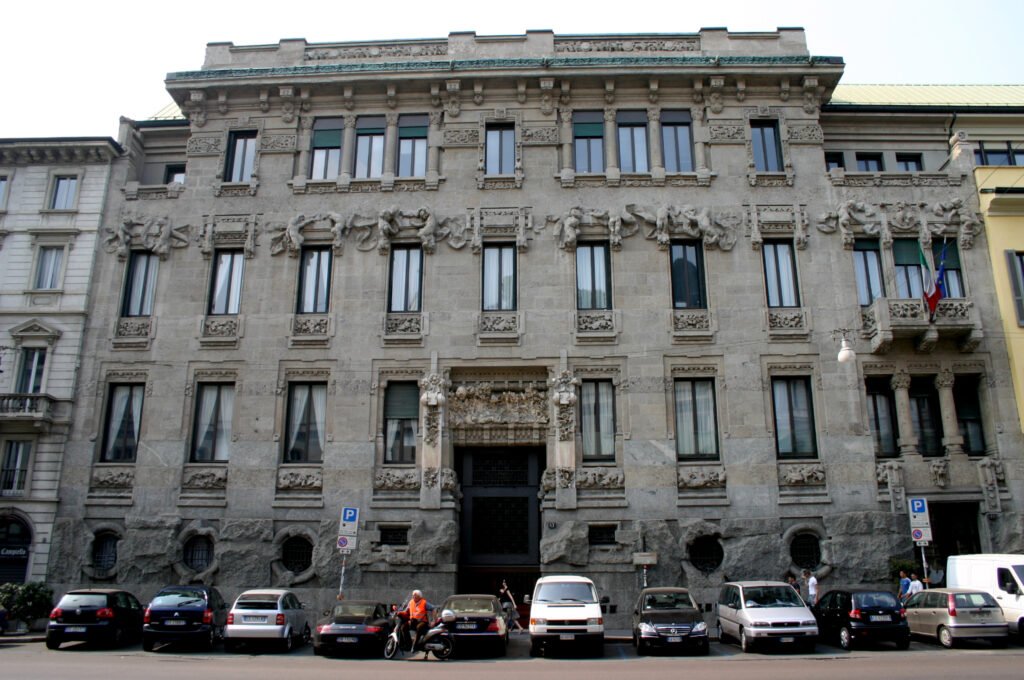
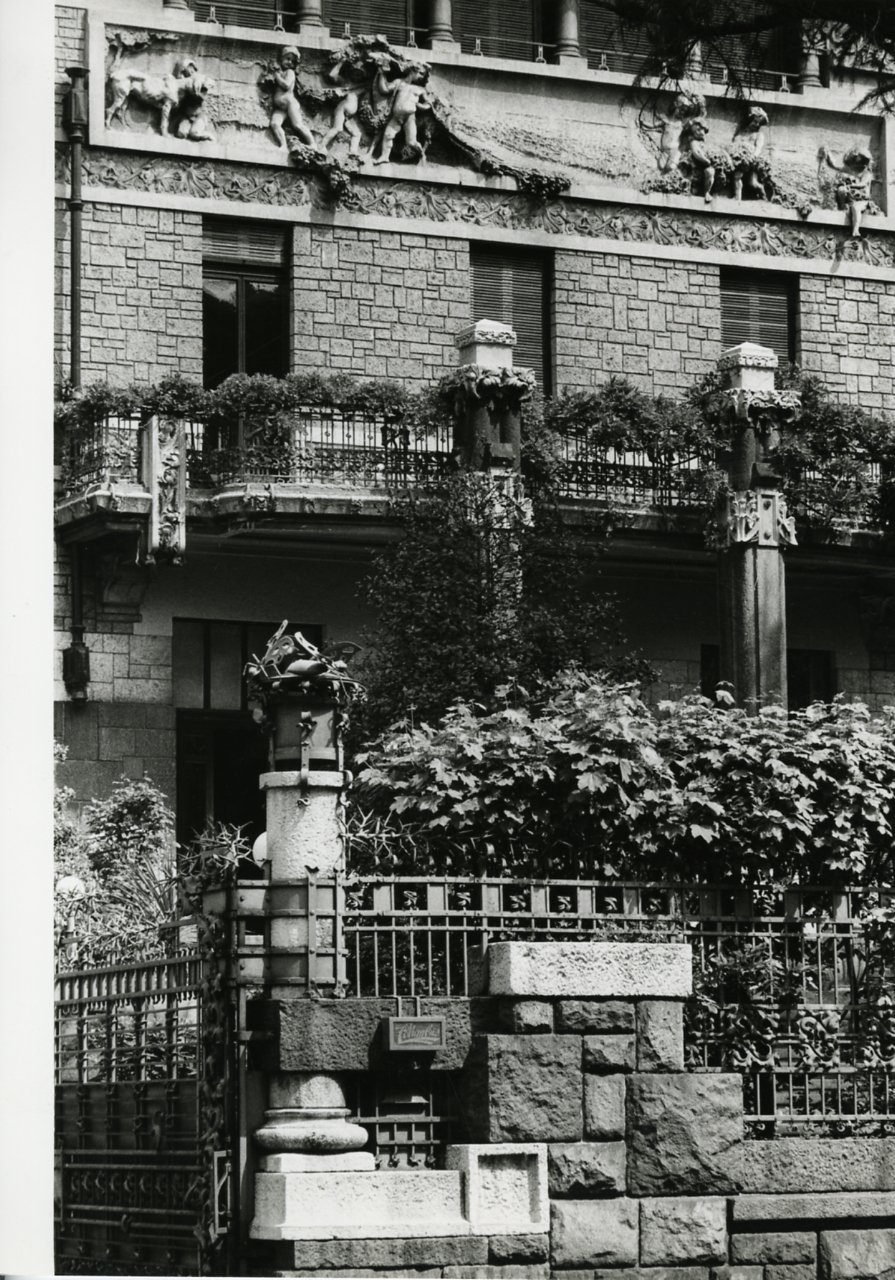
Palazzo Castiglioni was the public debut of this sensibility, but Sommaruga’s range extended beyond the monumental. His Villa Romeo-Faccanoni, completed in 1914 on Via Buonarroti, shows what happens when the same formal intelligence turns to a more intimate programme. Today the building functions as the Clinica Columbus, and its garden elevation — enriched with ironwork by Alessandro Mazzucotelli — remains one of the subtlest achievements in the city’s Liberty canon. Mazzucotelli was not merely a craftsman executing a designer’s drawings. His wrought iron had its own logic, pulling organic forms from the metal that no other hand in Italy could have produced with the same tension between rigour and growth. The collaboration between Sommaruga’s stone and Mazzucotelli’s iron represents something specific to the Italian branch of the movement: a dialogue between mass and filigree rather than the all-over surface treatment favoured in Brussels or Barcelona.
The Tiled Streets of Porta Venezia
A few minutes on foot from Corso Venezia, the character of the district shifts. The streets around Via Malpighi and Via Vincenzo Bellini are residential rather than representative, and the Liberty buildings here were built not for industrialists performing power but for a prosperous urban middle class settling into a modern city. The scale is domestic. The ambition is not.
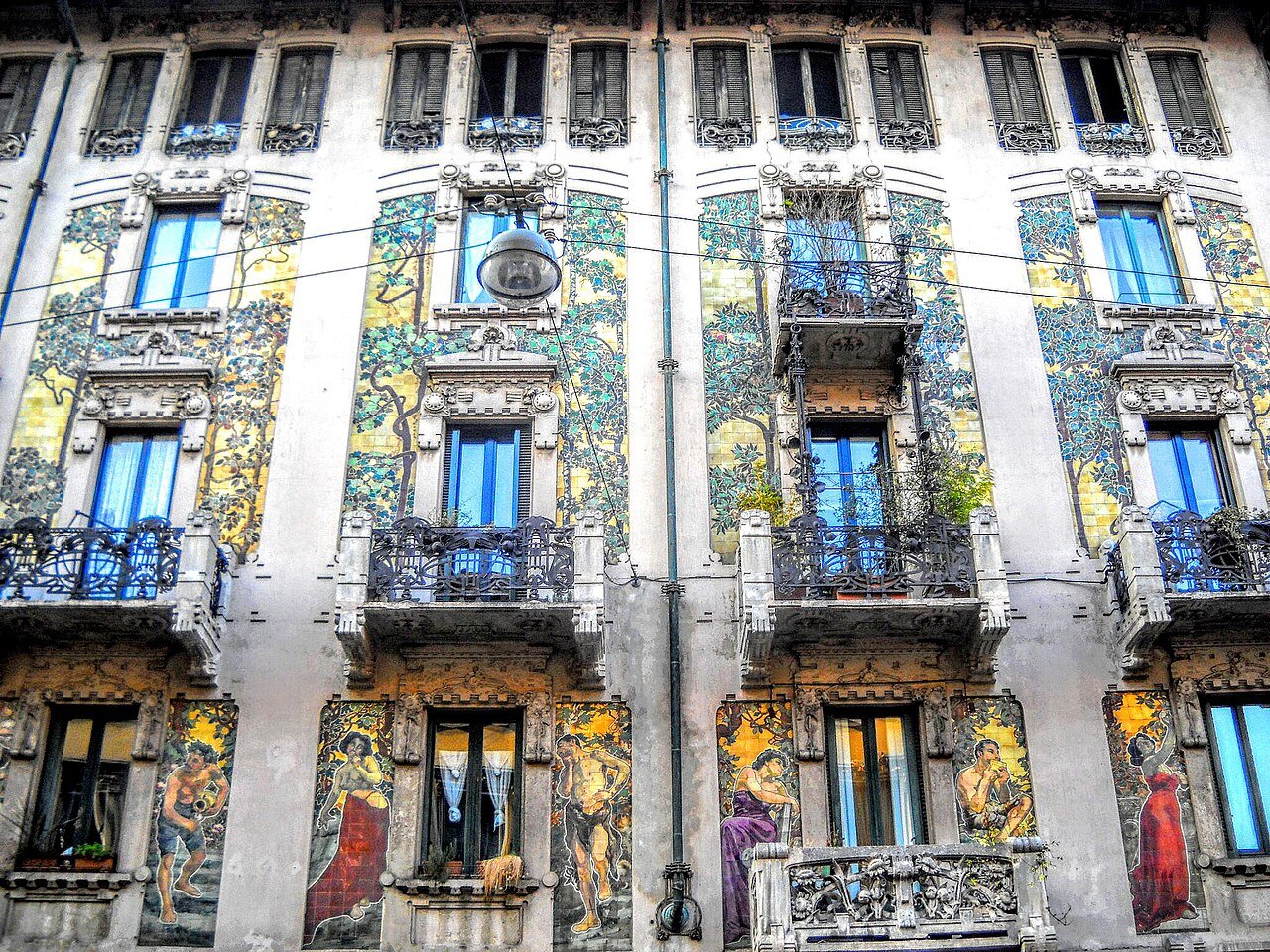
Casa Galimberti, designed by Giovanni Battista Bossi and completed between 1904 and 1905, stands at Via Malpighi 3 as perhaps the most immediately striking surface in Milanese Liberty. The entire façade is sheathed in painted ceramic tiles. Not applied as a band or a frieze, but as a total covering — figural panels, floral grotesques, and female heads repeated across the full width and height of the building. In bright morning light the colours read almost aggressively: terracotta, sage, cobalt. Liberty across Europe discovered the possibilities of industrial ceramic at roughly the same moment, but few buildings deployed it so completely. Bossi’s approach here has more in common with the tiled housefronts of Lisbon or the azulejo traditions of the Iberian peninsula than with anything built before it in northern Italy.
On Via Vincenzo Bellini 11, Casa Campanini offers a different kind of confidence. Alfredo Campanini built it for himself between 1904 and 1906, and that fact matters: the building carries the authority of a designer who answered to no client. The ironwork at the entrance, the carved stone window surrounds, and the carefully calibrated proportions of the street elevation add up to one of the most assured statements in the Milanese Liberty repertoire. Campanini knew exactly what he was doing.
Why It Happened Here
Liberty in Milan was not an accident of taste. It was an expression of money and of a particular moment in the city’s self-understanding. Milan’s industrial and commercial bourgeoisie — families enriched by textile manufacture, banking, and the accelerating commerce of a newly unified Italy — wanted architecture that was modern but not cold, innovative but not threatening. Art Nouveau across Europe served exactly this social function, providing a visual language of dynamism and natural abundance that felt progressive without being political. In Vienna it was called Jugendstil. In Barcelona it found its most extreme expression in the work of Antoni Gaudí. In Brussels it had been born in Victor Horta’s Hôtel Tassel. Each city inflected the shared impulse differently.
Milan’s inflection was Sommaruga. He was the movement’s leading Milanese architect, and his influence on younger practitioners shaped the density of Liberty building in the Porta Venezia quarter. The concentration there — multiple significant buildings within a ten-minute walk of each other — reflects both the pace of residential development in that part of the city around 1900 and the way clients followed architectural fashion into a single neighbourhood. Mazzucotelli’s workshops supplied the ironwork across much of this district, creating a material continuity that gives the streets a coherence even where individual buildings differ sharply in approach.
How to Walk It
The walk takes between two and two and a half hours at a comfortable pace, with time to look properly at each façade. Start at Porta Venezia metro station on line 1 (red line). From there Palazzo Castiglioni on Corso Venezia is a short walk south; spend time on both the street elevation and the side elevations before moving on. All four buildings are residential or institutional, so access is to the exterior only — the façades are the point, and they are fully visible from the pavement.
From Palazzo Castiglioni, walk north and then west to reach Villa Romeo-Faccanoni on Via Buonarroti — the distance is longer, around twenty minutes on foot, so some visitors prefer to take the metro one stop and walk from there. Return east to the Porta Venezia district for the second half of the walk: Casa Galimberti is at Via Malpighi 3, and Casa Campanini is a short distance away on Via Vincenzo Bellini 11. Both streets are quiet enough to photograph from the pavement without traffic difficulties. The neighbourhood has good cafés along Corso Buenos Aires if you want to break the walk at the midpoint.
Morning light falls well on Casa Galimberti’s south-facing façade. Late afternoon suits Palazzo Castiglioni. Neither building requires a reservation or an entrance fee to appreciate. They are simply there, on public streets, as they have been for over a century.
Milan’s Liberty walk pairs naturally with the Art Nouveau capitals of Europe series — read the guides to Barcelona and Brussels to place the Milanese buildings in their wider European context.
Frequently Asked Questions
What is Liberty architecture and how does it relate to Art Nouveau?
Liberty is the Italian name for the Art Nouveau movement that spread across Europe between roughly 1890 and 1914. The term came from Liberty of London, the department store whose imported fabrics popularised the style in Italy. The same movement was called Jugendstil in German-speaking countries, Modernisme in Catalonia, and Art Nouveau in France and Belgium.
Who was Giuseppe Sommaruga and why does he matter?
Giuseppe Sommaruga was the leading Liberty architect in Milan. His Palazzo Castiglioni on Corso Venezia, completed around 1903–1904, marked the public arrival of the style in the city and influenced the generation of architects who followed him. His later Villa Romeo-Faccanoni, completed in 1914, shows a more refined side of the same formal vocabulary.
Who was Alessandro Mazzucotelli?
Alessandro Mazzucotelli was Milan’s pre-eminent Liberty ironworker, whose wrought-iron gates, railings, and decorative elements appear across the city’s most important buildings in the style. His collaboration with Sommaruga on Villa Romeo-Faccanoni is among the finest examples of the partnership between architecture and craft that defines Italian Liberty at its best.
Can visitors enter the Liberty buildings in Porta Venezia?
The major Liberty buildings in Milan — including Palazzo Castiglioni, Casa Galimberti, and Casa Campanini — are private residences or functioning institutions, so interior access is not available to the general public. The façades are fully visible from the street and represent the primary architectural statement in each case. Villa Romeo-Faccanoni operates as the Clinica Columbus and is not open for visits.
How long does the Liberty walk in Milan take?
Allow between two and two and a half hours for a walk that takes in all four key buildings: Palazzo Castiglioni, Villa Romeo-Faccanoni, Casa Galimberti, and Casa Campanini. The Porta Venezia cluster — Casa Galimberti and Casa Campanini — can be done in under an hour if you are short of time. The metro station at Porta Venezia on line 1 is the natural starting point.
Is Porta Venezia the only Liberty district in Milan?
Porta Venezia holds the densest concentration of Liberty buildings in the city, making it the natural focus for a walking tour. Individual examples of the style survive in other neighbourhoods, including the area around Via Buonarroti where Villa Romeo-Faccanoni stands. The city hub page on Milan — Liberty, Rationalism and the World Capital of Design maps the broader distribution of significant buildings across the city.


