
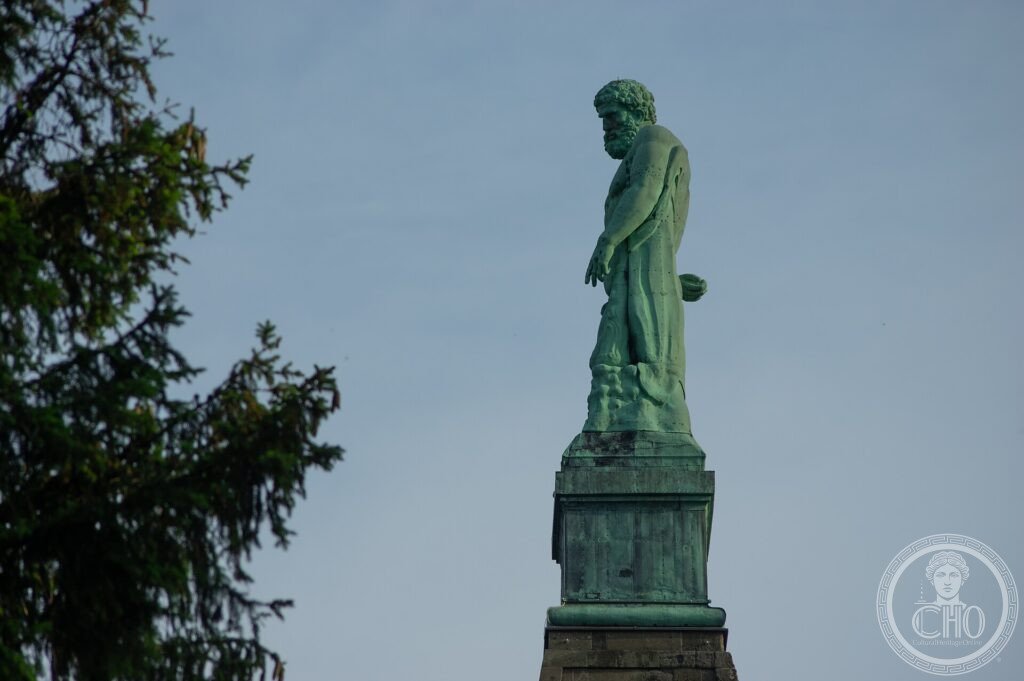
Bergpark Wilhelmshöhe (1701–1717): l’Ercole gigante e le acque che scendono dalla collina
Sopra Kassel, una statua colossale di Ercole domina un intero versante: da lì, nei giorni stabiliti, l’acqua precipita per centinaia di metri lungo cascate barocche, getti e ruscelli fino al castello. Il Bergpark Wilhelmshöhe è il più grande parco collinare d’Europa, un teatro d’acqua e di paesaggio.
At a glance
The Bergpark Wilhelmshöhe, rising above Kassel, is the largest hillside park in Europe and a spectacular monument of Baroque and landscape garden art. At its summit a colossal copper statue of Hercules, set on a great pyramid and octagon built between 1701 and 1717, commands the whole slope. On set days, water released at the top tumbles down a series of Baroque cascades, fountains and channels for hundreds of metres to the palace below. This grand water theatre was inscribed by UNESCO in 2013.
Key facts
- UNESCO: World Heritage since 2013 (Bergpark Wilhelmshöhe)
- Largest in Europe: the biggest hillside park on the continent
- The Hercules: a colossal copper statue (1701–1717) on a pyramid and octagon
- Water features: Baroque cascades, fountains and channels down the slope
- Water games: staged on set days, the water descends without pumps, by gravity
- Romantic park: later landscaped with lakes, an aqueduct and a folly castle
History
From 1701 the landgraves of Hesse-Kassel began transforming the hillside above their residence into a vast Baroque garden crowned by the Hercules, a copper colossus on a monumental octagon, symbol of their power and of the strongman of myth. An elaborate system was built to carry water to the summit so that it could descend the slope in a theatrical sequence of cascades and basins.
In the later 18th and 19th centuries the formal design was extended in the English landscape style, with serpentine lakes, a Roman-style aqueduct, grottoes and the romantic Löwenburg “castle”. The whole became a continuous park uniting Baroque grandeur and Romantic naturalism, the water games still performed today.
What you see
At the top, the giant Hercules stands on his octagon and pyramid, visible across Kassel, with a sweeping view down the slope. On water-game days, water bursts from beneath him and runs down the great stone cascades, leaps in fountains and flows through the romantic features — the aqueduct, the Devil’s Bridge, the lake — to a final towering jet before the palace.
Wilhelmshöhe Palace at the foot houses an important art gallery, including Rembrandts.
Practical information
- Park: freely open; the water games run on set days in the warm season
- The Hercules: can be climbed for the view (seasonal)
- Time needed: half a day, timed to the water games
- Palace: the Old Masters gallery is a highlight
Getting there
The Bergpark rises on the western edge of Kassel in Hesse, central Germany. Kassel is on the high-speed rail network; a tram runs to Wilhelmshöhe at the foot of the park. GPS: 51.3158° N, 9.3947° E.
Nearby
- Wilhelmshöhe Palace — the Old Masters gallery at the foot of the park
- Kassel — the city of the documenta art exhibition
- Löwenburg — the romantic mock-medieval castle in the park
Sources
- UNESCO World Heritage Centre — “Bergpark Wilhelmshöhe” (ref. 1413)
- Museumslandschaft Hessen Kassel — official body
- Encyclopaedia Britannica — Kassel
Find it on the map
See this place and what’s around it →📷 Diventa un fotografo di Cultural Heritage Online
Condividi le tue foto dei luoghi: restano pubblicate con la tua firma come autore. Più vengono viste, più ti fai conoscere — e presto un concorso premierà le foto più apprezzate.
Accedi o registrati gratis per aggiungere una foto