
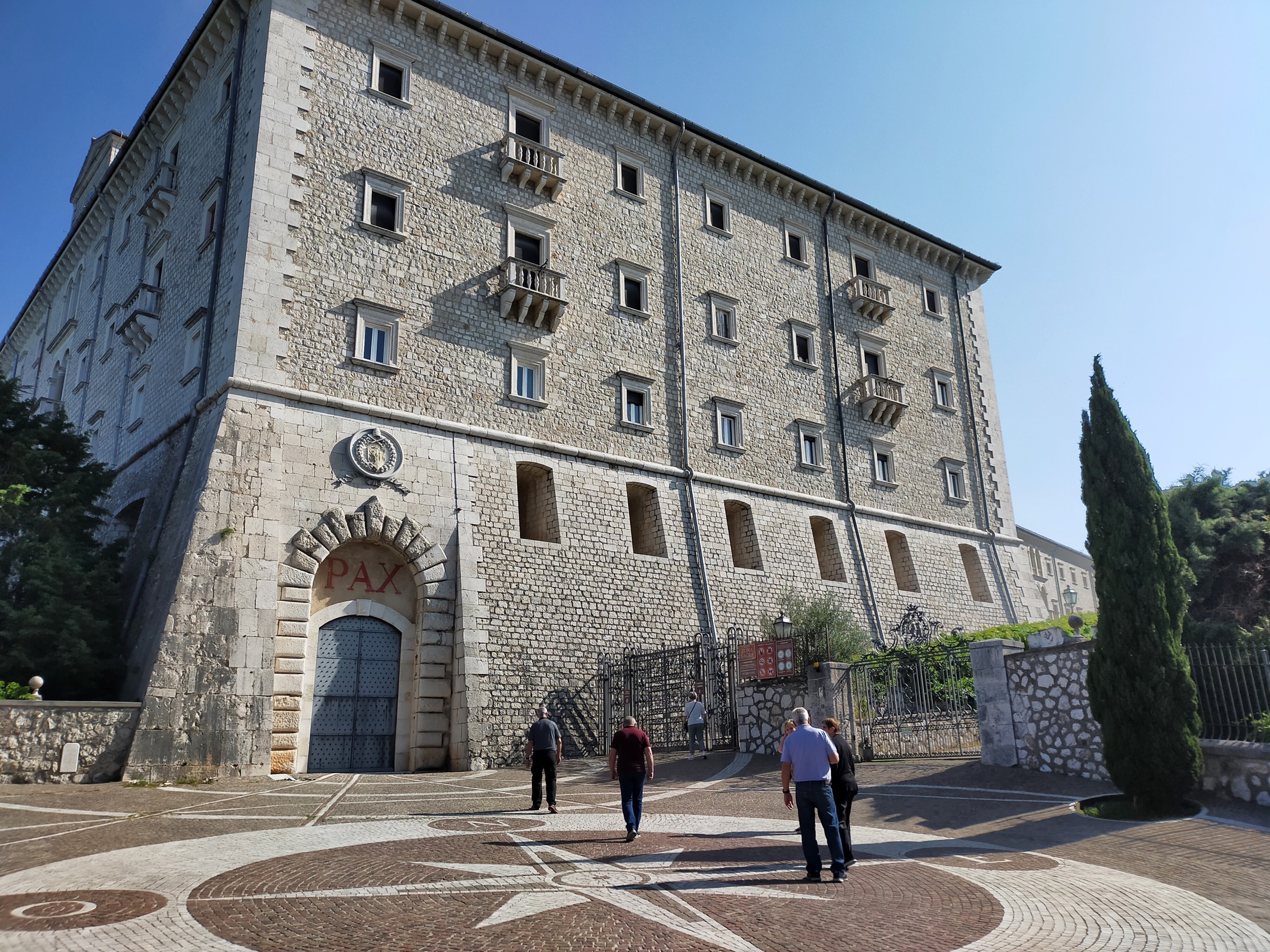
Abbey of Monte Cassino
Founded around 529 by Saint Benedict of Nursia on a rocky hill some 130 kilometres southeast of Rome, the Abbey of Monte Cassino is the first house of the Benedictine Order and the place where Benedict composed the Rule that would shape Western monasticism for the next fifteen centuries. Destroyed four times across its history — by Lombards, Saracens, an earthquake and, on 15 February 1944, by Allied bombers — the abbey has been rebuilt each time on the same summit. The complex visible today was raised between 1948 and 1964, reconstructed dov’era, com’era — where it was, as it was.
- Address
- Via Montecassino, 03043 Cassino FR
- Period
- Founded c. 529 by Saint Benedict of Nursia; current building 1948–1964 (post-WWII reconstruction)
- Founder
- Saint Benedict of Nursia
- Function
- Motherhouse of the Benedictine Order; cradle of the Rule of Saint Benedict
- Current use
- Active Benedictine abbey + museum + library; open to public visits
- Coordinates
- 41.4894° N, 13.8133° E
- Notes
- Destroyed four times: by the Lombards (c. 577), Saracens (883), earthquake (1349), and Allied bombing (15 February 1944); rebuilt each time on the original site
Gallery
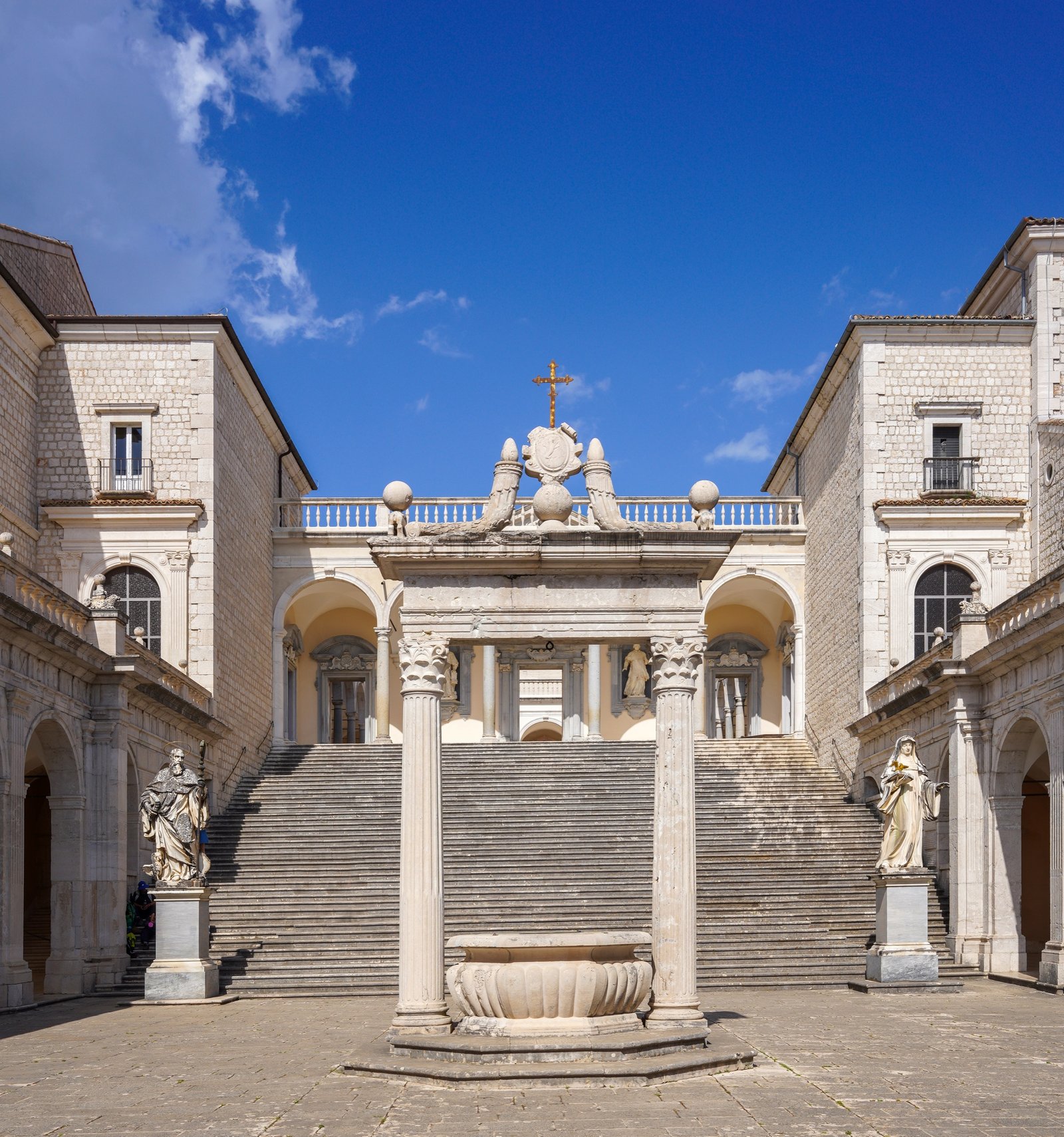
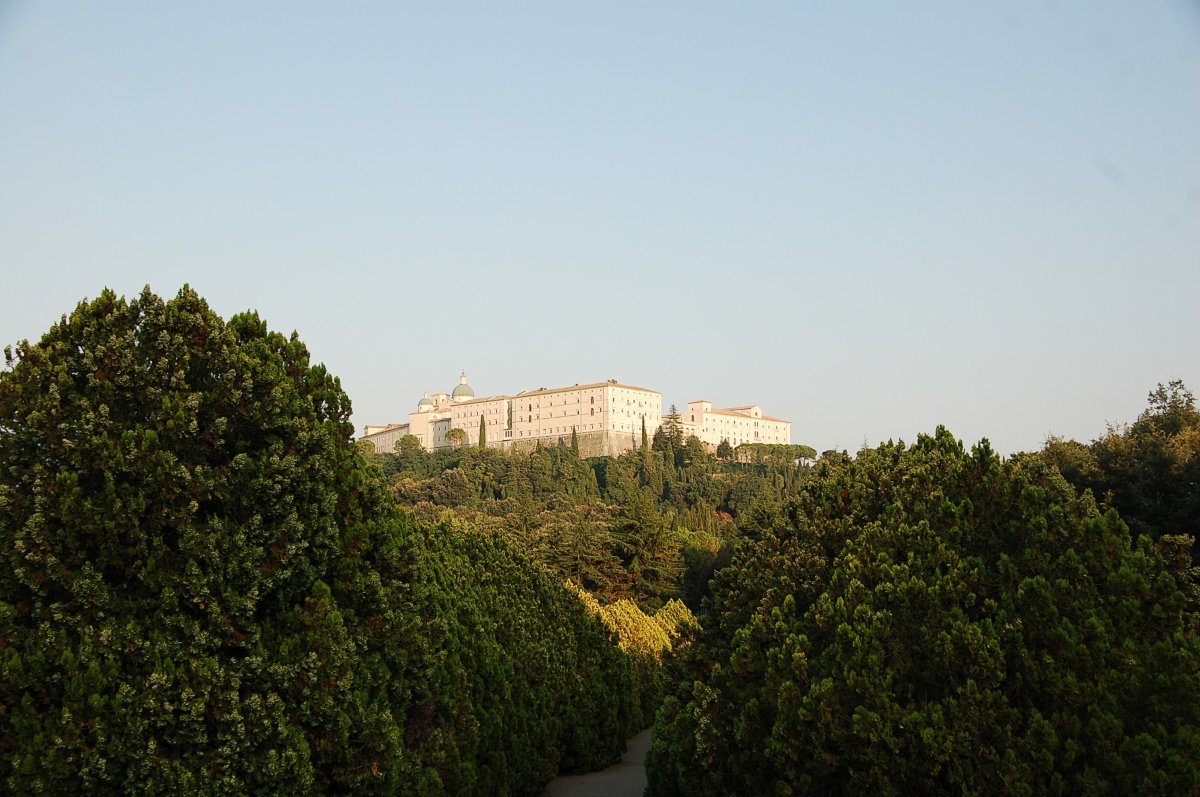
Two views from the rebuilt complex: the Bramante cloister inside the monastery walls and the Polish War Cemetery on the slope below, which together mark the abbey’s monastic vocation and its place in twentieth-century memory.
Visit on the map
Via Montecassino · 41.4894° N, 13.8133° E
Download for your navigator
A single waypoint, ready for GPS apps, navigators, and contacts.
According to the hagiography written by Pope Gregory the Great, Benedict of Nursia climbed to the summit of Monte Cassino around 529, after leaving the hermit colony of Subiaco, and chose for his new community a hilltop still crowned by the ruins of a temple to Apollo. On that site he founded the first house of what would become the Benedictine Order and there, in the following years, he composed the Regula Benedicti — the Rule of Saint Benedict — a short text balancing prayer, study and manual labour (ora et labora) that became the foundational charter of Western monasticism. From the same hill descended the scriptorium tradition that copied and preserved a substantial part of classical Latin literature through the early Middle Ages, alongside a hospital and a school that served the surrounding territory.
The abbey’s history is marked by four total destructions on the same summit. Around 577 the first monastery was sacked by the invading Lombards and abandoned; it was refounded by Petronax of Brescia in 718. In 883 a second destruction came at the hands of Saracen raiders, after which the community lived in exile at Teano and Capua until the site was reoccupied in 949. In 1349 a major earthquake levelled the medieval buildings, prompting Pope Urban V to call for a Europe-wide Benedictine contribution toward their rebuilding. The fourth and most documented destruction occurred on 15 February 1944, during the Battle of Monte Cassino: in three waves, 142 B-17 Flying Fortresses, 47 B-25 Mitchells and 40 B-26 Marauders dropped roughly 1,150 tonnes of high-explosive and incendiary bombs on the abbey, reducing it to rubble. The only people killed by the raid inside the monastery were some 230 Italian civilians who had taken refuge among its walls.
Reconstruction began in 1948 under Abbot Ildefonso Rea, working from the original architectural drawings and surviving fragments under the rule dov’era, com’era — where it was, as it was. The rebuilt basilica was consecrated by Pope Paul VI in 1964, the year the abbey was also proclaimed Patron of Europe together with the figure of Saint Benedict. On the slope immediately below the monastery, the Polish War Cemetery inaugurated in 1945 holds the graves of more than 1,050 Polish soldiers of General Władysław Anders’ II Corps, who broke the Gustav Line and reached the ruined summit on 18 May 1944. Today Monte Cassino functions again as an active Benedictine community with its museum, library and archive, and remains a territorial abbey of the Catholic Church, open to visitors from the town of Cassino below.
Resources & References
Editorial picks across Wikipedia, photo archives, and the official portal.
All photographs Wikimedia Commons (CC-BY / CC-BY-SA / Public Domain) unless otherwise stated. Editorial text Cultural Heritage Online, OASIS Tech LLC USA.
Find it on the map
See this place and what’s around it →Historical events at this place (1)
📷 Diventa un fotografo di Cultural Heritage Online
Condividi le tue foto dei luoghi: restano pubblicate con la tua firma come autore. Più vengono viste, più ti fai conoscere — e presto un concorso premierà le foto più apprezzate.
Accedi o registrati gratis per aggiungere una foto