
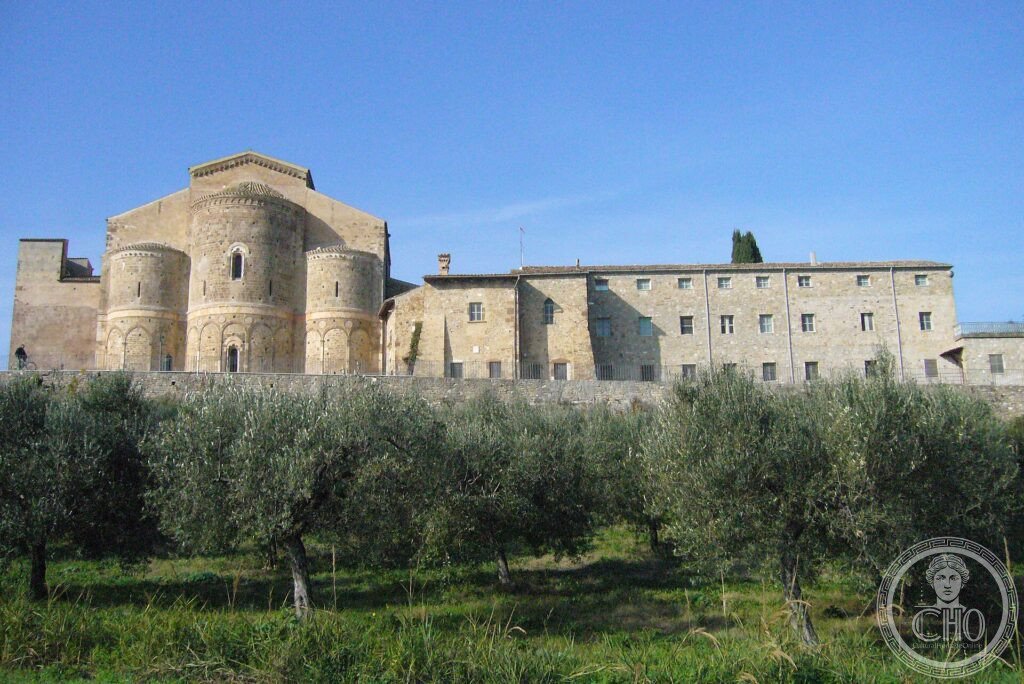
The name “in Venere” is not a medieval addition: here where the Benedictine abbey now stands there was a Roman temple of Venus on the Adriatic promontory that Ovid knew. The monks of the eleventh century built above it, and in the thirteenth century carved the Portal of the Moon — one of the most magnificent Romanesque portals in Italy, with cycles of figures of a quality that comes as a surprise in this corner of Abruzzo.
At a glance
The Abbey of San Giovanni in Venere stands on a long promontory that projects into the Adriatic south of Fossacesia, in the province of Chieti, Abruzzo. Visible from the sea for miles, it was built on the site of a Roman temple of Venus — hence the name, which records the continuity between pre-Christian and Christian sacred geography at this coastal landmark. A Benedictine community was established here in the late 10th or early 11th century and the abbey grew quickly, becoming one of the most important Benedictine houses on the Adriatic coast of Abruzzo by the 12th century. The church, rebuilt in the Romanesque style in the late 11th–12th century, was given its most celebrated feature in the early 13th century: the Portale della Luna (Gate of the Moon), a doorway with a lunette and surround carved with figures of extraordinary refinement — a deposition from the cross, a pantocrator, prophets and apostles — that represent the highest level of Romanesque sculptural art in Abruzzo. The abbey is surrounded by a pine wood above the Adriatic; the view from the church forecourt toward the sea is one of the most dramatically positioned of any Italian abbey.
Key facts
- Pre-Christian site: Roman temple of Venus on the same promontory, documented by Ovid; the “in Venere” of the abbey name recalls this pagan predecessor
- Founded: Benedictine community documented from c. 1014; church rebuilt in Romanesque style 11th–12th century; at its height controlled extensive coastal and inland properties
- Portale della Luna: the abbey's masterpiece (early 13th c.); a richly carved portal with lunette, two side reliefs, and archivolts depicting Christ in Majesty, Deposition, Apostles, Prophets; the finest Romanesque carving in Abruzzo
- Crypts: the abbey has two crypts: the lower crypt (pre-Romanesque, possibly on the foundations of the Venus temple) and the upper crypt (11th century, with columns bearing ancient spolia capitals)
- Today: managed by the Italian state (MiC) and the Chieti diocese; church open daily; cloister accessible; panoramic views over the Adriatic
History
The sacred significance of the Fossacesia promontory predates Christianity by at least a millennium: the Roman temple of Venus that occupied the site is mentioned by Ovid in the Ars Amatoria, and its foundations are thought to underlie the abbey's earliest Christian construction. A small church dedicated to St John was built here in the early Christian period; the Benedictine community, documented from 1014, transformed this small cult-site into a full monastery in the 11th century. The abbey's position on the Adriatic coast made it both strategically important (for maritime commerce and coastal defence) and spiritually prestigious (pilgrims arriving by sea from the East would see it as their first Italian landmark).
The construction of the Portale della Luna in the early 13th century marked the abbey's artistic peak. The workshop responsible for the carving was clearly trained in a sophisticated tradition — the quality of the figure sculpture, especially in the Deposition panel (with its limp body of Christ and the expressive grief of the mourners), is comparable to the best Romanesque carving in Puglia and Campania. The name “Porta della Luna” refers to the crescent-shaped lunette above the central door. After the suppression of 1806 the abbey fell into disuse; the church was restored and reopened in the 20th century; the monastery buildings are now partially used as a cultural centre by the Chieti province.
What you see
The abbey is approached through a pine wood on the promontory crest, with glimpses of the Adriatic below on both sides. The church facade presents the Portale della Luna: a projecting porch on twin columns with carved capitals, enclosing the doorway whose lunette and surround carry the sculptural programme — Christ in Glory in the tympanum, flanked by angels; on the lintel, the Deposition and Entombment; in the archivolts, prophets and apostles in alternation. The detail of the carving, especially in the Deposition (the swooning Virgin, the closed eyes of Christ, the ladder against the cross) is astonishing. The interior is a three-aisle nave in the severe Abruzzese Romanesque style; the double crypt below the raised presbytery is one of the most atmospheric spaces in the abbey. The cloister, to the north, is partially ruined.
Practical information
- Opening hours: daily 09:00–12:00 and 15:00–18:00 (summer); reduced hours in winter; check MiC and diocesi.chieti.it
- Admission: free
- Time needed: 1 hour; add time for the view and pine wood walk
Getting there
By car from Lanciano (10 km north-west): SP37 toward Fossacesia, then follow signs to the abbey. By car from Pescara (40 km north): A14 motorway, exit Lanciano, then SP37. GPS: 42.2481° N, 14.4722° E.
Nearby
- Fossacesia marina — 2 km below the abbey; Adriatic beach; seafood restaurants
- Lanciano — 10 km north-west; medieval towers; the sanctuary of the Eucharistic Miracle of Lanciano (8th century)
- Parco Nazionale della Majella — 20 km west; mountain hiking; wolf, chamois, golden eagle
Sources
- Wikipedia — “Abbey of San Giovanni in Venere” (en.wikipedia.org/wiki/Abbey_of_San_Giovanni_in_Venere)
- Diocesi di Chieti — diocesi.chieti.it
- Adriano La Regina, Sangro Valley Survey — primary archaeological source
Find it on the map
See this place and what’s around it →📷 Become a Cultural Heritage Online photographer
Share your photos of places: they stay published under your name as the author. The more they're seen, the more you get noticed — and soon a contest will reward the most appreciated photos.
Log in or sign up free to add a photoIs this page about you?
This page is read by travellers and heritage enthusiasts who find it on Google. Tell us how you are connected to this place and we will take it from there.