
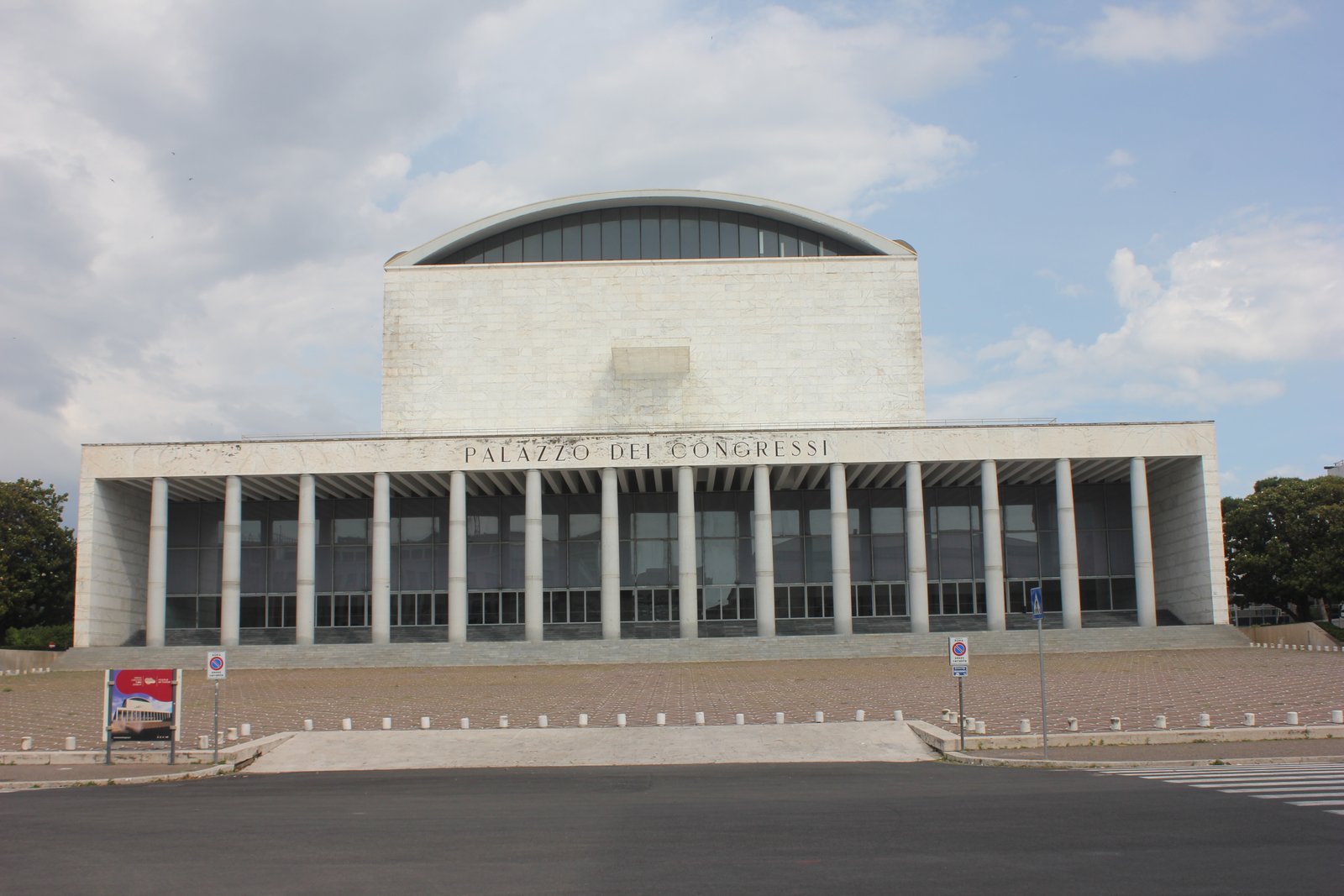
Adalberto Libera’s winning entry for the 1937 EUR 42 competition is a 45-metre travertine cube wrapped around a single luminous void: an Italian rationalist answer to the question of what state architecture could look like without copying Rome’s imperial past.
At a glance
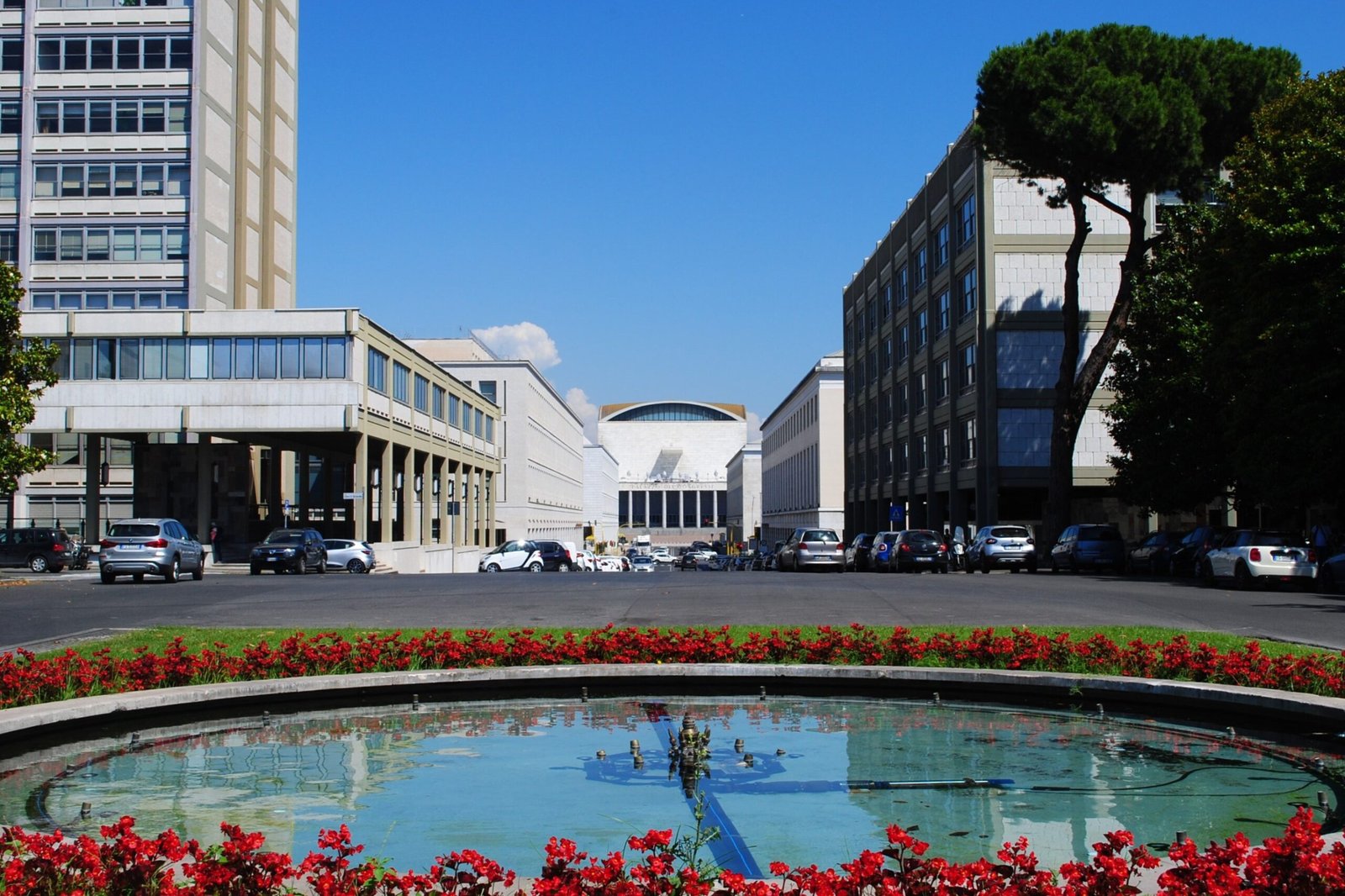
The Palazzo dei Congressi sits at the south-eastern end of the EUR district, on Piazza John Fitzgerald Kennedy, on axis with the Palazzo della Civiltà Italiana more than a kilometre away. Adalberto Libera won the 1937 competition for the building and worked on the design between 1937 and 1939; construction began in 1938, was largely structural by 1943, and stopped during the war. Work resumed in 1952 and the palazzo opened in 1953, with completion in 1954. It hosted the fencing tournament at the 1960 Rome Olympics and today operates as the EUR convention centre managed by EUR S.p.A.
Key facts
- Architect: Adalberto Libera (winning entry, 1937).
- Builder: Bassanini s.i.c., Milan.
- Design and construction: designed 1937-1939; built 1938-1954, interrupted by the Second World War.
- Dimensions: central cube of 45 metres per side; rear glazed wall 65 m wide and 10 m high; auditorium spanned by thirteen 28-metre reinforced-concrete frames.
- Materials: reinforced-concrete frame faced entirely in travertine; copper roof over the central hall.
- Address: Piazza John Fitzgerald Kennedy, 00144 Rome.
- Coordinates: 41.8339° N, 12.4744° E.
History
In December 1936 the Italian government created the Ente per l’Esposizione Universale di Roma to plan a world’s fair on the road to the sea, scheduled for 1942 to mark the twentieth year of the Fascist regime. The new district took the name EUR 42 from the acronym and the date. Competitions for the most prominent buildings — among them the Palazzo dei Ricevimenti e dei Congressi, the exedra of Piazza Imperiale, the basilica of Santi Pietro e Paolo, and the Palazzo della Civiltà Italiana — were launched between June and October 1937. Libera’s entry won; the second-prize scheme by Giuseppe Terragni, Cesare Cattaneo and Pietro Lingeri was set aside, a decision Giuseppe Pagano publicly called an “occasione perduta” in 1941.
The final designs were approved on 11 February 1938 by Mussolini himself, and excavation began in April. Because the foundation type was only settled in December 1938, real construction started in 1939. By 1943 the main volume was essentially complete, but the war stopped all work; the EUR buildings already standing were used as billets for German and then Allied troops, and after 1945 as shelters for displaced families. When the Ente EUR was reconstituted to finish the district, work on the palazzo resumed in 1952 and the building opened in 1953, in time for the Agriculture Exhibition held across the EUR pavilions that year.
In 1955 the IOC awarded the 1960 Olympics to Rome, and the palazzo — chosen for its volume and easy access — was assigned the fencing competition. Twenty changing rooms for 380 athletes were fitted out, seventy press positions installed, and a temporary branch of the Banca Nazionale del Lavoro opened inside. On 19 August 1960 the building hosted the opening ceremony of the 57th IOC session; from 29 August to 10 September it staged the foil, épée and sabre tournaments.
What you see
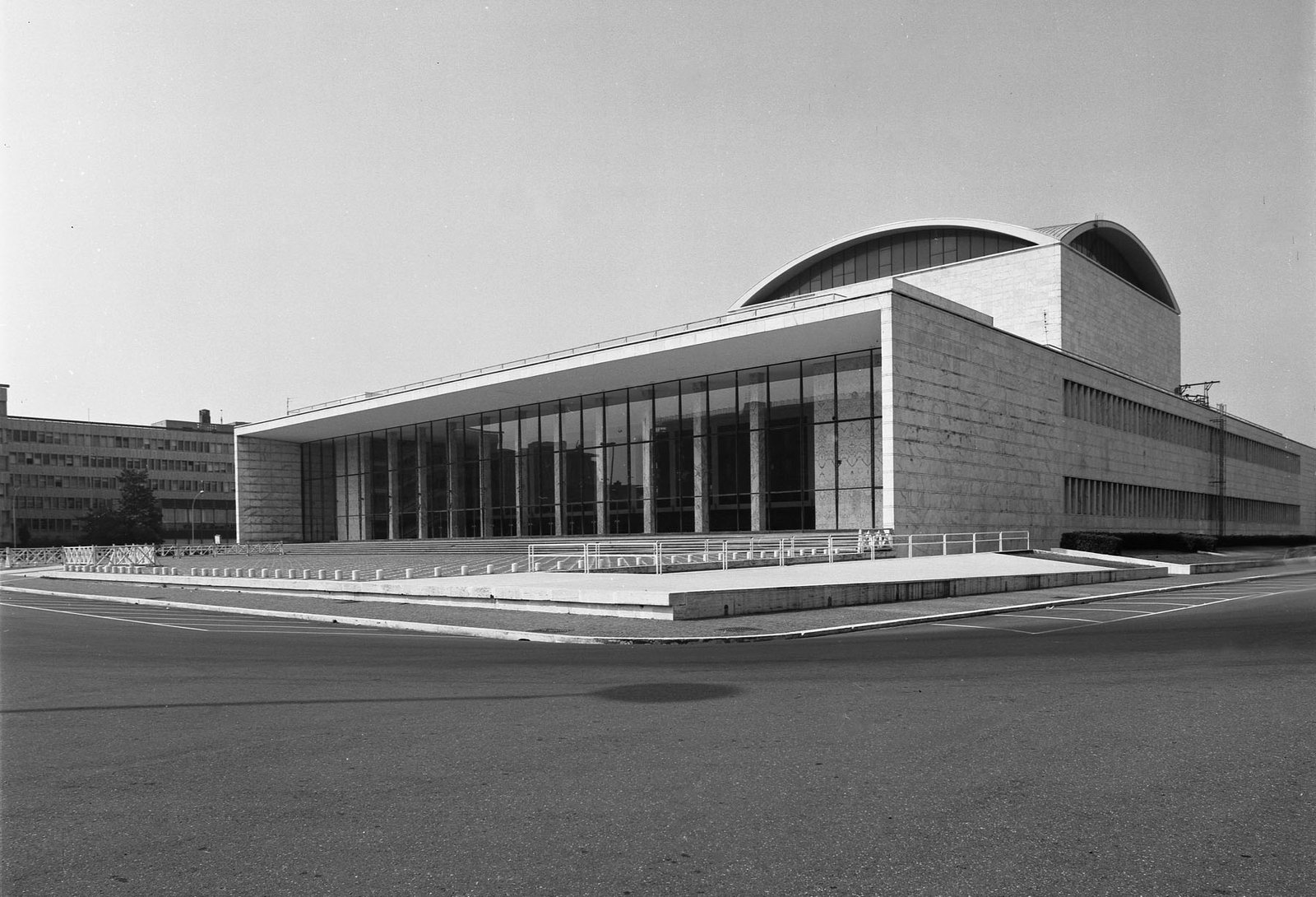
The building is, in essence, a 45-metre travertine cube riding on a long parallelepiped base. The base carries the front portico facing Piazza Kennedy, an atrium more than sixty metres wide, the service volumes, and an open-air auditorium at the rear. The cube contains a single hall, the Sala dei Ricevimenti, whose stairs and balconies are pushed against the inner walls so that the space stays clear. Walking in from the portico, the central hall reads as a perfect cube of light: no internal columns, and the roof seems to hover above you. It is held up by two crossed Vierendeel steel trusses arched along the diagonals of the square plan, carrying secondary beams, a Perret-type slab, and a copper covering above.
The front portico is the one element Libera said he could not avoid: in the changed cultural climate of the post-war he described the colonnade as a concession to the Fascist brief he could only soften, reducing the columns to travertine-clad piers that read more as structure than ornament. The original design called for a bronze quadriga by Francesco Messina on the projecting central console, never installed. The rear of the palazzo dissolves into a recessed glass wall 65 metres wide and 10 metres high, supported on slender steel piers; Libera is thought to have wanted the same transparency on the principal facade. Inside the atrium, a large allegorical fresco of triumphant Rome by Achille Funi was already in place when work resumed, and during the 1952-53 finishing campaign Gino Severini added a painting on masonite with scenes of rural life, in dialogue with the agricultural exhibition opening that year.
Practical information
- Opening: the palazzo is a working convention centre — interior access depends on the event calendar; the portico, piazza and rear elevation are always visible from the street.
- Best time of day: late morning, when the sun rakes the travertine portico and emphasises the cube’s mass.
- Time needed: 30-45 minutes for the exterior; pair with a walk to the Palazzo della Civiltà Italiana along the EUR axis.
- Photography: the rear glazed wall and the lateral facades read best in soft light; avoid harsh midday contrast on the travertine.
- Accessibility: the piazza in front of the building is flat and step-free; lateral access varies by event.
Getting there
The palazzo is in EUR, the planned business district south of central Rome. Metro line B stops at EUR Fermi and EUR Palasport, both within a five-minute walk of Piazza Kennedy. From Termini the journey takes about twenty minutes by metro. By car the building sits beside Via Cristoforo Colombo, the former Via Imperiale that connects the city to Ostia and the sea; surface parking is available around the surrounding piazzas. Fiumicino airport is roughly twenty kilometres south-west, reached in around 25 minutes by car or via the FL1 commuter train to Roma Tiburtina.
Nearby
- EUR (E42) Rationalist Walk — the curated itinerary with map and GPX
- EUR, 1937–1954: Walking the Quarter of the Exposition That Never Opened — by Stefano Vigolo
- Palazzo della Civiltà Italiana — Guerrini, La Padula and Romano’s “square Colosseum” closes the same EUR axis to the north-west.
- Basilica dei Santi Pietro e Paolo — the EUR’s domed church on the highest point of the district.
- Archivio Centrale dello Stato — the former Museo delle Comunicazioni building, another 1942-exposition palace converted to civic use.
- Palazzo dello Sport — Pier Luigi Nervi’s 1960 Olympic arena, on the axis south of the Palazzo dei Congressi.
See the place
Sources
- Wikipedia, “Palazzo dei Ricevimenti e dei Congressi” (Italian edition).
- Wikimedia Commons — Category: Palazzo dei Congressi (Rome).
- EUR S.p.A., owner and operator of the Palazzo dei Congressi.
- Giuseppe Pagano, “Occasione perduta,” Casabella-Costruzioni, 1941, on the competition outcome.
- Francesco Garofalo, Adalberto Libera (2002), on the monumentality of the principal elevation.
Image gallery
Find it on the map
See this place and what’s around it →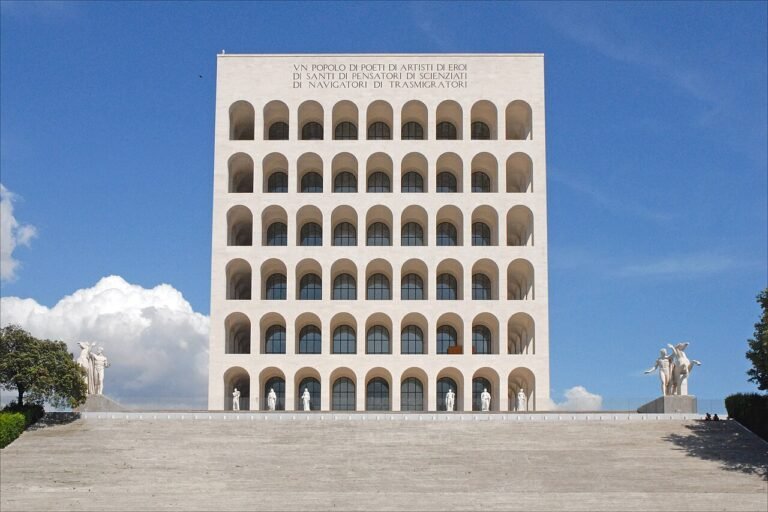
Historical events at this place (5)
📷 Become a Cultural Heritage Online photographer
Share your photos of places: they stay published under your name as the author. The more they're seen, the more you get noticed — and soon a contest will reward the most appreciated photos.
Log in or sign up free to add a photoIs this page about you?
This page is read by travellers and heritage enthusiasts who find it on Google. Tell us how you are connected to this place and we will take it from there.