
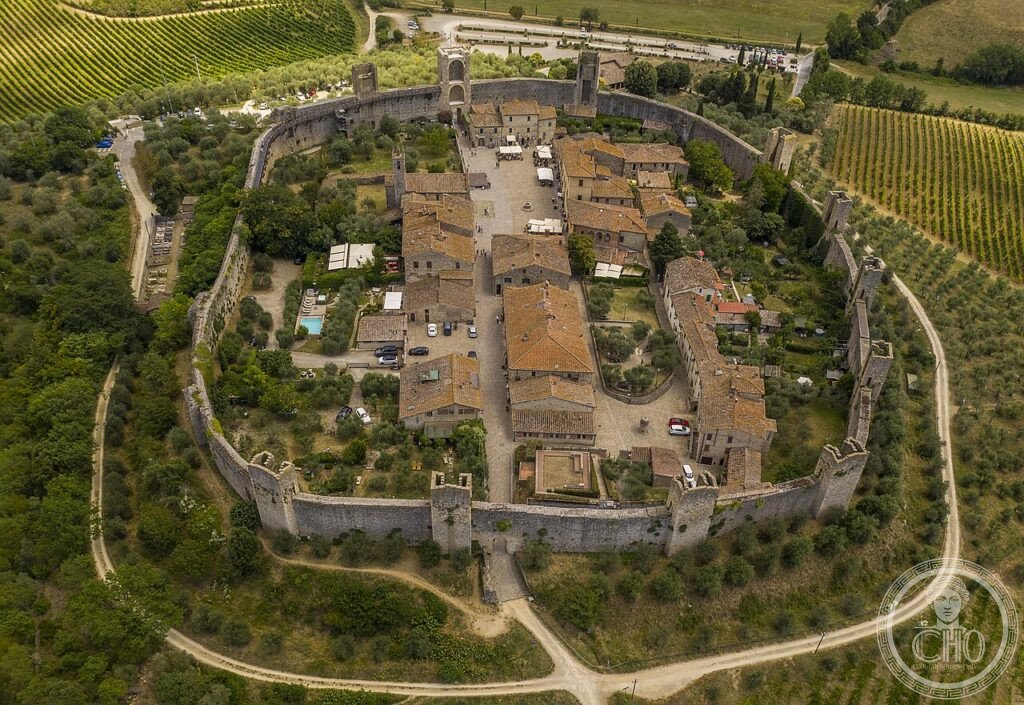
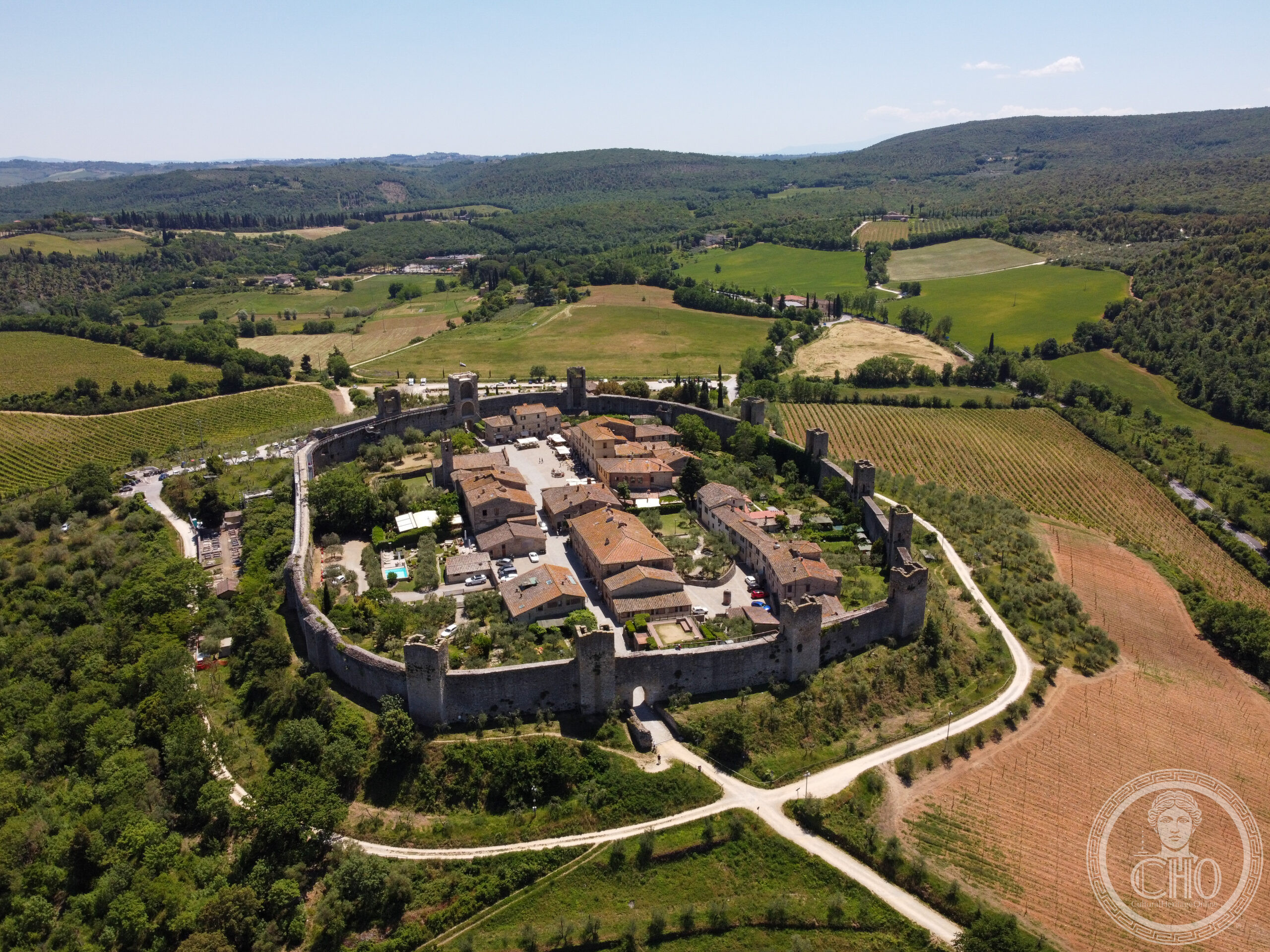
A ring of fourteen towers on a hilltop in the Val d’Elsa, Tuscany — the best-preserved medieval circuit wall in Italy, completed in 1219 for the Republic of Siena as a military outpost against Florence, and immortalised by Dante in Canto XXXI of the Inferno as the image through which he introduces the giant Nimrod at the edge of Hell’s deepest pit: “as Monteriggion crowns itself with towers.”
At a glance
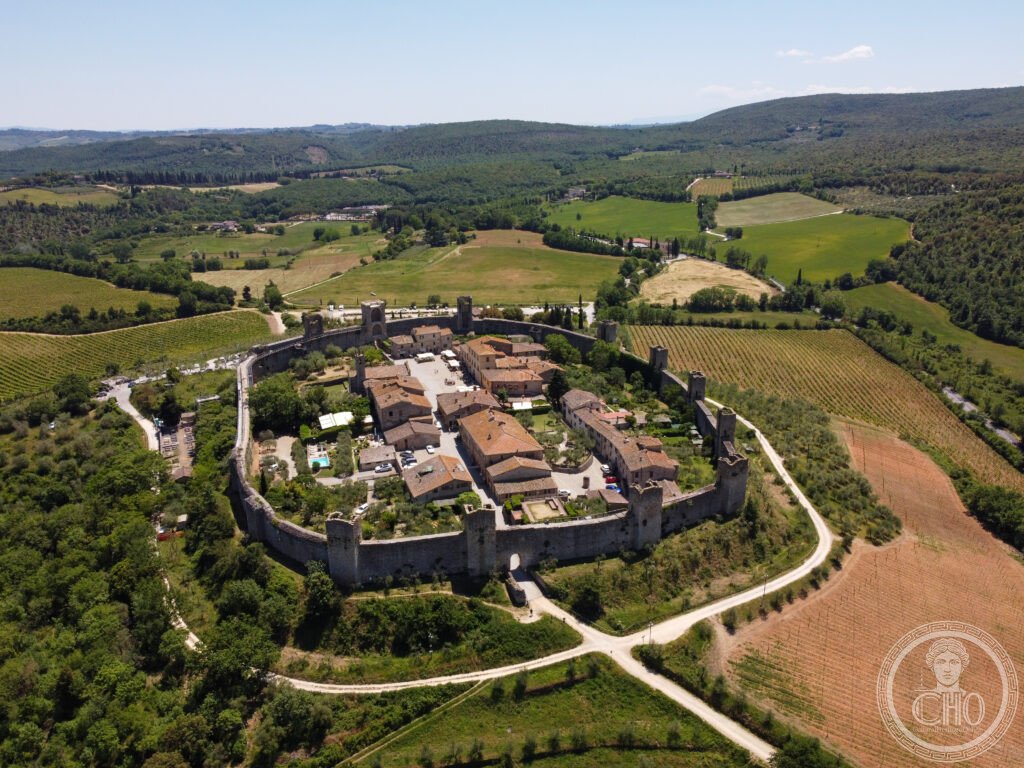
Monteriggioni is a small fortified hilltop town in the Val d’Elsa, approximately 15 kilometres north-west of Siena. It was built between 1214 and 1219 by the Republic of Siena as a military fortress and watchtower overlooking the road to Florence — the Via Cassia, which runs through the valley below. The plan is elliptical: the circuit wall follows the rim of the hilltop over a perimeter of approximately 570 metres, with fourteen towers at regular intervals. These towers — all circular at base, originally about 20 metres high, now reduced to between 14 and 18 metres — were so conspicuous that they became a cultural reference point within a generation of their construction: in 1306–1321, Dante used Monteriggioni in Canto XXXI of the Inferno to describe the sight of the giants guarding the ninth circle of Hell.
The village inside the walls — a single piazza (Piazza Roma), the Collegiate Church of Santa Maria Assunta, a few streets of medieval houses — has fewer than 300 permanent inhabitants and has changed relatively little since the fourteenth century. The combination of the perfectly preserved wall, the fourteen towers, and the rolling Tuscan landscape below makes Monteriggioni one of the most photographed hill towns in Italy.
Key facts
- Construction: 1214–1219; by the Republic of Siena; military fortress against Florence
- Circuit wall: ~570 m perimeter; elliptical; 14 towers (circular base, original height ~20 m)
- Dante reference: Inferno XXXI, 40–43: “Come Monteriggion di torri si corona / cosi la proda che il pozzo circunda / torreggiavan di mezza la persona / li orribili giganti…”
- Siena dominion: 1213–1555; ceded to Florence after the Siege of Siena (1555), when a Sienese garrison betrayed the fortress to Charles V of Spain
- Piazza Roma: the single piazza inside the walls; surrounded by medieval houses and the Collegiata di Santa Maria Assunta (12th century, restored)
- Museo di Monteriggioni: inside the walls; armour, medieval weapons, interactive exhibits on life in a medieval fort
- GPS: 43.3924, 11.2198 — Google Maps
History
Monteriggioni was built at a moment of high tension between the two great Tuscan communes — Siena and Florence — whose rivalry over territory, trade routes, and political influence had been escalating since the twelfth century. In 1214, the Sienese government ordered the construction of a fortified outpost on the hill overlooking the Via Cassia (the ancient Roman road connecting Siena and Florence), which was the main commercial artery between the two cities. The fortress was completed in 1219: a circuit wall with fourteen towers, a garrison, and a small residential settlement for the families of the soldiers.
The strategic importance of Monteriggioni was confirmed in 1260, when it served as a rallying point for the Sienese forces before the Battle of Montaperti — the greatest military victory of Siena over Florence, in which a Sienese-Ghibelline coalition led by Farinata degli Uberti defeated the Florentine Guelph army with catastrophic losses. Dante, who was a Florentine Guelph and a partisan of the losers of Montaperti, knew Monteriggioni as a symbol of Sienese military power; his use of it in the Inferno (written c. 1306–1321) reverses that symbolism by making it an image of the monstrous.
What you see
The best view of Monteriggioni is from the Via Cassia below, looking up at the hilltop: from the valley, all fourteen towers are visible on the skyline, giving the precise visual image that Dante describes in Canto XXXI of the Inferno. The approach from the valley road takes approximately 15 minutes on foot; from the car park at the base of the hill, a path leads up through olive groves to the main gate. There is only one main entrance to the village, the Porta Franca (or Porta Romana), facing east toward Siena.
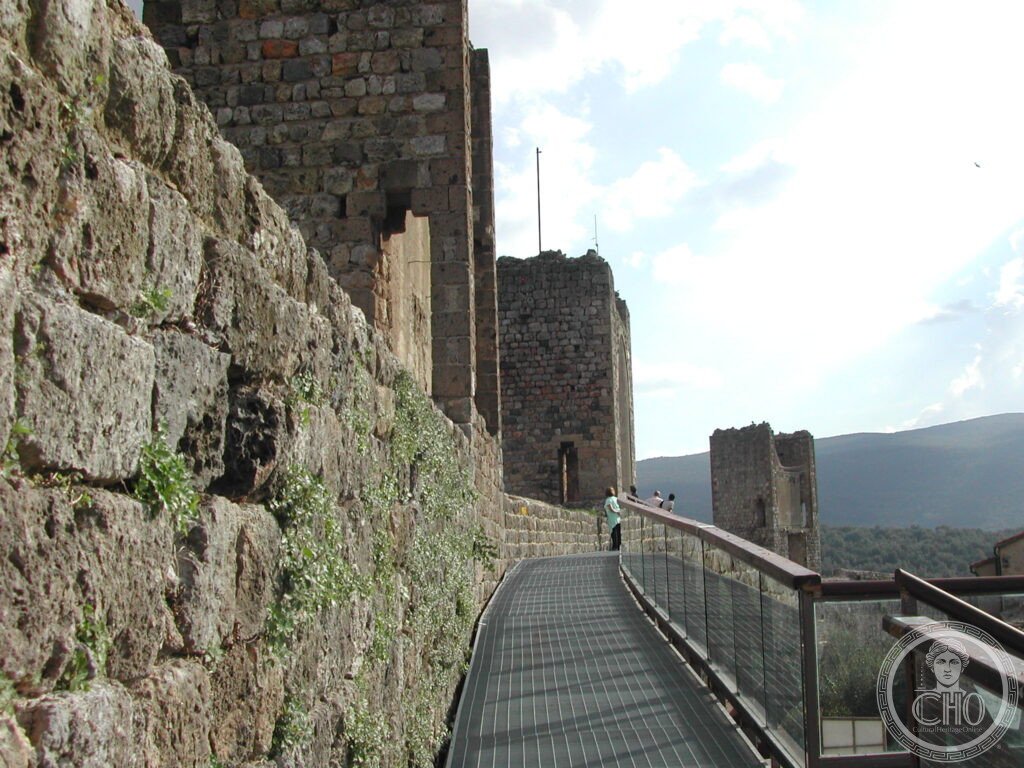
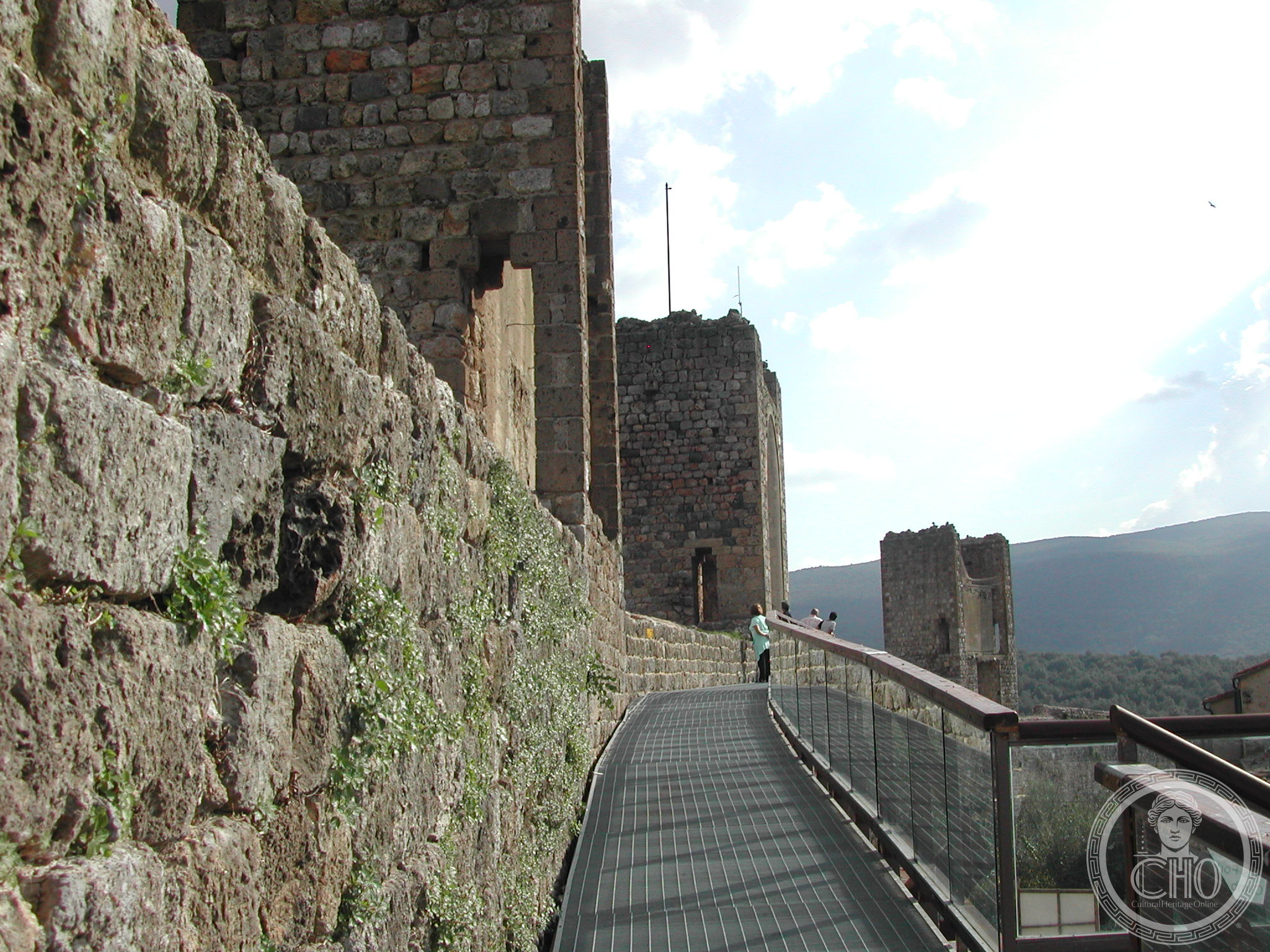
Inside the walls, the village is small enough to be walked in twenty minutes. The most interesting elements are the circuit wall itself — walkable in part along the base of the towers (a paved path goes around the inside of the entire perimeter) — and the Museo di Monteriggioni, which occupies the ground floor of the Collegiate Church and the adjacent tower. The museum has a good collection of medieval armour and weapons, and interactive recreations of daily life in a thirteenth-century military garrison. In July, the village hosts the Medievalis festival, in which the population dresses in medieval costume and the towers are lit at night.
Gallery
Practical information
- Village: Always open; free to enter. The walls and towers are visible from outside at all times.
- Museo di Monteriggioni: Open daily March–October 9:30–19:30; November–February 10:00–13:30 and 14:00–17:30. Admission ~€7.
- Tower visit: One tower (Torre 1) is open for climbing as part of the museum ticket; good view over the village and the Val d’Elsa.
- Visiting hours: The village is quiet on weekday mornings in spring and autumn; weekend afternoons in summer are crowded. The best light for photography of the circuit wall is in morning (east light on the towers) or late afternoon (golden hour).
- Parking: Car park at the base of the hill (paid); limited spaces inside the gate for disabled access.
Getting there
Monteriggioni, Siena, Toscana. 15 km north-west of Siena on the Via Cassia (SS2). By car from Siena: 20 minutes; by car from Florence: 55 minutes (A1 Certosa exit, then SS2 south); by car from San Gimignano: 20 minutes. By bus: Siena Mobilità bus line 130 from Siena station to Monteriggioni (30 minutes, approximately hourly on weekdays; reduced on weekends; check current timetables). No direct train service; nearest station is Siena. The village is 15 minutes on foot from the main road bus stop at the base of the hill. Note: the Via Cassia below Monteriggioni is part of the Via Francigena pilgrimage route (Canterbury to Rome); the village is a popular stop for walkers doing the Francigena on foot.
Nearby
- Siena — 15 km south-east; the Piazza del Campo and Duomo (UNESCO 1995); the Palio is run on the Campo on 2 July and 16 August each year; the Pinacoteca Nazionale has the finest collection of Sienese painting
- San Gimignano — 20 km north-west; 14 medieval towers (originally 72); UNESCO 1990; the Piazza della Cisterna and the Collegiata are the main monuments; the Vernaccia di San Gimignano DOCG is produced in the surrounding hills
- Colle di Val d’Elsa — 12 km north; a town divided into Colle Bassa (lower; medieval) and Colle Alta (upper; Renaissance); known for crystal manufacturing since the XIV century; the Ponte di Colle (13th century) crosses the Elsa river with a single arch of 23 metres
Sources
- Wikipedia EN: Monteriggioni
- Dante Alighieri: Divina Commedia, Inferno XXXI, 40–43 (c. 1306–1321)
- Waley, Daniel: Siena and the Sienese in the Thirteenth Century, Cambridge UP, 1991
- Balestracci, Duccio: “The Palio of Siena,” The Medieval History Journal 3.2 (2000)
Gallery
Find it on the map
See this place and what’s around it →📷 Become a Cultural Heritage Online photographer
Share your photos of places: they stay published under your name as the author. The more they're seen, the more you get noticed — and soon a contest will reward the most appreciated photos.
Log in or sign up free to add a photo