
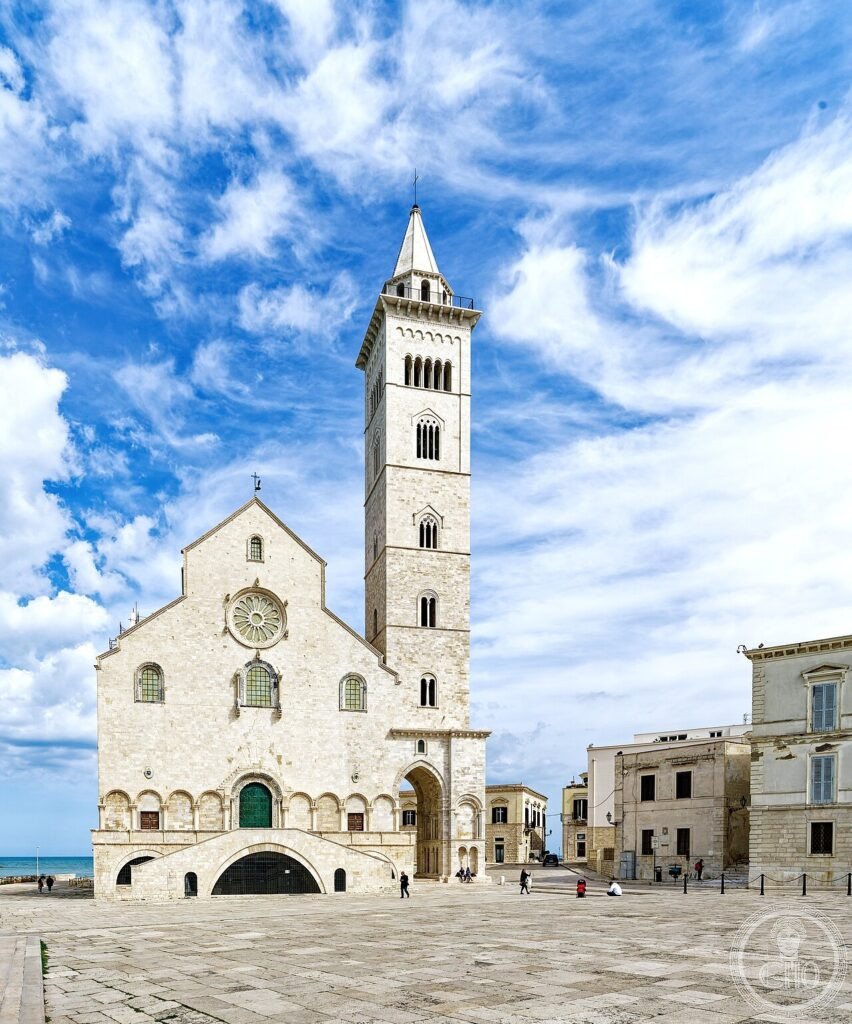
The most dramatically sited Romanesque cathedral in Italy — begun in 1099 by a bishop moved to action by the death of a Syrian pilgrim, Nicholas the Pilgrim, whose body is still in the crypt below — in pale golden Trani limestone, directly on the edge of the harbour, so that from the sea the building appears to rise from the water, its 59-metre bell tower reflected in the Adriatic.
At a glance
The Cattedrale di San Nicola Pellegrino (Cathedral of Saint Nicholas the Pilgrim) stands at the northern end of the port of Trani, in the Apulia region, where the harbour wall becomes the cathedral foundation and the building faces directly out to sea. It was begun in 1099, shortly after the death of Nicholas the Pilgrim — a Greek itinerant monk who had walked from Greece to Apulia crying “Kyrie eleison” and was believed by the local population to be a living saint; when he died at Trani in 1094, his miraculous reputation was such that the Bishop Bisanzio began construction of a cathedral dedicated to him, whose crypt would house his relics.
The cathedral is one of the masterpieces of the Apulian Romanesque — the distinctive regional style that developed in Puglia in the eleventh and twelfth centuries under Norman rule, combining Lombard structural traditions, Byzantine decorative elements (reflecting the Norman-Byzantine connections of the period), and the local golden-white calcarenite limestone into buildings of extraordinary solidity and elegance.
Key facts
- Foundation: 1099; patron Bishop Bisanzio of Trani; dedicated to Nicholas the Pilgrim (1099 death, 1099 canonisation)
- Completion: Nave and facade: XII century; bell tower: completed 1230 (height 59 m)
- Material: Trani limestone (calcarenite bianca); the same stone used for the sea walls and the entire historic centre; warm golden-white tone
- Style: Apulian Romanesque; blind arcading on facade and apses; leonine door jambs; carved portal
- Crypt: Most interesting interior space; four levels: hypogeum (burial level), crypt of San Leucio, crypt of Santa Maria della Scala, crypt of San Nicola Pellegrino (with the saint’s relics)
- Bell tower: 59 m; octagonal spire; begun with the nave; the final elements completed 1230
- Site: Directly on the port wall; visible from the sea from a distance of several kilometres
- GPS: 41.2774, 16.4152 — Google Maps
History
Nicholas the Pilgrim was a young Greek monk who arrived in Apulia in the early 1090s, travelling from place to place and crying “Kyrie eleison” (Lord have mercy) in Greek — an unusual form of itinerant devotion that attracted large crowds and generated suspicion among some ecclesiastical authorities. He died at Trani in 1094, aged approximately 19, and was canonised by Pope Urban II in 1098–1099 — one of the fastest canonisations in medieval history. The bishop of Trani, Bisanzio, immediately began construction of a cathedral that would contain the saint’s relics and attract pilgrims.
The timing of the construction coincided with the First Crusade (1096–1099), in which Trani played a significant role: the city was a major embarkation port for crusading armies travelling to the Holy Land, and the cathedral’s construction was partly financed by the fees and gifts of crusaders stopping at Trani. The Norman rulers of Apulia — who had conquered the region in the 1040s–1080s — were also patrons; the style of the building reflects the Norman preference for a massive, simple Romanesque structure adorned with Byzantine-influenced decorative details that was the signature of Norman patronage in both Sicily and southern Italy.
What you see
The approach from the port is the most powerful: the cathedral stands at the end of the northern breakwater, with no other buildings between it and the sea on three sides. The facade faces east (toward the harbour entrance), the north wall faces the open Adriatic, and the south wall looks into the old city. The golden-white calcarenite of the building is the same material as the sea walls, the harbour breakwaters, and the old city walls — the entire historic centre of Trani is built of this stone, giving the city an unusually uniform and luminous appearance.
The facade: a three-portal composition with the central portal the most elaborately carved. Two lions support the jambs of the central door; the arch above is decorated with carved vines, birds, and centaurs. The rose window above the central portal is a later addition (XIII century). The blind arcading that frames the facade is characteristic Apulian Romanesque; each blind arch is outlined in a slightly different shade of calcarenite, giving the facade a rich textural quality that is best seen in low-angle morning or evening light.
Inside, the cathedral is austere: three aisles divided by rows of reused ancient columns (many of which are Roman-period, brought from earlier buildings); the nave rises to approximately 12 metres; the apse has a semi-dome. The most interesting spaces are underground: the multilevel crypt system beneath the nave, where the four distinct levels (from the early Christian period to the Romanesque) are accessible and clearly distinguished.
Gallery
Practical information
- Cathedral: Open Monday–Saturday 9:00–12:00 and 15:30–19:00; Sunday 9:00–12:00 and 17:00–19:00. Free.
- Crypt: Accessible with the cathedral ticket; the four levels of the crypt are all open to visitors; bring a light if possible as some areas are dimly lit.
- Bell tower: Occasionally open for guided ascent (enquire locally); the view from the top is the best in Trani.
- Best time to visit: Morning in spring or autumn; the facade faces east and is at its most golden in early morning light. The promenade along the harbour to the cathedral is best in the evening.
- Duration: 45–60 minutes for the cathedral and crypt; add time for the harbour promenade (30 minutes).
Getting there
Piazza Duomo, Trani, Puglia. Trani is on the Adriatic coast, 43 km north-west of Bari. By train: Trenitalia main line Bari–Foggia–Naples; trains from Bari every 30–60 minutes (35 minutes); from Barletta 15 minutes. Trani station is 10 minutes on foot from the cathedral (via the historic centre). By car: A14 Bologna–Taranto, exit Andria or Barletta; follow the SS16 to Trani (15 minutes from the motorway exit). Parking: free parking along the southern harbour front; paid parking at Piazzale Europa. The cathedral is at the far north of the harbour promenade (500 metres from the main harbour front).
Nearby
- Castel del Monte — 30 km south-west; the UNESCO-inscribed octagonal castle of Frederick II of Hohenstaufen (1240–1250); eight towers, eight rooms per floor, mathematical proportions based on the number eight; the most enigmatic medieval building in Italy (UNESCO 1996 ref.398)
- Barletta — 10 km north-west; the only city in southern Italy with a standing late antique bronze colossus: the Colossus of Barletta (5 metres high, late 4th century CE, identity disputed) stands in the street outside the church of Santo Sepolcro
- Anfiteatro Romano di Canosa di Puglia — 20 km west; Roman amphitheatre and hypogea (second-century CE underground tombs with painted Daunian-style decoration); the Museo Nazionale Jatta in Ruvo di Puglia (20 km south) has the finest Apulian red-figure pottery collection in the world
Sources
- Wikipedia EN: Trani Cathedral
- Giorgi, Laura: Puglia romanica, Jaca Book, 1987
- Demus, Otto: The Church of San Marco in Venice, Dumbarton Oaks, 1960 (Byzantine influence in southern Italian Romanesque)
- Diocesi di Trani-Barletta-Bisceglie: diocesitrani.it
Find it on the map
See this place and what’s around it →
📷 Become a Cultural Heritage Online photographer
Share your photos of places: they stay published under your name as the author. The more they're seen, the more you get noticed — and soon a contest will reward the most appreciated photos.
Log in or sign up free to add a photoIs this page about you?
This page is read by travellers and heritage enthusiasts who find it on Google. Tell us how you are connected to this place and we will take it from there.