
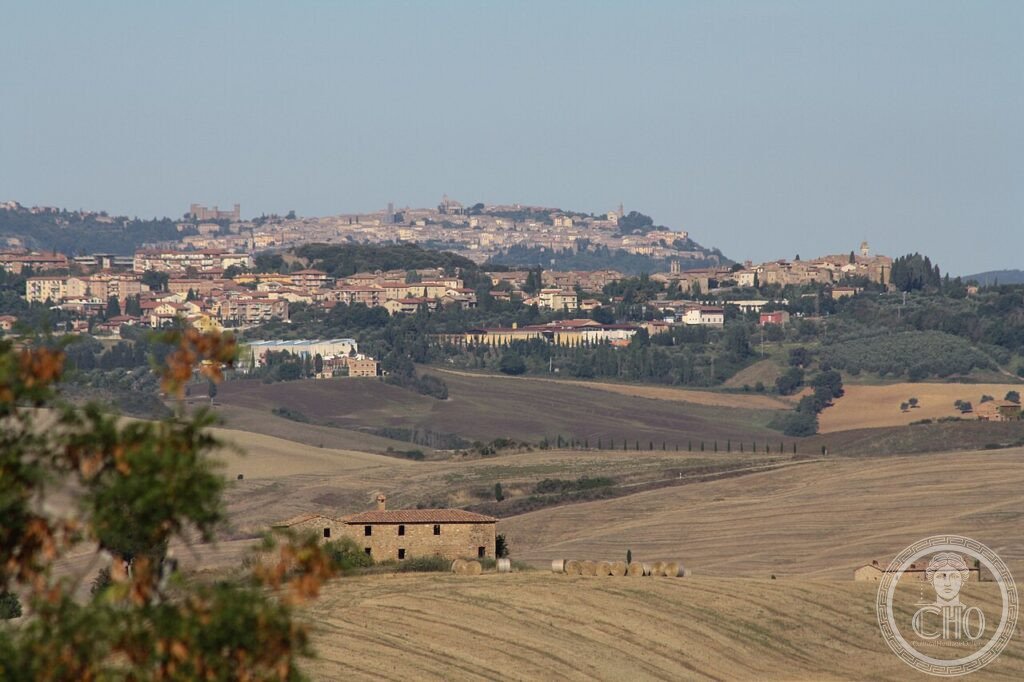
A hill town above the Val d’Orcia with a 1361 Sienese fortress and a 14th-century history as the last free Sienese republic (1555–1559), surrounded by vineyards that produce Brunello di Montalcino DOCG — first bottled commercially by Ferruccio Biondi Santi in 1888, now one of the most expensive and long-lived red wines in the world — in a landscape so extraordinary that it forms part of the UNESCO Val d’Orcia World Heritage Site.
At a glance
Montalcino is a hill town of approximately 5,000 inhabitants in the province of Siena, situated at 564 metres on a ridge between the valleys of the Orcia and Asso rivers, surrounded by a panorama of rolling Tuscan hills, cypress allées, and vineyards that produce one of Italy’s finest wines. The town is known internationally for two things: the Brunello di Montalcino DOCG (Italy’s most prestigious red wine denomination, produced from 100% Sangiovese Grosso in the territory around Montalcino) and the Fortezza (the 1361 Sienese fortress that dominates the town and provides the visual landmark of the area).
The landscape of the Val d’Orcia, which forms the valley below Montalcino to the south-west, is part of the UNESCO inscription “Val d’Orcia” (2004, ref. 1026), which recognises the Renaissance agricultural landscape managed by the Piccolomini popes (Pius II and Pius III) in the fifteenth century. Montalcino itself is not separately inscribed, but its territory forms part of the inscribed landscape.
Key facts
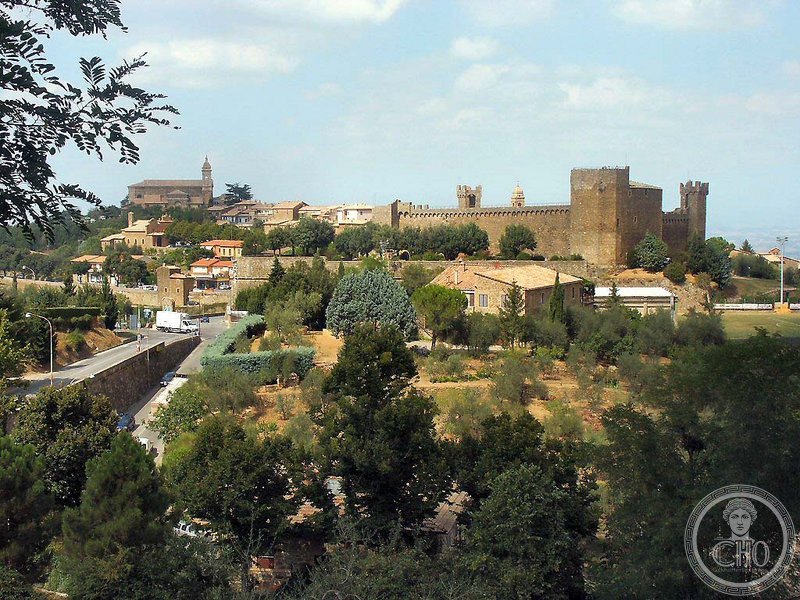
- Fortezza di Montalcino (Rocca): 1361; Sienese government; five-sided plan with circular corner towers; the last refuge of the free Sienese Republic (1555–1559)
- Last Republic of Siena: after the fall of Siena to Charles V (1555), a group of Sienese exiles held Montalcino as a free state in exile for four years (1555–1559); the episode is celebrated in the Palio of Montalcino, held annually on the last Sunday of October
- Brunello di Montalcino DOCG: 100% Sangiovese Grosso (local clone “Brunello”); first commercially bottled by Ferruccio Biondi Santi in 1888; DOCG status 1980; minimum 5 years aging (12 for Riserva); the 1955 and 1945 Biondi Santi vintages are among the most valuable wines in the world
- Rosso di Montalcino DOC: same territory and grape; 1 year aging; more accessible
- GPS: 43.0548, 11.4883 — Google Maps
History
Montalcino was a Sienese possession from the twelfth century; the fortress was built in 1361 as part of the Sienese defensive system against Florentine expansion. Its significance changed dramatically in 1555, when the Republic of Siena fell to the besieging forces of Charles V after the 14-month siege of the city itself. A group of Sienese patriots and Spanish exiles, led by Piero Strozzi, retreated to Montalcino and proclaimed the continuation of the Sienese Republic in exile — a political gesture that was part real resistance and part propaganda. The “Republic of Siena in Montalcino” lasted until 1559, when the Treaty of Cateau-Cambrésis settled the Italian political situation and Cosimo de’ Medici was ceded Siena and its territory by Spain; Montalcino was then incorporated into the Duchy of Tuscany under Medici rule.
The Brunello di Montalcino wine was the creation of Ferruccio Biondi Santi (1848–1917), who in the 1860s–1880s identified the specific genetic variant of Sangiovese grown in the Montalcino territory (which he called “Brunello”), and developed the long-aging technique that distinguishes the wine from other Sangiovese-based Tuscan reds. The first commercially labelled “Brunello di Montalcino” vintage was 1888. The wine remained obscure outside Tuscany until the 1960s–1970s, when the international wine market discovered it simultaneously with Barolo and Barbaresco as the alternative to Bordeaux for long-term cellaring.
What you see
The Fortezza dominates the southern end of the town: a five-sided Sienese fortress with five circular towers at the angles, still intact (without the residential additions of later centuries that obscure most Italian fortresses). The courtyard inside the walls houses an enoteca — the Enoteca Fortezza — where it is possible to taste wines from most of the major Brunello producers at the source, including library vintages that are not available elsewhere. The view from the fortress walls (accessible by climbing the rampart stairs, included in the enoteca entry) is one of the finest in Tuscany: the Val d’Orcia, Monte Amiata (1,738 metres, visible to the south-west), the Crete Senesi to the north-east, and the Maremma hills to the west.
The town itself is small (the historic centre is walkable in an hour) with a few significant buildings: the Logge del Palazzo dei Priori (XIV century), the Cathedral of San Salvatore (19th century neoclassical facade over a Romanesque core), and the Museo Civico e Diocesano d’Arte Sacra (Sienese paintings, 13th–16th century). The main street, Via Mazzini/Via Matteotti, has a high density of enotache, delicatessens, and Brunello sales points; Montalcino is a self-conscious wine tourism destination and the commercial infrastructure reflects this.
Gallery
Practical information
- Fortezza: Open daily April–October 9:00–20:00; November–March 10:00–18:00. Enoteca Fortezza on site; combination ticket for fortress visit and wine tasting ~€6; fortress-only ~€4.
- Wine tasting: The Enoteca Fortezza has an extensive list; major producers (Biondi Santi, Casanova di Neri, Poggio di Sotto, Il Poggione, Altesino) all have sales rooms in or near the town. Book producer visits in advance, especially during harvest (September–October).
- Museo Civico: Open Tuesday–Sunday 10:00–13:00 and 14:00–17:50 (summer until 17:50; winter until 17:20). Admission ~€4.
- Best season: Spring (April–June) for the landscape; autumn (September–November) for harvest and the Palio (last Sunday of October).
Getting there
Montalcino, Siena, Toscana. 40 km south of Siena; 110 km south of Florence; 160 km north of Rome. By car: from Siena follow the SR2 (Via Cassia) south to Buonconvento, then turn right on the SR2bis toward Montalcino (20 minutes from Buonconvento); or follow the SP45 direct from Siena (45 minutes total). From Rome: A1 north to Orte exit, then SS204/SS2 north via Acquapendente and Radicofani (2h30). No direct train service; nearest stations are Buonconvento (10 km, 1-2 buses per day to Montalcino) or Siena (40 km; better bus connections). TRA-IN buses from Siena to Montalcino several times daily (1h). Car is strongly recommended for exploring the wine estates in the surrounding territory.
Nearby
- Abbazia di Sant’Antimo — 10 km south; 12th-century Romanesque abbey in alabaster and travertine, in a valley below Monte Amiata; the Augustinian canons hold Gregorian chant services in the abbey church (09:30 and 18:30 daily); the alabaster stone changes colour from white in morning to gold at sunset
- Pienza — 20 km east; the first Renaissance ideal city, built by Pope Pius II Piccolomini (1459–1462) as a model of humanist urban planning; UNESCO 1996; famous also for Pecorino di Pienza cheese (aged in walnut leaves)
- Bagno Vignoni — 12 km east; a village built around a thermal pool (the “Piazza delle Sorgenti”): the central square is not a piazza but a rectangular thermal basin, used from Roman times, from which steam rises; famous from Tarkovsky’s film Nostalgia (1983)
Sources
- Wikipedia EN: Montalcino
- Wikipedia EN: Brunello di Montalcino
- Belfrage, Nicolas: Barolo to Valpolicella: The Wines of Northern Italy, Mitchell Beazley, 1999
- UNESCO Val d’Orcia: whc.unesco.org/en/list/1026
Gallery
Find it on the map
See this place and what’s around it →📷 Become a Cultural Heritage Online photographer
Share your photos of places: they stay published under your name as the author. The more they're seen, the more you get noticed — and soon a contest will reward the most appreciated photos.
Log in or sign up free to add a photo