
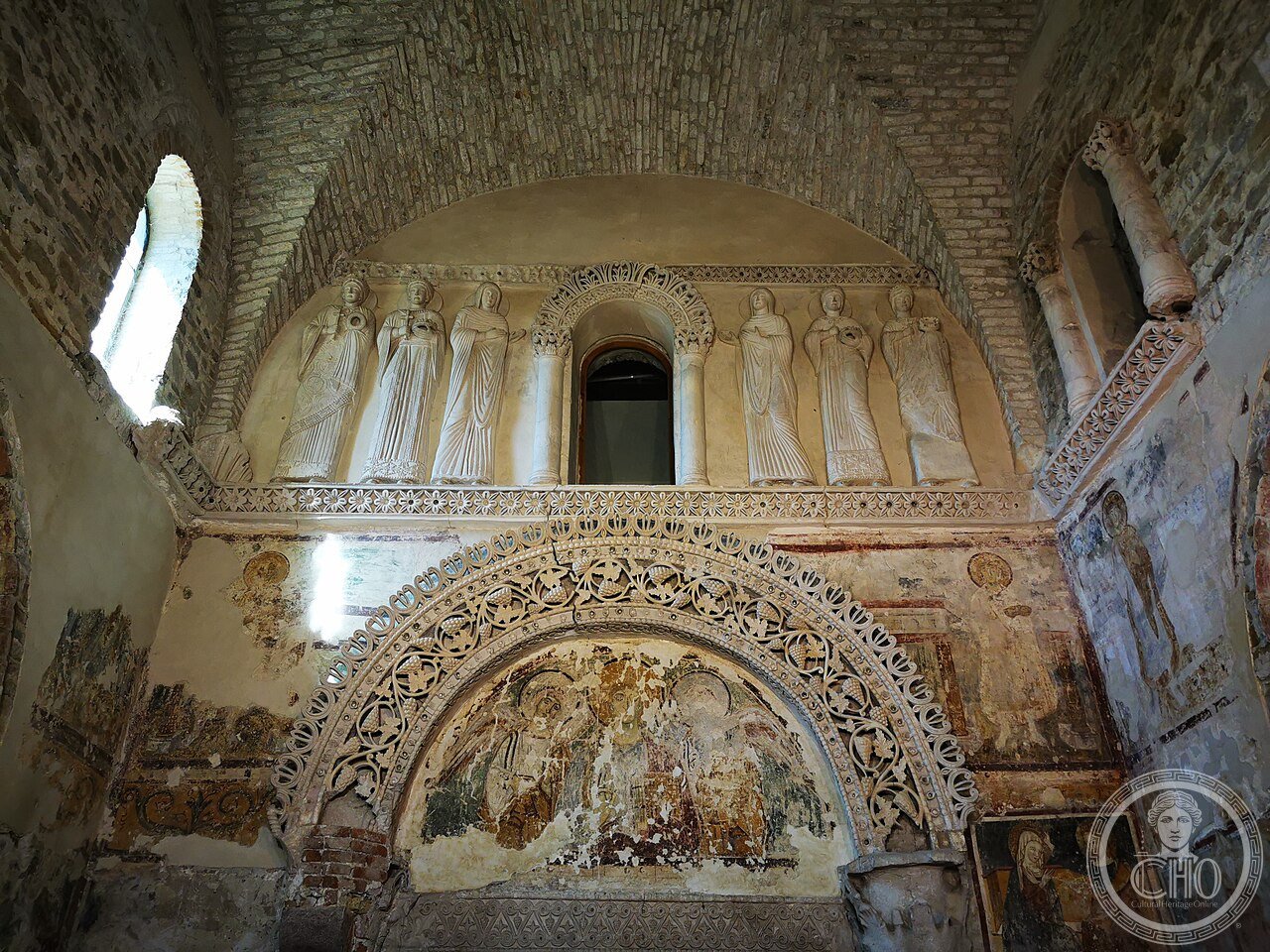
In the heart of Cividale del Friuli, once capital of the Longobard Duchy, a small oratory holds the best-preserved Longobard sculpture in Europe: six stuccoed female saints, known popularly as the Principesse, still gazing down from the west wall after nearly thirteen centuries.
At a glance
The Oratorio di Santa Maria in Valle, known as the Tempietto Longobardo, stands in the centre of Cividale del Friuli, the city the Longobards made capital of their Friulian duchy. Built around 736 CE, the small oratory measures about twelve metres by seven, its interior divided into three aisles by two rows of ancient columns reused from the Roman forum. The upper register of the west wall carries a stucco frieze of six standing female saints, popularly nicknamed the Principesse, above a band of interlaced vine scroll inhabited by birds and small animals, thought to be the oldest surviving example of this motif in stucco in Italy. Fragments of eighth-century fresco survive on the arch and in the apse, including a partial Majestas Domini and the symbols of the four Evangelists.
The Tempietto forms one component of the serial UNESCO World Heritage Site ‘Longobards in Italy, Places of Power’, inscribed in 2011 under reference 1312.
Key facts
- Type: early medieval oratory, Longobard period
- Official name: Oratorio di Santa Maria in Valle
- Date: built around 736 CE; a 2012 dendrochronological study by the Università di Udine dated the roof timbers to 729–742 CE
- Best known feature: six stucco female saints on the west wall, the ‘Principesse’
- Recognition: component of the UNESCO serial site ‘Longobards in Italy, Places of Power’, inscribed 2011
- Location: Via Monastero Maggiore 1, Cividale del Friuli
History
Cividale grew from Forum Iulii, a Roman market town said to have been founded under Julius Caesar around 52 BCE as a supply base for the Alpine frontier. Its Roman street grid survives in the modern city, with the old Cardo Maximus corresponding to today’s Via Carlo Alberto and the Roman forum lying beneath Piazza del Duomo.
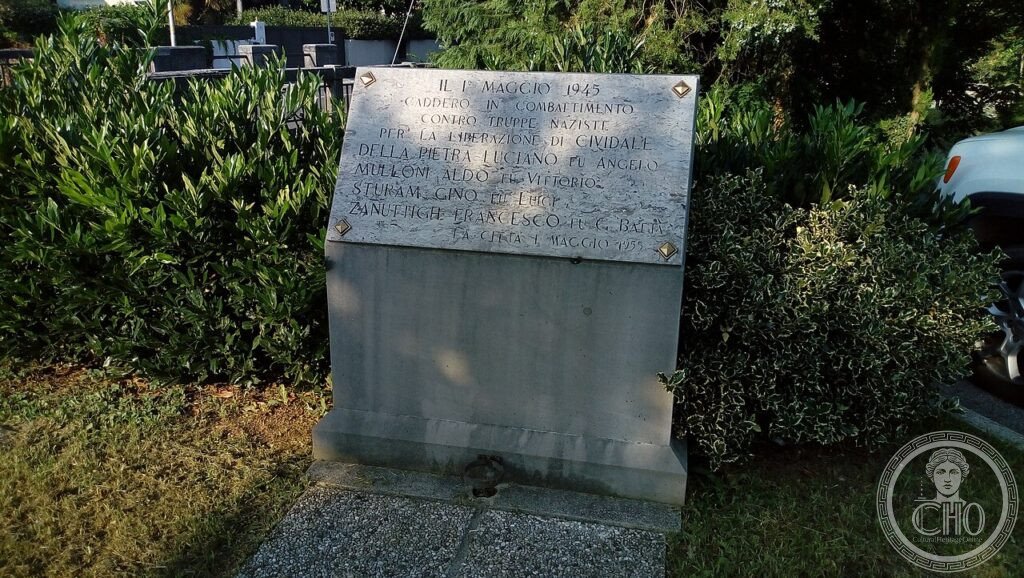
In 568 CE the Longobard king Alboin crossed the Alps and took Cividale, making it the seat of the first Longobard duchy in Italy under Duke Gisulf I. For over two centuries Forum Iulii served as the administrative centre of the Duchy of Friuli, the military command guarding the north-eastern frontier, until Charlemagne’s conquest of the Longobard kingdom in 774 CE. The Longobard cemetery excavated at Gallo di Zuglio, with its rich grave goods, is regarded as one of the most intact Longobard burial sites in Italy. After the Carolingian conquest, Cividale became the seat of the Patriarchate of Aquileia, a powerful ecclesiastical authority in the region for around a thousand years. In 2011 the Tempietto and Cividale’s other Longobard remains were inscribed by UNESCO as part of the serial site ‘Longobards in Italy, Places of Power’.
What you see
Inside the Tempietto, six columns support the three-aisled nave; four are reused Roman columns from the Forum Iulii, their capitals ranging from Byzantine to Longobard work. On the west wall, the six stucco saints stand frontal and haloed, each with a different hairstyle, plaited, loose or covered, thought to reflect differing conventions of female sanctity in the eighth century. Below them runs a band of interlaced vine scroll populated with small birds and animals. Traces of the original paint on the stuccoes have been detected under ultraviolet examination. Fragments of fresco survive on the arch and apse, including part of a Majestas Domini and the symbols of the four Evangelists, partly restored in the nineteenth century by the Austrian restorer Alois Knoll.
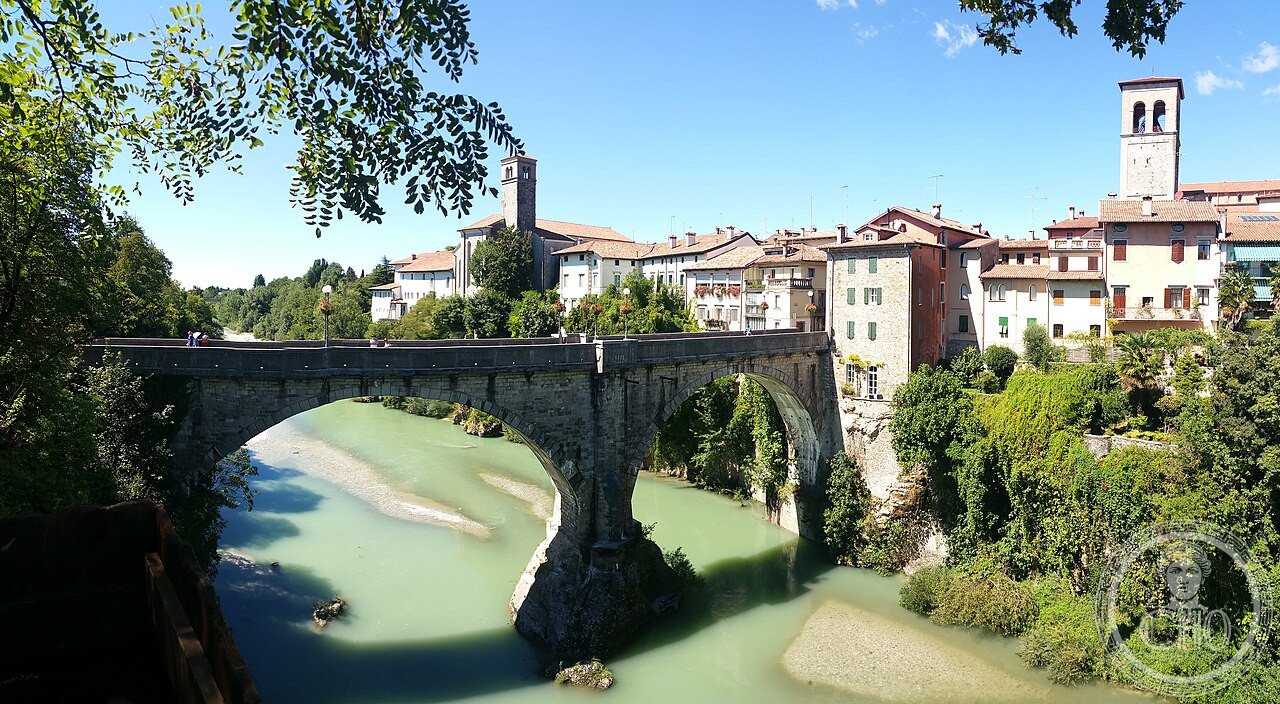
A short walk away, the Museo Archeologico Nazionale di Cividale holds the Altar of Ratchis, a marble altar commissioned by the Longobard duke Ratchis between 737 and 744 CE and carved on three sides with the Adoration of the Magi, Christ in Majesty with angels, and the Visitation. The museum also displays Longobard grave goods recovered from local burial sites. Nearby, the Ponte del Diavolo, a single-arch medieval bridge some twenty-two metres wide, crosses the Natisone gorge and offers views of the old town perched on the cliff above; local legend holds the bridge could only have been built with the devil’s help. Beneath the town, the so-called Celtic hypogeum, a rock-cut underground passage of debated purpose, can also be visited.
Practical information
- Tickets and hours: the Tempietto Longobardo and the Museo Archeologico Nazionale are ticketed separately; opening times vary by season, so check the official Cividale del Friuli or museum channels before visiting.
- Best light: the stucco figures on the west wall are lit by side windows, so morning visits generally give the clearest view.
- Combined visit: the Tempietto, the Museo Archeologico Nazionale, the Ponte del Diavolo and the Celtic hypogeum can comfortably be seen together in a single day.
Getting there
Cividale del Friuli is linked to Udine by the regional Ferrovie Udine-Cividale line, a separate operator from Trenitalia, so tickets should be bought specifically for this service. Udine in turn has rail connections to Trieste and to Milan; timetables and fares are best checked directly with the relevant rail operators before travelling.
Nearby
- Museo Archeologico Nazionale di Cividale — a short walk away, home to the Altar of Ratchis and Longobard grave goods.
- Ponte del Diavolo — the medieval bridge over the Natisone gorge, close to the historic centre.
- Celtic hypogeum — an underground rock-cut passage beneath the town, of debated original function.
- Gallo di Zuglio cemetery site — the Longobard burial ground whose finds are now held in the city’s archaeological museum.
Sources
- UNESCO
- Università di Udine
- Museo Archeologico Nazionale di Cividale
- Ferrovie Udine-Cividale (FUC)
Gallery
Find it on the map
See this place and what’s around it →📷 Become a Cultural Heritage Online photographer
Share your photos of places: they stay published under your name as the author. The more they're seen, the more you get noticed — and soon a contest will reward the most appreciated photos.
Log in or sign up free to add a photoIs this page about you?
This page is read by travellers and heritage enthusiasts who find it on Google. Tell us how you are connected to this place and we will take it from there.