
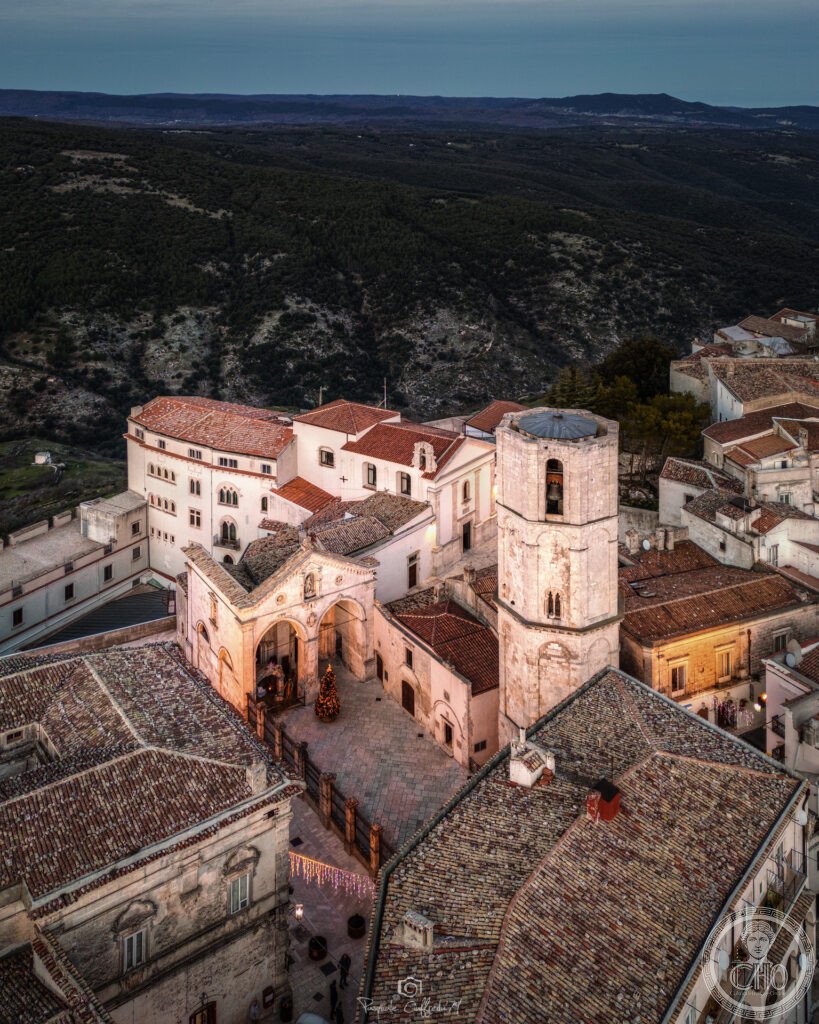
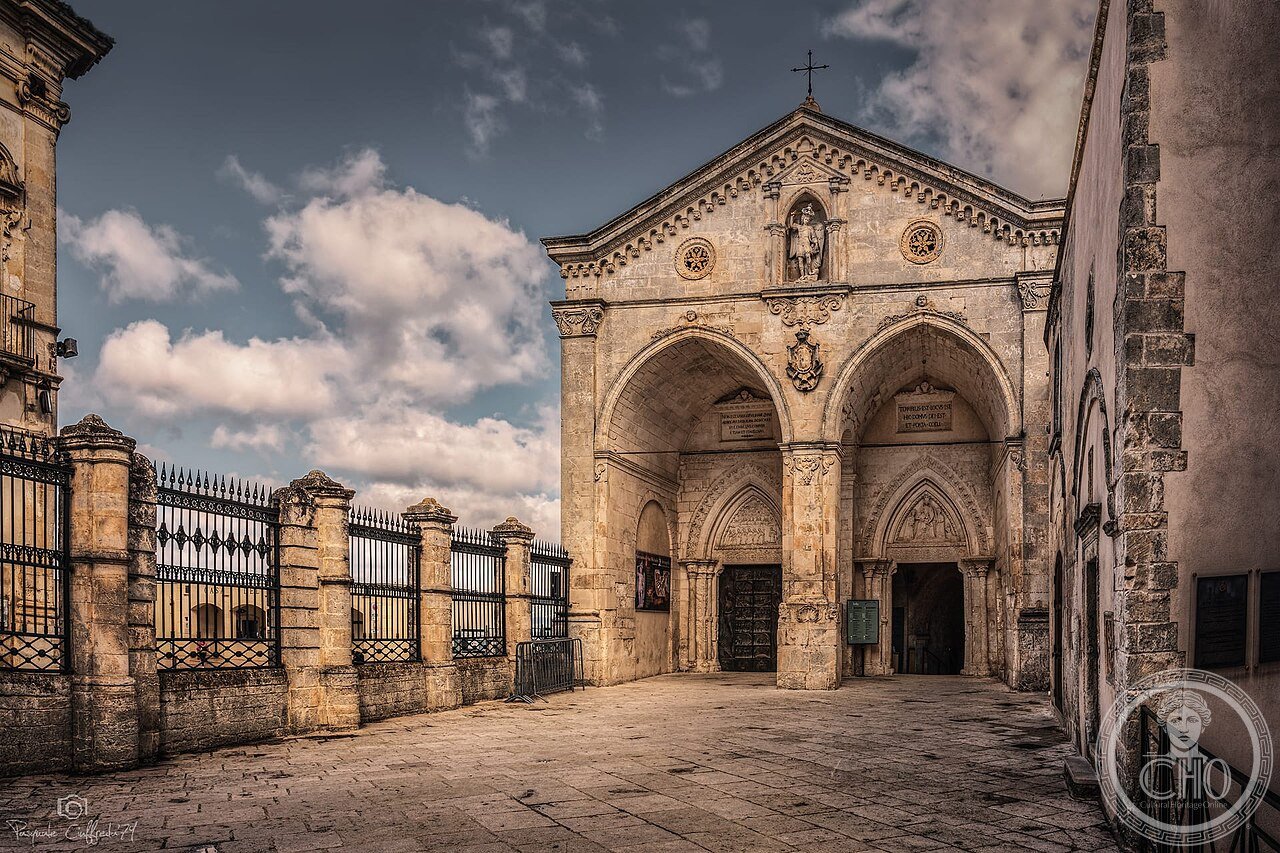
Cut into the white limestone of the Gargano, the Sanctuary of San Michele Arcangelo is built around a natural cave that tradition holds was never consecrated by a bishop, only by the Archangel Michael himself. Pilgrims have descended its worn stone steps since the early Middle Ages, past bronze doors cast in Constantinople in 1076.
At a glance
The Santuario di San Michele Arcangelo occupies a cave in the Gargano promontory where, according to tradition, the Archangel Michael appeared in 490 CE. The Lombards later adopted the site as the spiritual centre of their kingdom, and it became one of medieval Europe’s most frequented pilgrimage destinations alongside Rome and Santiago de Compostela. The sanctuary, listed under the UNESCO Longobards in Italy inscription of 2011 (reference 1312), sits at the heart of the historic town of Monte Sant’Angelo.
Key facts
- Location: Monte Sant’Angelo, Foggia province, Puglia, on the Gargano promontory.
- The cave: a natural grotto roughly 22 by 30 metres and 9 metres high, formed in Cretaceous limestone.
- The bronze doors: cast in Constantinople in 1076 CE, commissioned by the Amalfitan merchant Pantaleone di Mauro, with 24 panels showing the Apocalypse and the story of the apparitions.
- The bell tower: an octagonal Norman campanile associated with the same building tradition as Castel del Monte.
- Recognition: part of the UNESCO Longobards in Italy serial inscription, 2011, reference 1312.
History
Tradition places three apparitions of the Archangel Michael on Monte Gargano between 490 and 493 CE, with the Bishop of Siponto, Lorenzo Maiorano, as the central witness. The episodes are recorded in the Apparitio Sancti Michaelis in Monte Gargano, a Latin text thought to date from the seventh century, the oldest surviving copy of which is an eighth-century manuscript held in the Biblioteca Capitolare di Benevento. Because the cave was held to have been consecrated by divine intervention rather than by a bishop, it stands as the only basilica in Christendom never formally consecrated by human hand, a status later affirmed by a bull of Pope Gelasius I in 494 CE.
The Lombards took up the cult of Saint Michael as warrior patron of their military aristocracy. After the Lombard victory over a larger Byzantine force at Siponto in 663 CE, attributed to the Archangel’s intercession, the Duke of Benevento made the sanctuary the spiritual centre of the Lombard kingdom. Pilgrims travelled the Via Sacra Langobardorum from the Lombard capital at Pavia, a route that later merged with the southern Via Francigena. The Normans, under Robert Guiscard, took Monte Sant’Angelo from the Lombards in 1057 and continued the devotion, adding the bell tower. Crusaders bound for the Holy Land from the ports of Puglia are said to have stopped here to touch the bronze doors before embarking. The sanctuary was inscribed by UNESCO in 2011 as part of the Longobards in Italy serial site.
What you see
A forecourt above the cave entrance leads to the free-standing octagonal Norman bell tower, distinguishable by its restored upper storey. From there, a long flight of stone steps, worn concave by centuries of pilgrims, descends into the mountain to the mouth of the cave.
At the foot of the steps stand the bronze doors of 1076, their 24 panels arranged in two wings: one showing scenes from the Book of Revelation, the other episodes from the history of the sanctuary and the apparitions, including the Battle of Siponto. A donor inscription names Pantaleone di Mauro, who commissioned the same Byzantine workshops responsible for bronze doors at Amalfi, Rome’s San Paolo fuori le Mura and Atrani. Inside the cave, an altar marks a depression in the rock traditionally read as the Archangel’s footprint, enclosed by a bronze railing, and fragments of an eleventh-century Byzantine fresco, including a Deësis, survive on the walls.
A short walk from the sanctuary stands the so-called Tomba di Rotari, in fact a twelfth-century octagonal baptistery wrongly associated with the Lombard king Rotari, who died long before it was built. Its Romanesque portal is carved with two lions devouring human figures, a recurring motif in the Romanesque architecture of Puglia.
Practical information
- Access: the sanctuary and the Tomba di Rotari are open to visitors; check current access arrangements through the sanctuary’s own channels before travelling.
- On foot: the descent to the cave involves a long flight of stone steps, uneven from centuries of wear.
- Combining sites: a car is the practical way to link Monte Sant’Angelo with other Gargano sites such as the Foresta Umbra.
Getting there
Monte Sant’Angelo lies on the Gargano promontory above Manfredonia. Public transport connects the town with Foggia and, via Manfredonia, with Bari, using SITA SUD buses and Trenitalia services; timetables and fares are best checked directly with SITA SUD before travelling. Drivers reach the town via the road that climbs from Foggia through Manfredonia into the Gargano hills.
Nearby
- Tomba di Rotari — a short walk from the sanctuary, a twelfth-century octagonal baptistery with a Romanesque lion portal.
- Manfredonia — the historic harbour town below the Gargano, near the site of ancient Siponto and its battle of 663 CE.
- Foresta Umbra — an ancient forest in the Gargano interior, reachable by car from Monte Sant’Angelo.
Sources
- UNESCO
- Apparitio Sancti Michaelis in Monte Gargano
- Biblioteca Capitolare di Benevento
- SITA SUD
Gallery
Find it on the map
See this place and what’s around it →📷 Become a Cultural Heritage Online photographer
Share your photos of places: they stay published under your name as the author. The more they're seen, the more you get noticed — and soon a contest will reward the most appreciated photos.
Log in or sign up free to add a photoIs this page about you?
This page is read by travellers and heritage enthusiasts who find it on Google. Tell us how you are connected to this place and we will take it from there.