
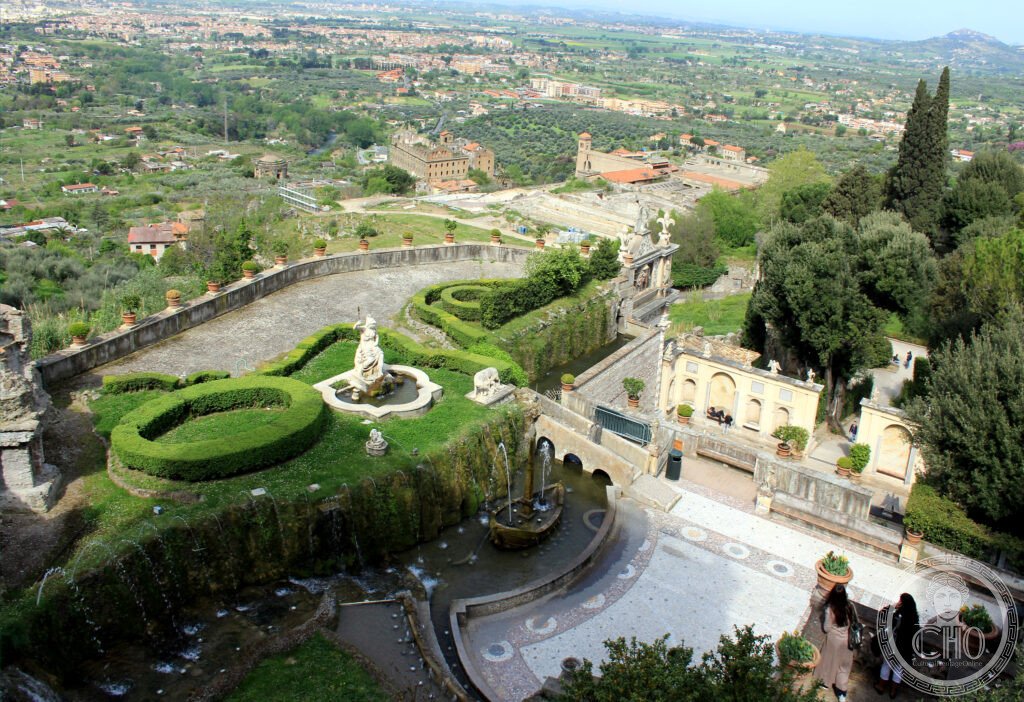
Villa d’Este
La Villa d’Este di Tivoli (UNESCO 2001, rif. 1025) è il prototipo del giardino italiano — 500 fontane disposte su terrazze scoscese, tutte alimentate senza pompe dal fiume Aniene tramite un acquedotto sotterraneo e un sistema di pressioni idrostatiche, e il modello per ogni giardino formale europeo dalla Fontainebleau di Versailles a Vaux-le-Vicomte.
At a glance
Villa d’Este Tivoli Lazio (the most precisely Villa d’Este zone Tivoli Lazio Italy 41.9631 N 12.7961 E UNESCO WHS 2001 reference 1025 Villa d’Este, Tivoli: the site (the villa and garden: the site area: 4.5 ha; the garden (the terraced slope: the slope grade: 28% (from the upper terrace to the lower garden: 36 m elevation change over 130 m horizontal distance); the 500 fountains (the water supply: the Aniene river water supply (the Aniene: the tributary of the Tiber that passes through Tivoli; the Canale Emissario (the emissary channel): a 500 m tunnel bored through the tufa rock of the Tivoli hill by Pirro Ligorio in 1560–1562 CE to divert Aniene water into the villa garden; the channel delivers 300 litres/second to the upper cistern (the “Meta Sudante” cistern: 300 m³ capacity at the top of the garden); the pressure (the cistern at +36 m above the lower garden generates 3.5 bar water pressure at the lowest fountain level: sufficient to feed all 500 fountains and jets without any pump)); the fountains (the main fountains: (1) the Fontana dell’Ovato (the “oval fountain”: the largest fountain in the garden; 18 m wide; 10 m high; the central figure: the nymph Albunea (the Sibyl of Tivoli) standing in the water jet; the 2 flanking rivers (the Aniene and the Ercolano) as reclining male figures; the 12 water jets that form a screen of water around the oval basin); (2) the Fontana dei Cento Cannoni (the “Hundred Cannons”: 100 water jets directed diagonally downward into the main basin from 100 spouts in the shape of eagle heads (the d’Este eagle): the most powerful fountain in the garden; the water hits the basin at 45° angle producing a roar audible 200 m away); (3) the Fontana dell’Organo Idraulico (the “Water Organ Fountain”: the world’s first hydraulic organ (the original machine (1568 CE): designed by Luc Besson (the French engineer, not the film director): water pressure forced air through organ pipes to produce music automatically; the original mechanism destroyed; the current functioning replica (1927 CE): a 2-register hydraulic organ that plays 4 pieces automatically every 2 hours)); (4) the Fontana di Nettuno (the largest water theatre in Italy: the full width of the garden at the lower level: 38 jets + 2 lateral waterfalls).
Key facts
- L’Organo Idraulico della Villa d’Este (1568 CE): il primo organo meccanico azionato dall’acqua e come Luc Besson (non il regista) lo ha progettato usando la pressione idrostatica come soffiante: the Water Organ (the Fontana dell’Organo: the world’s first automatic hydraulic organ (the instrument: built 1568 CE by the French hydraulic engineer Luc Besson (not the film director: 16th-century Luc Besson: c.1522–c.1600 CE; author of “Theatre des instrumens mathematiques et mechaniques” (Lyon, 1578 CE): the reference text on 16th-century hydraulic engineering in France); the mechanism (the original mechanism: the water from the upper cistern falls into a pneumatic chamber (the “aeolipile”: an enclosed chamber with no outlet except through the organ pipes); the falling water compresses the air in the chamber above it; the compressed air forces its way through the organ pipes (the pipes: 16 stops; 80 pipes; the scale: one octave of the C major scale; the pieces played: 4 pieces of 3–4 minutes each; automatic cycling every 2 hours); the 16th century CE water organs in Europe (the Villa d’Este organ was the first and was immediately copied: the Medici villa at Pratolino (1579 CE; lost); the Hellbrunn Palace near Salzburg (1615 CE; still functioning: the oldest continuously operating hydraulic musical instrument in the world))); the Liszt connection (Franz Liszt (1811–1886 CE) stayed at the Villa d’Este as the guest of Cardinal Hohenlohe for several months in 1867, 1869, 1877, and 1882 CE: he composed 2 pieces titled “Aux Cyprès de la Villa d’Este” (1877 CE: “Thénodie I” and “Thénodie II”: elegy for the dying cypresses of the garden; Liszt described the cypresses of the villa as “the most melancholy cypresses I know”) and the famous “Jeux d’eau à la Villa d’Este” (1877 CE: the evocation of the fountains that preceded Ravel’s “Jeux d’eau” (1901 CE) and Debussy’s “Reflets dans l’eau” (1905 CE) and directly influenced both))
- GPS (ingresso Villa d’Este, Piazza Trento, Tivoli): 41.9631° N, 12.7961° E
History
Da Ippolito II d’Este 1550 CE al UNESCO 2001 (the most precisely Villa d’Este zone history: the commission (Cardinal Ippolito II d’Este (1509–1572 CE): the son of Alfonso I d’Este Duke of Ferrara and Lucrezia Borgia (the daughter of Pope Alexander VI); appointed Governor of Tivoli by Pope Julius III in 1549 CE; the motivation for the garden: the political frustration (the Cardinal had been three times the runner-up in papal elections and was never elected Pope; the Villa d’Este was his consolation project: a statement of cultural supremacy to compensate for political failure); the architect (Pirro Ligorio (c.1512–1583 CE): the Neapolitan architect and antiquarian; appointed as the Cardinal’s personal architect in 1549 CE; the design source: Ligorio based the terrace-and-fountain garden layout on his own excavations at the Villa Adriana (3 km from Tivoli: the Roman villa of Emperor Hadrian, UNESCO 1999); the influence (the Villa d’Este influence on European garden design: (1) the French formal garden: André Le Nôtre (1613–1700 CE) visited the Villa d’Este in 1678 CE on his Italian tour: his design for Versailles (the gardens: 1662–1700 CE) uses the same east-west axial system with transversal allées; (2) the English landscape garden: the reaction AGAINST the Villa d’Este model (Horace Walpole wrote in “The History of the Modern Taste in Gardening” (1771 CE): “The gardens of Italy are the most formal, the most stiff, the most pedantic, the most constrained that nature can be tortured into”: the Villa d’Este was the target of this critique)); the UNESCO inscription (2001 CE: reference 1025).
What you see
Fontana Ovato, Cento Cannoni, Organo Idraulico, Viale delle Cento Fontane (the most precisely Villa d’Este zone visit (2–3 hours): the ticket (€10; daily 8:30 to 1 hour before sunset (summer closing 18:30; winter 15:30); the visit sequence: enter via the loggia (the upper loggia: the frescoed hall directly accessible from Piazza Trento: the frescoes (by Livio Agresti and assistants, 1565–1572 CE): the cycle of the Hesperides and the myth of Hercules and the apples of the garden of the Hesperides (the allegorical connection: the d’Este family crest = the eagle + the lily; Hercules = the d’Este ancestor in the family genealogy)); go down the left staircase → the Fontana dell’Organo (the Water Organ: the demonstrations every 2 hours: 10:00, 12:00, 14:00, 16:00, 18:00 in summer; the 3 minutes of automatic play are worth timing the visit around) → the Fontana di Nettuno (the lower water theatre: 38 jets + 2 lateral waterfalls; the best view from the upper balcony looking down) → the Viale delle Cento Fontane (the “Hundred Fountains Alley”: 100 water jets along a 130 m path; the nymphs in terracotta + the d’Este eagles + the obelisks: the decorative program designed by Ligorio as an allegory of the rivers of the world) → the Fontana dell’Ovato (the end of the alley: the largest fountain; the Sibyl nymph; the 12 jets; the benches for sitting in the spray); the Rometta (the “little Rome”: the miniature Rome in the garden: a sculptural group representing the Tiber, the wolf, the Castor and Pollux, a model of the Septizonium: built 1567–1570 CE); the cypresses (the cypress trees of the villa: some of the original trees planted by Pirro Ligorio in 1565 CE have been identified by dendrochronology (the tree-ring analysis): the oldest surviving cypress in the villa dates to c.1573 CE: 450+ years old).
Practical information
- Come combinare Villa d’Este e Villa Adriana in un giorno da Roma, e perché l’ordine giusto è Villa Adriana al mattino e Villa d’Este al pomeriggio: il trasporto (Roma Tiburtina → Tivoli: COTRAL bus (50 min; €2.40; partenze ogni 30 min da Via Tiburtina di fronte alla stazione metro B; il bus arriva alla stazione di Tivoli (400 m dalla Villa Adriana) e poi continua fino al centro di Tivoli (200 m dalla Villa d’Este)); il percorso ottimale (mattina 9:00: scendere alla fermata “Villa Adriana” (dopo 40 min di bus) → Villa Adriana (3h: €12; la Villa Adriana è molto grande (120 ettari) e richiede scarpe comode; le zone da non perdere: il Canopo (lo specchio d’acqua egizio) + il Pecile (il grande giardino-portico) + la “Piazza d’Oro” (la sala eptagonale con l’abside)); pranzo a Tivoli centro (20 min in bus o taxi €10); pomeriggio 13:30: Villa d’Este (2h30); partenza 16:00 per Roma (bus COTRAL 50 min; arrivo Roma 16:50)); il periodo migliore (aprile-maggio: le fontane più abbondanti (piena primavera + piene del Aniene); le Fontane in funzione (verificare il calendario annuale sul sito villadestetivoli.info perché la Fontana dei Cento Cannoni può essere temporaneamente chiusa per restauro))
Getting there
COTRAL bus da Roma Tiburtina (50 min, €2.40, ogni 30 min). GPS: 41.9631/12.7961. €10. 8:30–tramonto. Organo Idraulico ogni 2h.
Nearby
- Villa Adriana Tivoli (UNESCO 1999 rif. 907 — Canopo + Pecile + Piazza d’Oro) — 3 km (bus COTRAL 10 min; €12; la villa dell’Imperatore Adriano 118–134 CE; 120 ha; la fonte di ispirazione di Pirro Ligorio per la Villa d’Este)
- Subiaco (Monastero di San Benedetto + Monastero di Santa Scolastica — VI sec. CE) — 35 km (COTRAL 1h; il monastero dove Benedetto di Norcia (480–547 CE) fondò la prima comunità monastica benedettina c.500 CE; il Sacro Speco (la grotta del giovane Benedetto nel Monte Taleo); il chiostro cosmatesco 1053 CE)
Gallery


Sources
- Wikipedia, Villa d’Este; Pirro Ligorio; Luc Besson (engineer); Ippolito II d’Este, accessed June 2026
- UNESCO, Villa d’Este, Tivoli, WHS reference 1025, inscribed 2001
- Besson, Luc. Theatre des instrumens mathematiques et mechaniques. Lyon, 1578 CE (the Water Organ mechanism description)
Find it on the map
See this place and what’s around it →📷 Diventa un fotografo di Cultural Heritage Online
Condividi le tue foto dei luoghi: restano pubblicate con la tua firma come autore. Più vengono viste, più ti fai conoscere — e presto un concorso premierà le foto più apprezzate.
Accedi o registrati gratis per aggiungere una foto