
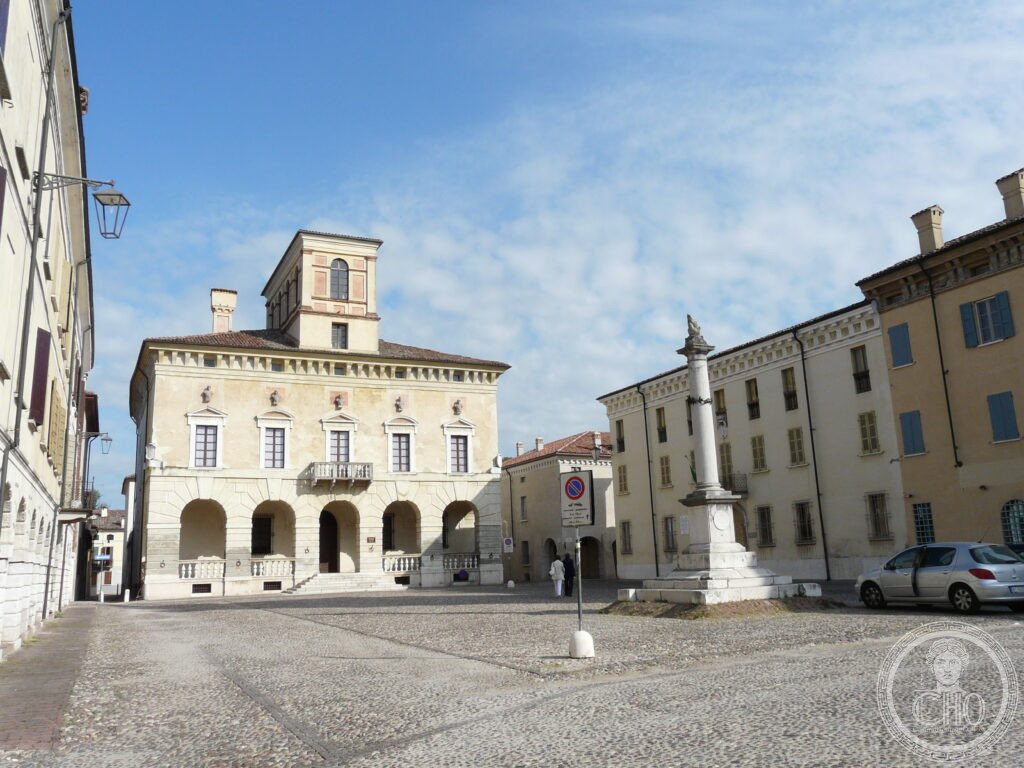
Sabbioneta was built from nothing on a Po plain field between 1556 and 1589, the personal project of a Renaissance condottiero who wanted his own miniature Rome. Its hexagonal walls, ducal palace and Scamozzi’s theatre survive largely as he left them.
At a glance
Sabbioneta is a walled Renaissance town near Mantua, laid out as a complete ideal city rather than grown organically over centuries. It is counted among a small group of planned Italian cities from the period, alongside Pienza, the Herculean addition to Ferrara, Palmanova and Grammichele, and is generally described as the most intact of them.
The town was designed in its entirety by Vespasiano Gonzaga Colonna, a Spanish-trained military commander who chose to build a city instead of continuing a career of arms. Its hexagonal circuit of walls and bastions, its arcaded main square and its theatre by Vincenzo Scamozzi all date from a single, closely documented building campaign.
Key facts
- Founder: Vespasiano Gonzaga Colonna (1531–1591)
- Built: 1556–1589
- Plan: a regular hexagon of walls, roughly 1.2 km in circumference, with six corner bastions
- Key building: the Teatro all’Antica by Vincenzo Scamozzi, commissioned in 1588 and completed in 1590, described as the oldest surviving purpose-built covered theatre still standing in its original location
- Recognition: inscribed on the UNESCO World Heritage List in 2008 jointly with Mantua, reference 1287
History
Vespasiano Gonzaga Colonna began building Sabbioneta in 1556 on the site of an older village, whose name in Lombard dialect referred to the sandy soil of the area. The old village church was demolished in 1558 and the first stone of the new Palazzo Ducale was laid in September 1559, with a Latin oration delivered at the ceremony by the court humanist Aldo Manuzio the Younger, grandson of the Venetian printer Aldus Manutius.
Vespasiano had trained as a military engineer in Spanish academies and served the Habsburgs in Flanders, meeting Philip II in Brussels in 1561. That experience shaped Sabbioneta’s defences: the hexagonal, bastioned circuit of walls follows the Italian fortress design that had spread to the Low Countries and returned to Italy as a fully developed system. He described his ambition, in a letter to Philip II, as building a second Rome in miniature, compressing a theatre, a forum, a gymnasium, a mint, a library and a university into a small walled polygon.
Vespasiano died in March 1591 without a male heir, and Sabbioneta passed through a succession of Gonzaga cadet branches before coming under Habsburg and then Austrian control until 1866. Its decline was slow rather than dramatic, and the town’s population has changed little in the centuries since. It was inscribed on the UNESCO World Heritage List in 2008 together with Mantua.
What you see
The whole town can be explored on foot within its walls. The Piazza d’Armi is the main square, a rectangle lined with porticoed houses on three sides, all built to a uniform arcaded facade under a rule that obliged every owner along the square to conform, an early instance of enforced architectural uniformity. The fourth side is closed by the facade of the Palazzo Ducale, completed in 1568, with a row of arched windows and a distinctive double window above the portal that marked the residences of the Gonzaga cadet branch. Inside, the Sala degli Imperatori holds sixteenth-century sandstone busts of Roman emperors in wall niches; the original antique busts were removed to Mantua in the eighteenth century.
The Teatro all’Antica stands nearby, a two-hundred-and-fifty-seat theatre with a gilded wooden ceiling painted with gold stars on blue, and a stage backdrop showing a street in forced perspective. The present painted canvas dates from 1688, replacing Scamozzi’s original. The Galleria degli Antichi is a long gallery, ninety-seven metres in length, built to display Vespasiano’s collection of antique sculpture, since moved to Mantua; today it houses casts and temporary exhibitions. Outside the walls, the hexagonal fortifications and their corner bastions can still be traced, with one bastion accessible by an external staircase giving views over the surrounding plain.
Practical information
- Visiting the monuments: the Palazzo Ducale, Teatro all’Antica, Galleria degli Antichi and other sites can be visited individually or on a combined ticket; check the official museum circuit for current admission arrangements.
- Combining with Mantua: Sabbioneta and Mantua share the same UNESCO listing and are often visited together in a single day.
- On foot: the walled town is compact and best explored on foot; the full perimeter of the walls can be walked in a short time.
Getting there
Sabbioneta lies close to Mantua and can be reached from there by local bus or by car; it is also within reach of Cremona. Timetables and routes are best checked with the local transport operator before travelling.
Nearby
- Mantua — a short journey away, sharing the same UNESCO inscription and home to the Palazzo Ducale di Mantova, where several of Sabbioneta’s original antique sculptures and busts were taken.
- Cremona — a nearby city often combined with a visit to Sabbioneta.
Sources
- UNESCO
Find it on the map
See this place and what’s around it →📷 Become a Cultural Heritage Online photographer
Share your photos of places: they stay published under your name as the author. The more they're seen, the more you get noticed — and soon a contest will reward the most appreciated photos.
Log in or sign up free to add a photo