
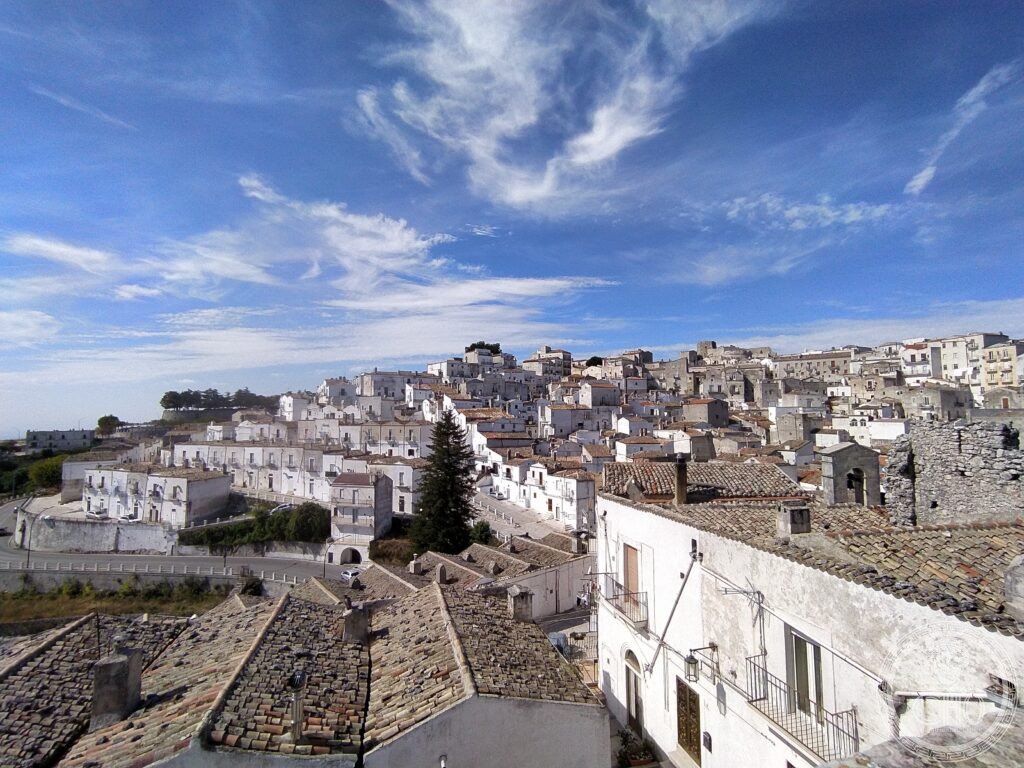
Carved into the white limestone of the Gargano promontory, this is held to be the oldest sanctuary dedicated to the Archangel Michael in the West. Its cave, reached down a rock-cut stair, still holds Byzantine bronze doors made in Constantinople in 1076 and a marble statue of the Archangel venerated for centuries by pilgrims, Crusaders and Lombard kings alike.
At a glance
The Sanctuary of San Michele Arcangelo lies at the southern edge of Monte Sant’Angelo’s old town, on the Gargano promontory that juts into the Adriatic. According to tradition the site was founded around 490 CE after the Archangel Michael appeared three times to Lorenzo Maiorano, Bishop of Siponto, consecrating the cave below the town as his shrine. The sanctuary later became a stop on the Via Sacra Langobardorum, the Lombard pilgrimage route linking Pavia to Rome, and it is inscribed on the UNESCO World Heritage List as part of the serial site “Longobards in Italy: Places of Power”, reference 1318, listed in 2011.
Key facts
- Bronze doors: two leaves cast in Constantinople in 1076, with 24 silver-inlaid bronze panels each, 48 in total, depicting Old and New Testament scenes and the Gargano apparitions.
- Commission: the doors were ordered by Pantaleone di Mauro Comite, a wealthy Amalfitan merchant, the same patron behind the bronze doors of Amalfi Cathedral and the Basilica of St Paul Outside the Walls in Rome.
- Campanile: an Angevin bell tower around 24 metres high, begun under Norman patronage and completed under Charles II of Anjou, topped by an octagonal spire of white Gargano limestone.
- The cave: a grotto roughly 35 by 22 metres with a 15-metre ceiling, holding a 15th-century marble statue of the Archangel said to be of Carrara stone.
- Building stone: a pale Cretaceous limestone quarried locally, the same material used for the rock-cut churches scattered across the Gargano.
History
Before the Christian cult took hold, the cave on Monte Gargano seems to have served as an oracle site linked to a local deity: third-century-BCE inscriptions in the Oscan alphabet found here name a figure called Diomedes, evidence of an earlier hero cult. Christian tradition dates the sanctuary’s founding to a sequence of apparitions between 490 and 493 CE, when the Archangel Michael is said to have appeared to Bishop Lorenzo Maiorano of Siponto, instructing him to consecrate the cave and celebrate Mass there, and later intervening during a siege of Siponto by the forces of Odoacer. The earliest surviving account of these events, the Apparitio Sancti Michaelis, is a Latin text written at the sanctuary itself and now held at the Bibliothèque nationale de France.
The Normans took Monte Sant’Angelo in 1042 from Byzantine control, and William Iron Arm, the first Norman duke of Puglia, is said to have visited that year and donated the site of the bell tower. The sanctuary later served as a gathering point for Crusaders departing from the nearby port of Siponto, with Bohemond of Antioch reported among the pilgrims before the First Crusade; tradition holds that Crusaders cut their hair at the altar as an offering to the Archangel before embarking. Long before that, the sanctuary had already become a key stop for Lombard kings travelling the Via Sacra Langobardorum between Pavia and Rome; Grimoald I is credited with donating the bronze altar known as the Altare della Grotta after his pilgrimage in 663.
What you see
From the Gothic portal at street level, a staircase cut into the pale rock descends to the cave entrance, where the 1076 bronze doors stand open. Read from left to right, the left leaf carries scenes from the Annunciation to the Crucifixion and the right leaf continues from the Resurrection to the Last Judgement, closing with two panels showing the Gargano apparitions; one panel shows the Archangel weighing souls, flanked by demons trying to tip the scales. Beyond the doors lies the grotto itself, cool and stable in temperature throughout the year, with the marble statue of the Archangel as its focal point.
Outside, the Angevin campanile rises above the sanctuary; from its terrace the view takes in the Gargano forest inland and the Adriatic coastline to the east.
Practical information
- Access: entry to the sanctuary itself is free of charge; guided visits focusing on the bronze doors run at intervals, and current times are best confirmed with the sanctuary’s own office before travelling.
- What to bring: the stair down to the cave is uneven rock, and the grotto stays noticeably cooler than the street outside, whatever the season.
- Combine with: the medieval cave-houses and Norman castle of Monte Sant’Angelo’s old town sit within easy walking distance of the sanctuary.
Getting there
Monte Sant’Angelo is reached from Foggia by regular bus service; the Foggia bus station lies close to the Trenitalia railway station, making it a straightforward onward connection for travellers arriving by train. Current timetables should be checked with the local operator ahead of a visit.
Nearby
- Siponto — about 15 km away, the coastal town from which Crusaders are said to have embarked after visiting the sanctuary.
- Gargano Forest — the wooded interior of the promontory, visible from the sanctuary’s bell tower.
- Historic centre of Monte Sant’Angelo — adjoining the sanctuary, with medieval cave-dwellings and a Norman castle.
Sources
- UNESCO
- Bibliothèque nationale de France
- Apparitio Sancti Michaelis
Find it on the map
See this place and what’s around it →📷 Become a Cultural Heritage Online photographer
Share your photos of places: they stay published under your name as the author. The more they're seen, the more you get noticed — and soon a contest will reward the most appreciated photos.
Log in or sign up free to add a photoIs this page about you?
This page is read by travellers and heritage enthusiasts who find it on Google. Tell us how you are connected to this place and we will take it from there.