
Mtskheta

Mtskheta Georgia Svetitskhoveli Cathedral Jvari Monastery ancient capital Kingdom Iberia UNESCO
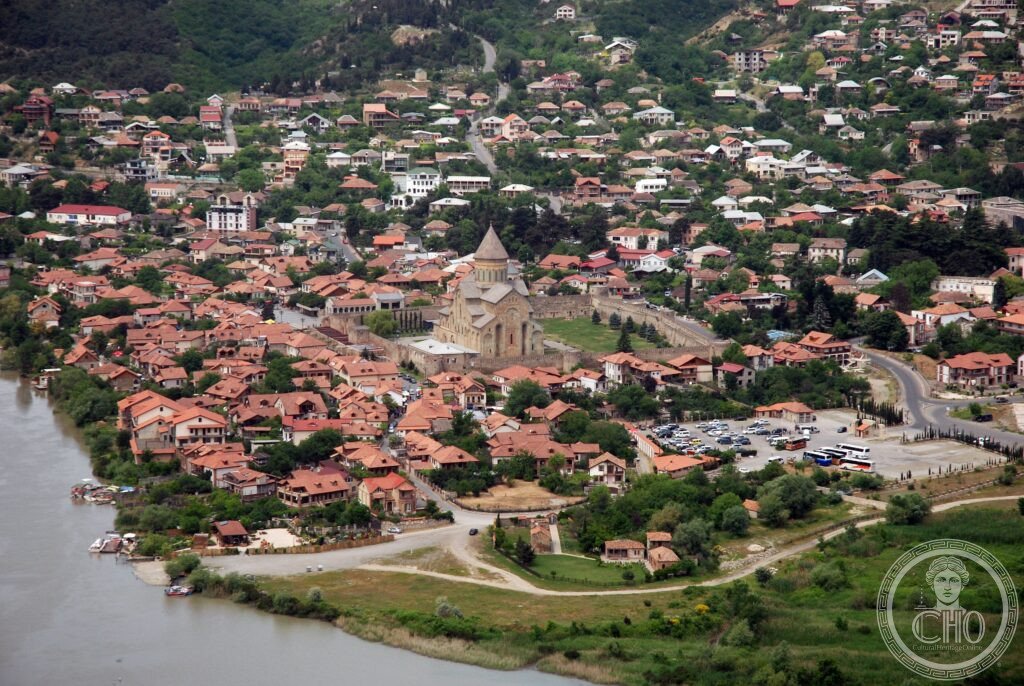
Svetitskhoveli Cathedral (the Living Pillar Cathedral; original church founded 4th century CE; current structure 1010–1029 CE; architect Arsukidze; the cathedral of the Catholicos-Patriarch of the Georgian Orthodox Church; the tallest building in medieval Georgia; the exterior stone carvings — grapevines, animals, geometric interlace — covering the drum and apses; the interior houses the tomb of the seamless robe of Christ (the Chiton of Christ, said to have been brought to Mtskheta by a Georgian Jew present at the Crucifixion)); with the Jvari Monastery (6th century CE; visible on the hilltop above the confluence of the Mtkvari and Aragvi rivers at the horizon), Mtskheta, Mtskheta-Mtianeti region, Georgia. UNESCO World Heritage Site 1994. Photo via Wikimedia Commons.
Mtskheta-Mtianeti region, Georgia · Capital of Kingdom of Iberia until 5th century CE; Svetitskhoveli Cathedral 1010–1029 CE; Jvari Monastery 586–605 CE; UNESCO WHS 1994

Mtskheta

Where Christianity arrived in the Caucasus and stayed — Mtskheta (Georgia; UNESCO WHS 1994) was the capital of the ancient Kingdom of Iberia for nearly a thousand years, became the site of Georgia’s conversion to Christianity in 327 CE, and preserves at its heart the Svetitskhoveli Cathedral, a living pillar of pale gold stone that has anchored Georgian identity across invasion, occupation, and empire.

At a glance

Mtskheta (the most precisely Mtskheta single Mtskheta-Mtianeti region Shida Kartli Georgia Caucasus 20 km north Tbilisi capital confluence Mtkvari Kura River Aragvi River natural defensive position site inhabited since Bronze Age ca 3000 BCE ancient capital Kingdom of Iberia Kartli 3rd century BCE to 5th century CE 327 CE King Mirian III Georgian conversion Christianity Saint Nino from Cappadocia missionary converted queen Nana first then King Mirian III 327 CE Georgia second country after Armenia to adopt Christianity as state religion before Byzantine Empire officially Christianized 380 CE UNESCO WHS 1994 reference 708 three principal monuments Svetitskhoveli Cathedral Jvari Monastery Samtavro Monastery convent UNESCO heritage in any UNESCO world heritage site).

Key facts

  • The Chiton of Christ and the Living Pillar (the relic that gave Svetitskhoveli Cathedral its name): Svetitskhoveli means “Living Pillar” in Georgian — the name refers to the founding legend of the cathedral: according to Georgian ecclesiastical tradition (recorded in the 10th-century “The Life of Kartli”), a Jew from Mtskheta named Elias was present at the Crucifixion in Jerusalem and brought Christ’s seamless robe (the Chiton, or Holy Robe) back to Mtskheta; his sister Sidonia, upon touching the garment, died instantly from the intensity of emotion and was buried holding the robe, which could not be separated from her hand; a cedar tree grew from her grave; King Mirian III ordered the tree cut to build the first church on the site, but the central pillar (the cedar column) rose into the air and could not be seated until Saint Nino prayed through the night, whereupon it descended and healed the sick — hence “Living Pillar” (Svetitskhoveli); the robe is believed to remain buried under the cathedral; the “pillar shrine” structure visible inside the current 11th-century cathedral marks the location of the original miraculous cedar pillar
  • GPS: 41.8455° N, 44.7212° E

History

From Iberian capital to Christian pillar to Persian and Arab conquest to Georgian renaissance to UNESCO heritage (the most precisely Mtskheta single Bronze Age settlement ca 3000 BCE archaeological evidence pottery bronze tools site 3rd century BCE Kingdom Iberia Kartli established Mtskheta capital Iberian kingdom 500+ years eastern Caucasus key position trade routes Silk Road branch 327 CE King Mirian III conversion to Christianity Saint Nino Cappadocian missionary arrived Georgia 320s CE converted Queen Nana first then miraculous healing of King Mirian III blind in forest prayed Christ recovered sight converted state religion 327 CE Georgia second country after Armenia 301 CE state Christianity before Roman Empire Theodosius 380 CE 4th 5th century CE first church site Mtskheta Svetitskhoveli 4th century CE wooden church Mirian III commission 478 CE capital moved Tbilisi new capital King Vakhtang I Gorgasali Mtskheta remains ecclesiastical capital 586 605 CE Jvari Monastery founded Erismtavari Stepanoz I monastery hilltop above confluence 654 CE Arab Caliphate conquered Tbilisi Mtskheta Arab period 654 1122 CE Arab emirate Tbilisi 1010 1029 CE current Svetitskhoveli Cathedral constructed Catholicos Melkisedek I architect Arsukidze largest medieval Georgian construction 1122 CE King David the Builder David Agmashenebeli liberated Tbilisi from Arabs Georgian kingdom united 12th century CE Georgian Golden Age Queen Tamar 1184 1213 CE Georgian empire peak 1220 CE Mongol invasions first wave 1386 1403 CE Timur Tamerlane repeated invasions and sack of Georgia 1555 CE Treaty of Amasya Persia Ottoman split Georgia Persian Safavid sphere 1747 CE weakened Georgian kingdom 1801 CE Russian Empire annexed Kingdom of Kartli-Kakheti 1801 CE Russian period 1801 1921 1921 CE Soviet Union incorporated Georgia 1991 CE Georgian independence 1994 CE UNESCO heritage: Saint Nino and the conversion of Georgia (how a foreign missionary woman changed the Caucasus): Saint Nino (ca. 296–338 CE; from Cappadocia in modern Turkey, possibly from Colastri near Antioch; her feast day is 14 January in the Georgian Orthodox Calendar — the second most important saint in Georgia after the Virgin Mary) arrived in Georgia ca. 320 CE as a slave or a refugee (sources disagree); she healed the Queen Nana of illness and the King Mirian III of blindness while lost in a forest (after conventional physicians failed); the conversions followed; what is historically notable is the mechanism of conversion: in Georgia, unlike in most of the Western Empire, Christianity spread first through the queen (a woman) and then the king, not through a bishop or a military decree; the cross that Saint Nino is said to have carried — a vine wood cross tied with her own hair (the Nino’s Cross) — is preserved in Svetitskhoveli Cathedral and is the most sacred object in Georgian Orthodox Christianity) — the most precisely Mtskheta single 327 CE King Mirian III Saint Nino Cappadocian Queen Nana first converted Mirian III blind forest prayed Christ sight restored conversion second country after Armenia state Christianity before Roman Empire Theodosius 380 CE 478 CE capital Tbilisi Mtskheta ecclesiastical remains 586 605 CE Jvari Monastery Stepanoz I hilltop confluence 1010 1029 CE Svetitskhoveli Melkisedek I architect Arsukidze largest medieval Georgian 1122 CE David Builder liberated Tbilisi Golden Age Tamar 1184 1213 CE Timur invasions 1386 1403 1801 CE Russian 1921 CE Soviet 1991 CE independence 1994 CE UNESCO Nino’s Cross vine wood hair most sacred Georgian Orthodox object UNESCO heritage in any UNESCO world heritage site).

What you see

Svetitskhoveli Cathedral, Jvari Monastery on the hilltop, and Samtavro Convent in the town (the most precisely Mtskheta single Svetitskhoveli Cathedral 1010 1029 CE current structure Catholicos Melkisedek I commissioned architect Arsukidze carved stone inscription punishment Arsukidze hand cut off after completion by jealous patron inscription records this cross-in-square plan typical medieval Georgian church 4 apses drum elevated cylindrical drum 8 windows above crossing 29m height interior largest medieval Georgian church Chiton Christ buried below central bay pillar shrine edicule structure marks original miraculous cedar column location Nino Cross most sacred object Georgian Orthodox normally in treasury Samtavro Monastery shown major festivals exterior stone carving grapevine motifs animal friezes interlace geometric ornament typical Georgian Romanesque decorative vocabulary arches carved bands elaborate but restrained vs Armenian stone carving same period Samtavro Monastery Convent 4th century CE Queen Nana first church female monastery Nino tomb inside convent church small 11th century CE church within convent grounds Queen Nana tomb King Mirian III tomb first Christian royals Georgia buried here Jvari Monastery 586 605 CE hilltop Erismtavari Stepanoz I commissioned top hill above confluence Mtkvari Aragvi rivers 656m elevation 20-30 min walk from town 4th century CE original cross erected hilltop Nino founded sanctuary 586 605 CE stone church built around cross four equal arms equal cross inscribed in square plan first fully realized example Georgian cross-in-square church type all later Georgian medieval churches derived from Jvari architectural type Pushkin poem The Mtsyri 1839 CE set at Jvari Monastery opening landscape description famous Russian literature confluence two rivers visible from Jvari platform panoramic view Mtskheta town plain rivers UNESCO heritage: Arsukidze and the punishment for building too well (the legend of the Svetitskhoveli architect): the external wall of Svetitskhoveli Cathedral includes a carved inscription that reads, in medieval Georgian: “Hand of Arsukidze, pray for him” — a commemoration carved after the architect Arsukidze had his right hand amputated; according to tradition (recorded in the 15th century CE), Arsukidze was punished by order of Catholicos Melkisedek I, who commissioned the cathedral, because the completed building surpassed anything Melkisedek himself could have imagined and the Catholicos feared Arsukidze would build something even greater elsewhere; the legend is a Georgian cultural memory of the creative jealousy between patron and creator; the carved hand above the inscription is the most emotionally specific memorial to an architect in any medieval building in the Caucasus) — the most precisely Mtskheta single Svetitskhoveli 1010 1029 CE Melkisedek I Arsukidze hand inscription carved cut off jealous patron cross-in-square plan 29m largest medieval Georgian Chiton buried below pillar shrine Nino Cross most sacred Georgian Orthodox Samtavro 4th CE Queen Nana Mirian III tombs first Christian royals Jvari 586 605 CE Stepanoz I hilltop confluence 656m 4th CE Nino original cross 586 CE stone church all later Georgian churches derived Jvari type Pushkin Mtsyri 1839 landscape confluence famous Russian literature UNESCO heritage in any UNESCO world heritage site).

Practical information

  • Getting there: from Tbilisi: marshrutka (minibus; 20–30 min; departs from Didube bus station in Tbilisi; GEL 1.50 = €0.50; very frequent); or taxi from Tbilisi (20 km; 25–35 min; GEL 15–25 = €5–9 each way; negotiate before entering); Svetitskhoveli Cathedral (free entry to grounds; a small donation (GEL 1–2) requested; modest dress required — shoulders and knees covered, women may need a headscarf from the entrance; open 9 AM–6 PM daily; the treasury requires special permission for Nino’s Cross access); Samtavro Monastery (free; working convent; respect the nuns at prayer; the tombs of Mirian III and Nana are inside the church — well-lit and accessible); Jvari Monastery (free; 20–30 min walk uphill from the road or taxi to the gate; the exterior stone carvings on the drum and the view over the confluence are the main attractions; allow 1h including the walk); combined visit Mtskheta + Jvari: half-day minimum from Tbilisi; best time (spring April–June and autumn September–October: Georgia’s best weather; avoid summer (35°C+ July–August, crowded with domestic Georgian tourists); the ancient cross-raising ceremony (October 14, Mtsketobi: the Feast of Svetitskhoveli — the largest annual gathering at the cathedral, with Orthodox liturgy, processions, and crowds of 10,000–20,000 worshippers)

Getting there

From Tbilisi: marshrutka 20–30 min (GEL 1.50) or taxi 25 min (GEL 15–25). Svetitskhoveli free (modest dress). Samtavro free (working convent). Jvari free (30 min walk). Half-day from Tbilisi minimum. Best: April–June, September–October. Feast of Svetitskhoveli October 14 (10k–20k worshippers). GPS: 41.8455, 44.7212.

Nearby

  • Tbilisi — 20 km south (the capital of Georgia; the Old Town (Abanotubani — the sulphur bath quarter: domed brick bathhouses above natural hot springs; the “Tbilisi” name derives from Georgian “tbili” = warm, for the hot springs); the Narikala Fortress (4th–17th century CE; the citadel above the Old Town; the view over the Mtkvari River gorge); the Bridge of Peace (2010 CE; Michele De Lucchi; a glass-and-steel pedestrian bridge; illuminated at night in a rhythm controlled by computer; the most controversial post-Soviet structure in the Caucasus — Tbilisi residents are divided about it))
  • Gori and the Uplitsikhe cave city — 65 km west (Gori: birthplace of Josef Stalin (1878 CE); the Stalin Museum (1957 CE; the most Soviet-era museum still largely intact in the former USSR; Stalin’s personal railway carriage inside the museum); Uplitsikhe cave city: a rock-cut urban complex carved from volcanic rock 1 km west of Gori; inhabited from the Bronze Age to the 13th century CE; the largest cave city in Georgia; approximately 700 cave-rooms, a theatre, pharmacy, winery, and temple visible; rarely crowded)

Sources

  • Wikipedia, Mtskheta; Svetitskhoveli Cathedral; Jvari Monastery; Saint Nino; Kingdom of Iberia, accessed June 2026
  • UNESCO, Historical Monuments of Mtskheta, WHS reference 708, inscribed 1994

Hero image: Mtskheta, Georgia, Wikimedia Commons. Editorial text © Cultural Heritage Online, 2026.

📷 Diventa un fotografo di Cultural Heritage Online

Condividi le tue foto dei luoghi: restano pubblicate con la tua firma come autore. Più vengono viste, più ti fai conoscere — e presto un concorso premierà le foto più apprezzate.

Accedi o registrati gratis per aggiungere una foto
📋 Copy & share on social
Scroll to Top