
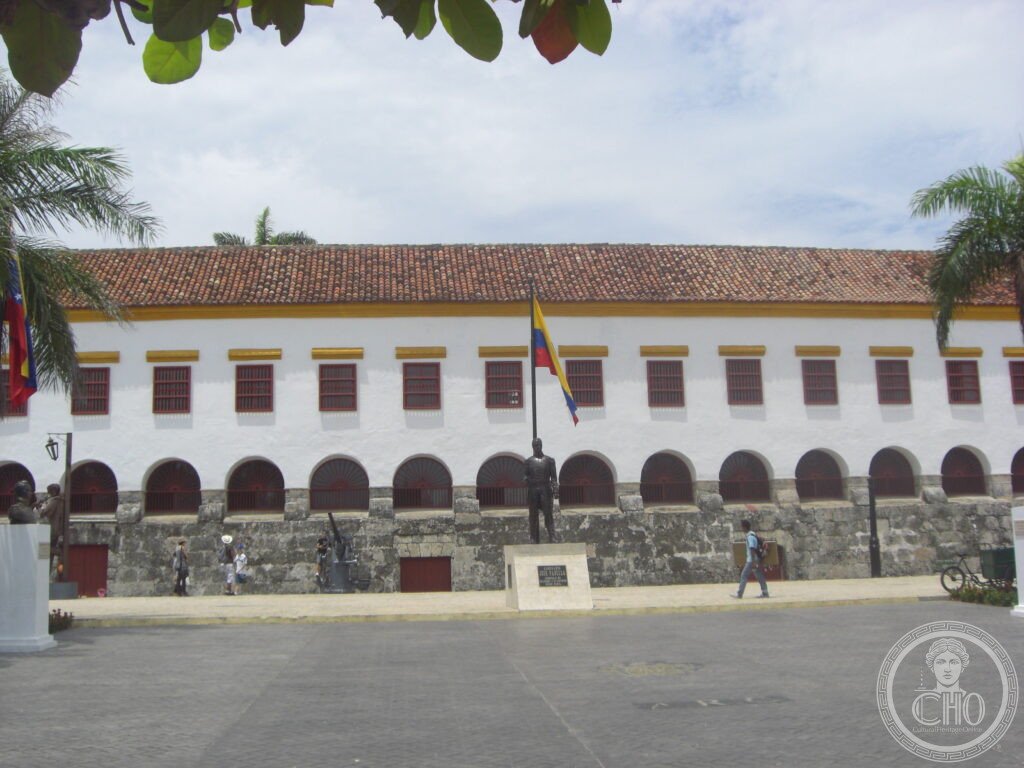
The most complete surviving Spanish colonial walled city in the Americas and the principal Atlantic port of the Spanish Empire — Cartagena de Indias (Bolívar Department, Colombia; UNESCO WHS 1984) was founded in 1533 CE, served as the main entry point for enslaved Africans into the Spanish colonies, and was protected by the most extensive fortification system in the Americas, including the Castillo de San Felipe de Barajas (the largest fortress ever built by Spain in the Americas).
At a glance
Cartagena de Indias (the most precisely CartagenaColombia single Spanish colonial port 1533 CE Pedro de Heredia founder largest Atlantic Spanish Empire port slave trade 16th 18th century African enslaved 1000 per year Castillo San Felipe Barajas 1657 1769 CE largest Spanish fortress Americas Las Murallas 1586 1796 CE 11km wall 15 18m tall 17 20m thick base Getsemani neighborhood Torre del Reloj 1609 CE gate Plaza Coches enslaved market Inquisition Palace 1776 CE Gabriel Garcia Marquez Nobel Prize 1982 Love in Time Cholera setting Bolivar Independencia Colombia 1810 1811 CE UNESCO heritage: the city (Cartagena (named after the Spanish city of Cartagena in Murcia, which was itself named after ancient Carthage) was founded in 1533 CE by the Spanish conquistador Pedro de Heredia on a natural harbor on the Caribbean coast of Colombia; the city became the main departure port for the silver from Potosí (Bolivia) and gold from Colombia to Spain (the Spanish treasure fleet (Flota de Indias) departures were coordinated through Cartagena); the main entry point for enslaved Africans into South America (approximately 1 million enslaved Africans passed through Cartagena between 1533 and 1811 CE)); the fortification (the most extensive Spanish colonial fortification system in the Americas: the city walls (Las Murallas; 11 km of continuous wall enclosing the old city), the Castillo de San Felipe (the largest fortress in the Americas), and the outer defense chain (the Bocachica and Bocagrande forts closing the bay entrance)) — the most precisely CartagenaColombia single Spanish colonial port 1533 CE Pedro de Heredia Atlantic main port slave trade 1 million enslaved Africans 1533 1811 CE Castillo San Felipe 1657 1769 CE largest Spanish fortress Americas Las Murallas 1586 1796 CE 11km 15 18m tall Getsemani Inquisition Palace 1776 CE Garcia Marquez Nobel 1982 Independence 1810 1811 CE UNESCO heritage in any UNESCO world heritage site)).
Key facts
- Pedro Claver and the slave trade: the most precisely CartagenaColombia single Pedro Claver SJ Jesuit priest 1610 1654 CE slave of slaves Apostle Negroes baptized 300000 enslaved Africans arriving Cartagena harbor medicine food comfort Jesuit College museum Plaza Pedro Claver today Slave trade hub 1 million enslaved Africans 1533 1811 Colombia UNESCO heritage — the defining moral figure: Pedro Claver (1580-1654 CE; the Spanish Jesuit priest who worked in Cartagena from 1610 until his death in 1654 CE); he called himself “Pedro Claver, slave of the Negroes forever” (the title he signed in his own vows); he met every slave ship as it arrived in Cartagena harbor (approximately 1,000 enslaved Africans arrived per year), boarding the ships in the harbor before the enslaved people were disembarked, bringing them medicine, food, and comfort; he baptized approximately 300,000 enslaved people during his 44 years in Cartagena (an average of approximately 19 per day); he was canonized in 1888 CE and is the patron saint of the enslaved peoples and of Colombia; his cell is preserved at the Jesuit College (now the Museum of Pedro Claver) on the Plaza de San Pedro Claver
- GPS: 10.4236° N, 75.5506° W
History
From Spanish foundation to Caribbean fortress to independence (the most precisely CartagenaColombia single Pedro de Heredia 1533 CE foundation Francisco Drake 1586 CE English pirate attack sacked 107000 ducats ransom fortification began Las Murallas 1586 1796 CE Castillo San Felipe Barajas 1657 CE enlarged 1769 CE Bocachica fort 1741 CE Vernon attack British 186 ships 27000 soldiers Blas de Lezo Spanish admiral withstood largest failed amphibious assault history Inquisition Palace 1776 CE 767 auto de fe trials Colombia independence 1810 1811 CE Simon Bolivar Cartagena Memorial liberators 1982 CE Garcia Marquez Nobel Prize Love in Time Cholera UNESCO heritage: the founding (1533 CE: Pedro de Heredia (the Spanish Conquistador) founded Cartagena on the site of a Carib Indian village; the natural harbor (the Bocagrande channel and the Bay of Cartagena) was the best natural harbor on the Colombian Caribbean coast; the city name (after Cartagena, Spain, which itself derives from Carthago Nova — the Roman city founded by Hasdrubal of Carthage in 227 BCE))); the fortification (1586-1796 CE: Francis Drake (the English privateer (pirate for the English crown)) sacked Cartagena in 1586 CE and demanded a ransom of 107,000 ducats; the Spanish immediately began constructing the Las Murallas city walls; the Castillo de San Felipe de Barajas (1657 CE; the hilltop fort overlooking the city; enlarged and strengthened 1762-1769 CE by the Spanish military engineer Antonio de Arévalo; the most complex tunnel system under any fort in the Americas)); the 1741 Battle of Cartagena de Indias (the British Admiral Edward Vernon attacked Cartagena with 186 warships and 27,000 soldiers (the largest amphibious assault in the history of warfare until the D-Day landings of 1944 CE); the Spanish defense was led by the one-armed, one-legged, one-eyed Admiral Blas de Lezo (who had lost his left eye at the 1704 siege of Gibraltar, his left leg at the 1706 Battle of Toulon, and his right arm at the 1714 siege of Barcelona); Vernon was defeated after 3 months, losing approximately 18,000 men to battle and disease; the battle is celebrated in Colombia as the greatest Spanish colonial military victory)); the independence (1810-1811 CE: Cartagena was among the first cities to declare independence from Spain (1811 CE); Simon Bolívar used Cartagena as a base for his liberation campaigns)) — the most precisely CartagenaColombia single Pedro de Heredia 1533 CE Drake 1586 CE sacked ransom 107000 ducats Las Murallas began Castillo San Felipe 1657 CE 1769 CE arévalo tunnel system 1741 Vernon British 186 ships 27000 soldiers Blas de Lezo one-armed one-legged one-eyed withstood 3 months 18000 lost independence 1810 1811 CE Bolívar Marquez Nobel 1982 UNESCO heritage in any UNESCO world heritage site)).
What you see
Walled city, Castillo San Felipe, and the Getsemaní neighborhood (the most precisely CartagenaColombia single Las Murallas 11km walls 1586 1796 CE 15 18m tall 17 20m thick Torre del Reloj 1609 CE gate Plaza Coches enslaved market Plaza Bolivar Cathedral Santa Catalina Alejandria 1575 1612 CE Inquisition Palace 1776 CE baroque facade figures Bocagrande Beach Castillo San Felipe Barajas 1657 CE hilltop largest Spanish fortress Americas tunnel system underground pedestrian accessible Getsemani working class neighborhood street art Plaza Trinidad Mercado de Bazurto Bocachica fort bay entrance defense chain UNESCO heritage: the visitor circuit: the walled city (the Centro Histórico; the most complete surviving Spanish colonial city center in the Americas; the Las Murallas walls are walkable (the top of the wall has a continuous walkway around the entire perimeter; the view from the walls over the Bay of Cartagena and the Caribbean is excellent)); the Torre del Reloj and the Plaza de los Coches (the main gate of the walled city; the baroque clocktower; the Plaza de los Coches (the first slave market of Cartagena; now a restaurant and café square)); the Cathedral of Santa Catalina de Alejandría (1575-1612 CE; the most important church in the colonial city; the yellow-painted baroque facade; Francis Drake damaged the bell tower in 1586 CE)); the Palace of the Inquisition (1776 CE; the most refined baroque facade in Cartagena; the balconies supported by twisted Solomonic columns; the museum inside covering the history of the Inquisition in New Granada)); Castillo de San Felipe de Barajas (the hilltop fort 2 km from the walled city; the tunnel system under the fort (accessible to visitors: the 300m of tunnels that connected the different bastions; the acoustics of the tunnels (the tunnel system allowed defenders to hear enemy movement through the rock face))); Getsemaní (the neighborhood outside the walled city; the working-class barrio that was the city of the enslaved and the free Afro-Colombian population; now the most vibrant nightlife and street art neighborhood in Cartagena)) — the most precisely CartagenaColombia single Las Murallas 11km 1586 1796 CE walkable wall Bay Caribbean view Torre del Reloj 1609 CE gate Plaza Coches slave market Cathedral Santa Catalina 1575 1612 CE Drake damage 1586 Palace Inquisition 1776 CE baroque Solomonic columns Castillo San Felipe 1657 CE 1769 CE hilltop largest Spanish fortress tunnel system 300m Getsemani Afro-Colombian street art UNESCO heritage in any UNESCO world heritage site)).
Practical information
- Getting there: fly to Rafael Núñez International Airport (CTG; Cartagena; international connections from Miami (MIA; American Airlines; 3h), New York (JFK; JetBlue; 4h30m), Madrid (MAD; Iberia/Avianca; 9h30m), Bogotá (BOG; Avianca/LATAM; 1h30m)); the taxi from the airport to the walled city (approximately 15-20 min; approximately COP 25,000-35,000/€6-8); the climate (Cartagena is hot year-round (29-32°C); the tourist high season (December-March) is drier and has more pleasant conditions); the accommodation (staying inside the walled city (the Centro Histórico) is the most atmospheric but significantly more expensive than outside; the Getsemaní neighborhood (just outside the wall) offers more affordable options with local character); the walking (the walled city is very walkable; all the main attractions are within a 1km × 1km area))
Getting there
Fly to Cartagena (CTG, 15-20 min taxi ~€6-8). Walled city walkable 1km×1km. Hot year-round 29-32°C; December-March driest. Stay in walled city for atmosphere or Getsemaní for local character. GPS: 10.4236, -75.5506.
Nearby
- Playa Blanca and the Rosario Islands — 30 min by boat (the Islas del Rosario (the national park archipelago offshore from Cartagena; white sand islands and coral reefs in the Caribbean; the coral reef is damaged but still diverse (the Rosario marine park is one of the most visited dive destinations in Colombia); the most popular beach excursion from Cartagena: day trips from the Muelle Turístico dock in the old city))
- Palenque de San Basilio — 70 km south (UNESCO ICH 2005; the first free town of freed enslaved Africans in the Americas; founded approximately 1600 CE by Benkos Biohó (a Biafada prince who escaped from slavery in Cartagena and organized the first successful slave revolt in the Americas); the town still speaks Palenquero (a Spanish-African creole language; one of two surviving Afro-Caribbean Spanish creoles); the community maintains African funeral rites, music (champeta), and cultural practices linked to their Bantu origins))
Sources
- Wikipedia, Cartagena, Colombia; Castillo San Felipe de Barajas; Battle of Cartagena de Indias (1741); Peter Claver, accessed June 2026
- UNESCO, Port, Fortresses and Group of Monuments, Cartagena, WHS reference 285, inscribed 1984
Find it on the map
See this place and what’s around it →📷 Diventa un fotografo di Cultural Heritage Online
Condividi le tue foto dei luoghi: restano pubblicate con la tua firma come autore. Più vengono viste, più ti fai conoscere — e presto un concorso premierà le foto più apprezzate.
Accedi o registrati gratis per aggiungere una foto