

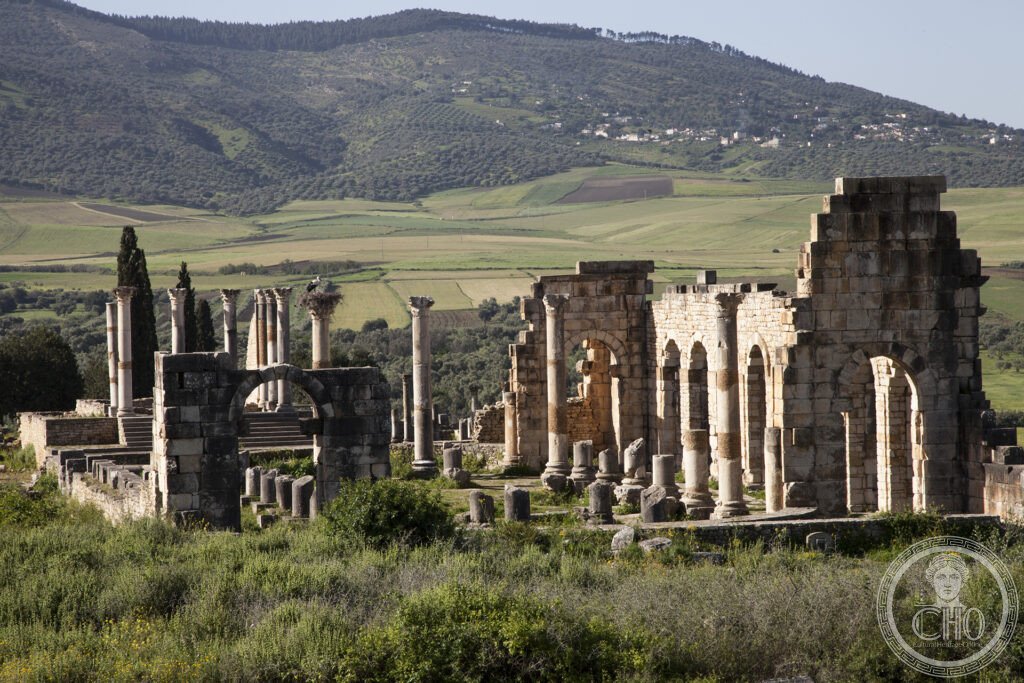
On a fertile plateau below the Zerhoun hills lie the ruins of Volubilis, the westernmost Roman city in Africa and the best-preserved in Morocco. Its triumphal arch, colonnaded street and in situ mosaic floors survive alongside the largest concentration of olive oil presses found anywhere in the Roman world.
At a glance
Volubilis was the capital of the Roman province of Mauretania Tingitana, a walled city of temples, a basilica and grand houses set among olive groves that still cover the surrounding hills. It is regarded as the most extensively excavated Berber-Punic-Roman city in the Maghreb, known for its surviving mosaic pavements, its olive oil production sites and its later role in the founding of Morocco’s first Islamic dynasty. The site was inscribed as a UNESCO World Heritage Site in 1997.
Key facts
- Location: near Moulay Idriss Zerhoun, Meknes-Tafilalet Region, Morocco
- Founded as Roman capital: capital of Mauretania Tingitana from 40 CE
- Key monument: Arch of Caracalla, completed 217 CE, 8.5 metres tall
- Mosaics: around 40 in situ mosaic floors, mainly 2nd–3rd century CE
- Olive oil industry: roughly 50 presses, the largest concentration known from the Roman world
- UNESCO status: inscribed World Heritage Site, 1997
History
Before Rome, Volubilis was the capital of the Berber Kingdom of Mauretania, a kingdom shaped in turn by Carthaginian, Ptolemaic and Roman influence. Its most celebrated ruler, Juba II, was raised in Rome under Augustus before returning to govern Mauretania with his wife Cleopatra Selene II, daughter of Cleopatra VII and Mark Antony, bringing Hellenistic and Roman culture to the kingdom.
After the assassination of the last Berber king, Ptolemy, the Emperor Claudius divided Mauretania into two provinces around 40 CE, and Volubilis became capital of the western province, Mauretania Tingitana. The Emperor Caracalla extended Roman citizenship to all free inhabitants of the empire in 212 CE, and the city’s great arch was raised in his honour a few years later. Roman administration withdrew from the region under Diocletian around 285 CE, though a Latin-speaking community is thought to have persisted at Volubilis for centuries afterwards.
In 788 CE, Moulay Idriss I, a descendant of the Prophet Muhammad, arrived at the ruined city, then known by its Arabic name Walili, after fleeing conflict in Arabia. Welcomed by the Berber Awraba tribe, he founded the first Moroccan Islamic state there. His son, Idris II, went on to found Fes in 808 CE, and Volubilis was gradually abandoned as the new city took over as political and spiritual centre. The site suffered further damage in the earthquake of 1755, the same event that struck Lisbon.
What you see
The visit follows a self-guided route linking the city’s main monuments, each signposted along the way. Near the entrance, olive groves surround the remains of oil presses, giving a sense of the scale of the ancient industry. The Orpheus House holds the finest mosaic on the site, a central medallion of Orpheus charming wild animals surrounded by narrative panels, sheltered in situ. The Capitoline Temple is the most visually striking standing structure, its podium reached by fourteen steps and three Corinthian columns still marking the pediment, though the original temple had six columns to front and rear.
The Arch of Caracalla remains the best-preserved monument on site, its dedicatory inscription still legible and column stumps tracing its line along the Decumanus Maximus, the colonnaded main street running from the arch to the Tangier Gate. The Bacchus House contains two separate mosaic floors, one showing Bacchus Triumphant and the other Bacchus discovering Ariadne. The Gordian Palace, thought to have been the governor’s residence, is the largest house on the site and preserves several further mosaic floors. Many of the mosaics and bronze sculptures removed from Volubilis are now held in the National Archaeological Museum in Rabat rather than displayed at the site itself.
Practical information
- Visiting: the site is explored on foot along a signposted route; there are no separate tickets for individual monuments.
- Best season: spring and autumn bring more comfortable temperatures, while summer can be very hot.
- Entry and current charges: check the site’s official channels for up-to-date entry arrangements.
- Combined visit: Volubilis is commonly visited together with Moulay Idriss Zerhoun as part of the same trip.
Getting there
Volubilis lies south of the Rif, reachable from Meknes or Fes, most commonly by grand taxi. Many visitors combine the journey with a stop at Moulay Idriss Zerhoun on the same outing. Current transport options and journey times are best confirmed locally or through official tourism channels.
Nearby
- Moulay Idriss Zerhoun — 2 km east, the most sacred pilgrimage town in Morocco, built around the mausoleum of Moulay Idriss I, who founded the first Moroccan Islamic state at Volubilis in 788 CE.
- Meknes — around 30 km south, the nearest major city and a common base for visiting the site.
- Fes — around 90 km south, founded in 808 CE by Idris II as the new capital after Volubilis was abandoned.
Sources
- UNESCO
Find it on the map
See this place and what’s around it →📷 Become a Cultural Heritage Online photographer
Share your photos of places: they stay published under your name as the author. The more they're seen, the more you get noticed — and soon a contest will reward the most appreciated photos.
Log in or sign up free to add a photoIs this page about you?
This page is read by travellers and heritage enthusiasts who find it on Google. Tell us how you are connected to this place and we will take it from there.