

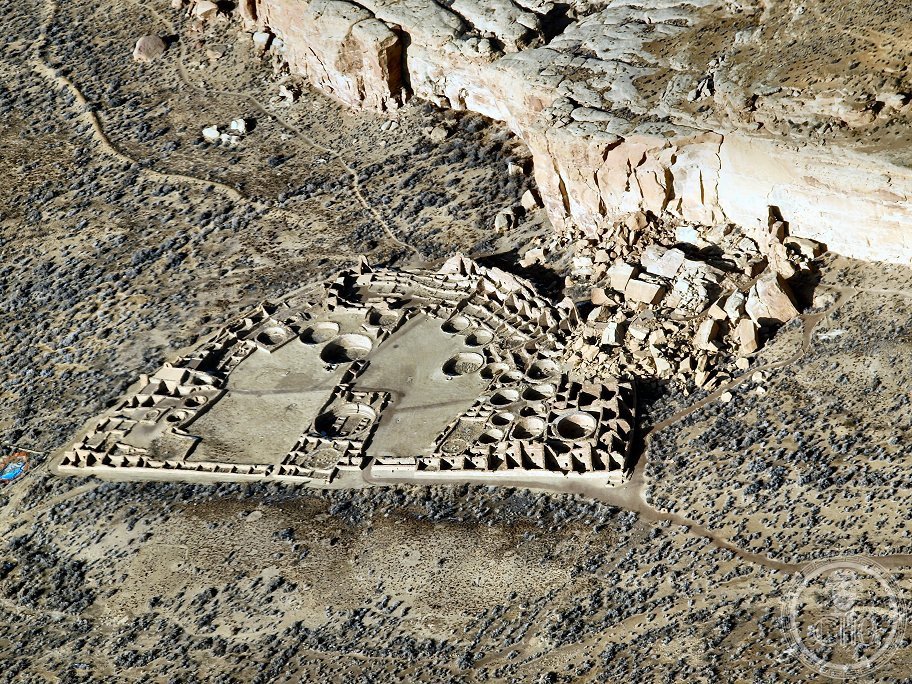
In a remote high-desert canyon, the Ancestral Puebloans raised a network of monumental great houses linked by hundreds of kilometres of engineered roads and tuned to solar and lunar cycles. Chaco Canyon stands as the clearest surviving expression of pre-Columbian architectural and astronomical knowledge in the American Southwest.
At a glance
Chaco Culture National Historical Park protects the ruins of the Chacoan civilisation, which flourished across a network stretching over a vast area of the Southwest between about 850 and 1150 CE. At its heart lie twelve great houses, the largest pre-Columbian multistorey structures north of Mexico, connected to more than sixty outlying great houses by roads cut arrow-straight through the bedrock.
The scale of construction, the precision of the astronomical alignments built into the walls and windows, and evidence of long-distance trade in turquoise, cacao, macaws and copper bells all point to Chaco as a hub of ceremony, exchange and redistribution rather than an ordinary settlement.
Key facts
- Location: San Juan County, New Mexico, United States
- Period: Chacoan culture, roughly 850–1150 CE
- Pueblo Bonito: the largest great house, built in phases, with roughly 800 rooms, 32 kivas and up to four storeys
- Road network: around 650 km of engineered roads, typically about 9 metres wide, linking Chaco Canyon to some 63 outlier great houses
- Astronomy: great houses, kivas and rock art aligned to solstices, equinoxes and the 18.6-year lunar standstill
- Status: inscribed as a UNESCO World Heritage Site in 1987
History
The Chacoan Phenomenon began around 850 CE with the first construction at Pueblo Bonito. Great houses used far more masonry than ordinary Ancestral Puebloan dwellings of the time, and their rooms show little sign of everyday domestic use, suggesting they served largely as storage, ceremonial and redistribution centres rather than housing.
Between about 1050 and 1100 CE the regional network reached its greatest extent, drawing in cacao from Mesoamerica made into a chocolate drink, scarlet macaws kept for their feathers and brought from Mexico, copper bells, and large quantities of turquoise processed at Chaco after being mined at Cerrillos to the south.
A prolonged drought around 1130 to 1150 CE brought construction to a halt and the regional network dissolved. Population shifted north towards the Mesa Verde area and later east to the Rio Grande valley, where their descendants include the modern Acoma, Zuni and Hopi peoples.
What you see
The visitor route takes in Pueblo Bonito, whose D-shaped plan is visible from a ground-level loop trail, along with its two great kivas seen as large circular depressions in the main court and the rooms where macaw remains were found. Chetro Ketl, the second-largest great house, preserves the only elevated tower kiva and the only colonnade known from a Chacoan great house, a detail read as evidence of contact with Mesoamerica.
Casa Rinconada is a large freestanding great kiva whose window openings align with the solstice sunrise. Petroglyph panels are scattered through the canyon, including the Fajada Butte spiral, aligned by sunlight at the solstices and equinoxes though not accessible up close, and a panel at Peñasco Blanco thought to depict the supernova of 1054 CE beside a crescent moon.
Practical information
- Access roads: the park is reached by unpaved roads from either the south, off Highway 550, or the north, via Navajo Route 57 from Farmington; a high-clearance vehicle is advisable and the southern route should be avoided after rain, when the clay surface becomes impassable
- Navigation: satellite navigation to the visitor centre can be unreliable, and the park’s own road guidance is recommended instead
- Facilities: a visitor centre and museum are on site; current opening arrangements and fees should be checked with the park directly
Getting there
Chaco Canyon lies well off the main highway network, reached only by unpaved approach roads from the south off Highway 550 or from the north via Farmington. The nearest airports are in Albuquerque to the south and Farmington to the west; visitors typically drive in, and checking road conditions with the park before setting out is advisable.
Nearby
- Cerrillos turquoise mines — roughly 120 km south, the source of turquoise processed in large quantities at Chaco
- Pueblo Pintado — roughly 200 km east, one of the outlier great houses aligned with the Chacoan network
- Farmington — reached via the northern unpaved approach, with an airport serving the region
- Mesa Verde area — to the north, where population moved as the Chacoan network dissolved
Sources
- UNESCO World Heritage Centre
- Chaco Culture National Historical Park
Find it on the map
See this place and what’s around it →📷 Become a Cultural Heritage Online photographer
Share your photos of places: they stay published under your name as the author. The more they're seen, the more you get noticed — and soon a contest will reward the most appreciated photos.
Log in or sign up free to add a photoIs this page about you?
This page is read by travellers and heritage enthusiasts who find it on Google. Tell us how you are connected to this place and we will take it from there.