
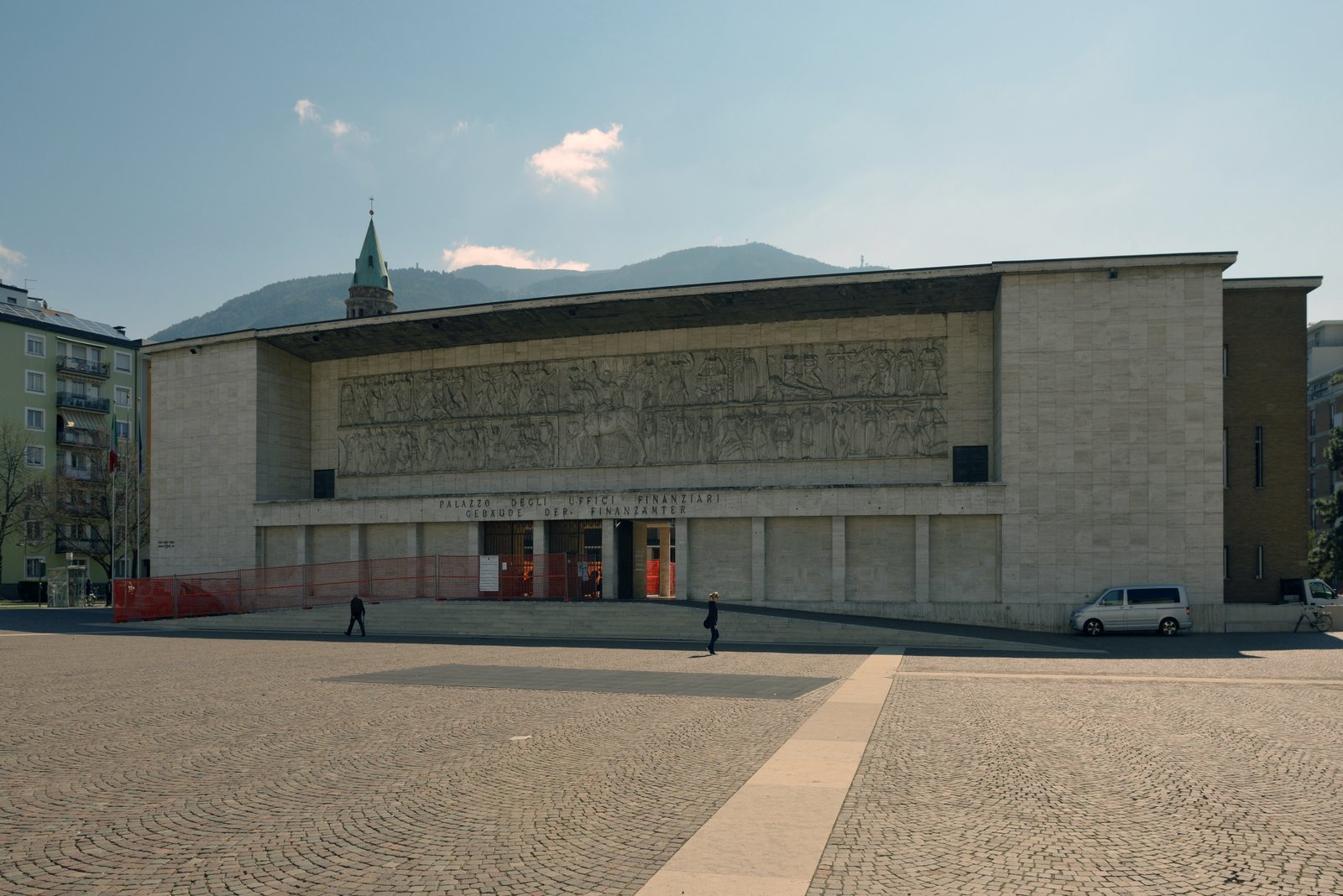
The former headquarters of the Italian Fascist Party in Bolzano carries the largest surviving figurative fascist bas-relief in Italy — 36 metres of travertine depicting Mussolini on horseback — now counterpointed by a neon Hannah Arendt quotation installed in 2017.
At a glance
The building at Piazza del Tribunale was designed between 1939 and 1942 by architects Guido Pelizzari, Francesco Rossi, and Luis Plattner as the Casa del Fascio — the local headquarters of the ruling party. Its convex curved frontage was designed to mirror the concave form of the courthouse opposite, giving the piazza a deliberate spatial symmetry that expressed the unity of party and judicial power. After 1945 it became the Palazzo degli Uffici Finanziari, housing state financial offices. The 36-metre bas-relief by sculptor Hans Piffrader — depicting Mussolini on horseback delivering the Roman salute, surrounded by soldiers, workers, and emblems of the regime — remained untouched, and is still there today.
Key facts
- Address: Piazza del Tribunale / Gerichtsplatz, Bolzano (formerly Piazza Arnaldo Mussolini)
- Coordinates: 46.4978°N, 11.3392°E (Google Maps)
- Built: 1939–1942
- Architects: Guido Pelizzari, Francesco Rossi, Luis Plattner
- Style: Italian rationalism
- Bas-relief: Hans Piffrader — 57 travertine panels, 36m long × 2.75m high, approximately 95 tonnes
- Current use: State financial offices (Agenzia delle Entrate and other fiscal bodies)
- Hannah Arendt installation: Neon quotation “Nessuno ha il diritto di obbedire / No one has the right to obey”, installed 2017 by the municipality
History
By 1939, Bolzano had been under fascist rule for sixteen years. The city had been substantially remade: Italian workers had been settled in new rationalist housing blocks, streets had been renamed, German-language schools had been closed (and only partially reopened under diplomatic pressure). In 1939, the regime offered the German-speaking population the Optionszwang — the “Option” — a forced choice between emigrating to Nazi Germany or remaining in Italy as fully Italianised subjects. The construction of the Casa del Fascio the same year was not coincidental: this was the regime asserting permanent control over the city at the same moment it was trying to resolve the “German problem” through emigration.
The building was designed by a trio of architects — Pelizzari, Rossi, and Plattner — who gave it a rationalist vocabulary consistent with the architectural language of other fascist-era public buildings in Bolzano. The key visual element was the commission to Hans Piffrader, a South Tyrolean sculptor who had worked under the regime, to create the monumental bas-relief. Piffrader’s work spans the entire upper facade: 57 panels of travertine limestone, placed in two superimposed rows, showing Mussolini on horseback at the centre in the act of the Roman salute, with a crowd of soldiers, workers, women, and children arranged around him. Above the central figure ran the words “Credere, Obbedire, Combattere” — Believe, Obey, Fight — the regime’s motto. The total weight of the relief is approximately 95 tonnes.
When Italy fell in September 1943, the Nazi SS established their regional headquarters in Bolzano and operated a transit camp (Lager di Bolzano) at the edge of the city — one of the last transit points for deportees to Auschwitz and Mauthausen. The Casa del Fascio remained in German SS control until liberation in May 1945. After the war, the building was repurposed for state financial administration, the most anodyne use the authorities could find for it. The bas-relief was neither removed nor contextualised for seven decades. In 2017, the Bolzano municipality installed an illuminated quotation from Hannah Arendt — “No one has the right to obey” — in metal letters on the plaza in front of the building, positioned so that it appears to address the bas-relief directly. An interpretive infopoint with multilingual panels was added subsequently.
What you see
The building curves gently around Piazza del Tribunale. The ground floor is recessed behind a colonnade that runs the full width of the facade, giving pedestrians shelter and the building an air of civic accessibility that its original purpose belied. The upper two floors are faced in light-coloured stone, plain and flat, with the Piffrader relief occupying a horizontal band across the entire width at approximately the second-floor level. The relief is large enough that it takes a few steps back to see it whole — from close range, the individual panels read as fragments: a soldier’s helmet, a fasces bundle, the rear legs of Mussolini’s horse.
The Hannah Arendt installation is at ground level in the piazza, rendered in back-lit metal lettering in three languages: Italian, German, and Ladin (the Rhaeto-Romance language spoken by a portion of South Tyrol’s population). The juxtaposition is stark and deliberate. The infopoint panels to the right of the entrance explain the history of the building and the bas-relief in the same three languages. This is Bolzano’s characteristic way of dealing with its difficult inheritance: not removal, but layering — another language, another voice, added to the stone without erasing what the stone says.
Cultural significance
The former Casa del Fascio is arguably the most complex site in Bolzano’s fascist landscape. The Monumento alla Vittoria is a monument — it was always intended to be seen and read as a symbol. The Casa del Fascio is a building that was also a seat of real administrative power: party membership, surveillance files, political decisions, and, during the German occupation, the logistics of deportation, all passed through this structure. The survival of the Piffrader relief intact — including, until relatively recently, the original fascist motto above Mussolini’s head — makes it an exceptional document of the period. The municipality’s decision in 2017 to respond with Arendt rather than demolition reflects South Tyrol’s broader approach: the 1972 Statute of Autonomy created a bicultural region in which memory is contested rather than resolved, and where the German-speaking majority governs alongside the Italian-speaking minority without either erasing the other’s past.
Practical information
- Access: The exterior, colonnade, and piazza are publicly accessible at all hours; the interior houses working government offices and is not open to tourists
- Interpretive panels: The infopoint on the piazza is accessible during daylight hours and provides context in Italian, German, and Ladin
- Time needed: 20–30 minutes to read the relief, the Arendt installation, and the interpretive panels
- Photography: The relief and piazza are freely photographable from public space
Getting there
Piazza del Tribunale is a 10-minute walk north from the train station (this itinerary’s previous stop) and a 5-minute walk southwest of Piazza Walther. From Via Garibaldi, turn left onto Via Cassa di Risparmio; the piazza opens at the end of the block. The building’s curved facade is visible from the entrance to the piazza.
Nearby
- Piazza Walther (Waltherplatz) — 5-minute walk east; the central square of Bolzano has its own fascist-era renaming history
- The Palazzo delle Poste (this itinerary’s next stop) — 3-minute walk south on Via dei Portici
- Bolzano Courthouse (Palazzo di Giustizia) — directly across the piazza, also 1930s-era construction, its concave facade designed to complement the Casa del Fascio’s convex curve
- This building is one of five stops on the thematic route Case del Fascio: from Como to Tirana, told in full in the article One Building Type, Five Fates.
Sources
Find it on the map
See this place and what’s around it →
📷 Become a Cultural Heritage Online photographer
Share your photos of places: they stay published under your name as the author. The more they're seen, the more you get noticed — and soon a contest will reward the most appreciated photos.
Log in or sign up free to add a photoIs this page about you?
This page is read by travellers and heritage enthusiasts who find it on Google. Tell us how you are connected to this place and we will take it from there.