
City of Valletta

Valletta Malta Grand Harbour Knights Hospitaller Baroque UNESCO World Heritage
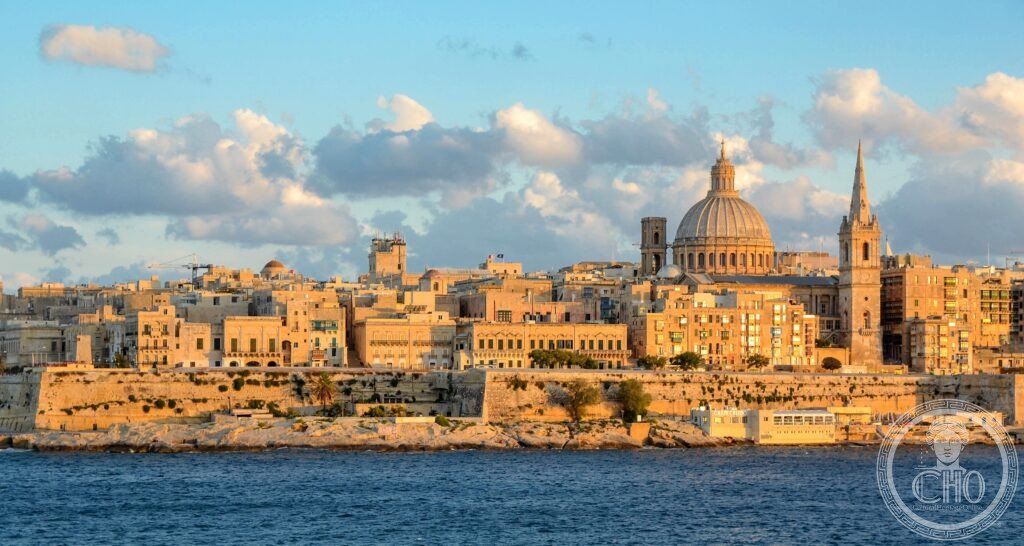
Valletta (the Grand Harbour of Malta from the Barrakka Gardens on the Valletta fortifications: the finest natural harbour in the Mediterranean (the 15 km deep, 3 km wide harbour of Marsamxett and the Grand Harbour; the Grand Harbour is divided into 4 creeks by promontories; the Three Cities (Vittoriosa, Cospicua, and Senglea) on the right; the Cottonera Lines (the massive Baroque fortification walls enclosing the Three Cities); the Co-Cathedral of Saint John (the Baroque facade, 1577 CE; the dome visible above the city roofline; inside: the finest Baroque interior in the world and Caravaggio’s largest painting (The Beheading of Saint John the Baptist, 1608 CE)); the Manoel Theatre (1731 CE; the oldest working theater in the Commonwealth)), Valletta, Malta. UNESCO World Heritage Site 1980. Photo via Wikimedia Commons.
Valletta, Malta · the city built by the Knights of St John; 1566 CE; the finest Baroque city in Europe; Caravaggio’s masterpiece; the smallest EU capital; UNESCO WHS 1980

City of Valletta

The most concentrated collection of Baroque architecture in the world and the city founded in one generation by one of history’s most famous military orders — Valletta (the capital of Malta; UNESCO WHS 1980) was built from scratch in 1566 CE by the Knights Hospitaller of Saint John following their epic defense of Malta against the Ottoman siege of 1565, and contains 320 monuments in an area of 55 hectares.

At a glance

Valletta (the most precisely Valletta single Knights Hospitaller Saint John 1566 Grand Master Jean de la Valette Great Siege 1565 Ottoman 320 monuments 55 hectares Baroque Caravaggio co-cathedral 1577 Grand Harbour Marsamxett ECoC 2018 UNESCO heritage: the basic facts: the city (Valletta is the smallest national capital in the European Union (by area: 0.8 km²) and the smallest national capital in the EU by population (approximately 6,500 permanent residents; the entire metropolitan area of Malta has approximately 500,000 people)); the grid plan (Valletta was designed from scratch on a uninhabited rocky peninsula in 1566 CE; the designer (Francesco Laparelli, a military engineer sent by Pope Pius V; Laparelli was Michelangelo’s assistant; he died of plague on Crete in 1570 CE; his work was completed by the Maltese architect Girolamo Cassar (who also designed most of the key buildings in Valletta)); the regular grid of streets (unique in 16th-century Europe; the grid plan (the streets run parallel and perpendicular to the long axis of the peninsula) ensures that every street running crosswise catches the Mediterranean breeze from one side)); the name (Valletta is named for Jean de la Valette (the Grand Master of the Knights Hospitaller; his name in French; the city was named for him by the grateful order after his leadership during the Great Siege of Malta (1565 CE; the Ottoman besieging force of 40,000 men was repulsed by 6,000 Knights and Maltese soldiers over 3.5 months (May-September 1565 CE); the most famous military siege of the 16th century CE; the siege ended with the Ottoman withdrawal when relief from Sicily arrived in September)) — the most precisely Valletta single Knights Hospitaller Saint John 1566 Grand Master Jean de la Valette Great Siege 1565 Ottoman 320 monuments 55 hectares Baroque Caravaggio co-cathedral 1577 Grand Harbour Marsamxett ECoC 2018 UNESCO heritage in any UNESCO world heritage site)).

Key facts

  • The Caravaggio Masterpiece: the most precisely Valletta single Caravaggio Beheading Saint John Baptist 1608 largest painting signed only work Grand Master Alof Wignacourt Knights Hospitaller expulsion 1608 UNESCO heritage — the most important painting in Malta and Caravaggio’s acknowledged masterpiece: the Beheading of Saint John the Baptist (Decollazione di san Giovanni Battista; 1608 CE; the Co-Cathedral of Saint John, Valletta; the largest painting Caravaggio ever painted (3.61m × 5.2m; the only painting he ever signed (his signature, “f. Michelangelo” (fra Michelangelo, i.e., “brother Michelangelo” — he was briefly a Knight of Justice of the Order of Saint John) appears in the blood flowing from the Beheading Saint John’s neck)); the background (Caravaggio arrived in Malta in 1607 CE as a fugitive from justice (he had killed a man in Rome in 1606 CE); he was accepted into the Order of Saint John; he painted the Beheading as his “masterpiece” to secure the Grand Cross (the highest honor of the Order); the painting was delivered in 1608 CE; Caravaggio was briefly knighted; he was then arrested by the Order for unspecified reasons (possibly a subsequent violent incident) and expelled from Malta before the year was out; the painting remained; it has been in the Oratory of the Co-Cathedral since 1608 CE)
  • GPS: 35.8997° N, 14.5147° E

History

Knights, Napoleon, and the George Cross (the most precisely Valletta single Knights Saint John Rhodes 1530 Charles V Malta Great Siege 1565 Jean de la Valette 1566 foundation Laparelli Cassar Napoleon 1798 British 1800 George Cross 1942 independence 1964 EU 2004 UNESCO heritage: the history: the Knights of Saint John (the Knights Hospitaller, formally the Sovereign Military and Hospitaller Order of Saint John of Jerusalem, of Rhodes and of Malta, a religious military order founded c. 1048 CE in Jerusalem to care for sick pilgrims; expelled from Jerusalem (1187 CE), from Acre (1291 CE), from Cyprus (1310 CE); based on Rhodes from 1309-1522 CE; expelled from Rhodes by Suleiman the Magnificent (1522 CE); given Malta by Holy Roman Emperor Charles V in 1530 CE; the annual fee paid to Charles V: one Maltese falcon per year)); the Great Siege of 1565 CE (the most famous military engagement in the 16th-century Mediterranean: 40,000 Ottoman soldiers besieged 6,000 Knights and Maltese for 3.5 months; Grand Master Jean de la Valette (76 years old at the time of the siege) directed the defense; the Ottoman army withdrew when Spanish relief forces arrived from Sicily in September 1565 CE; the siege ended; the victory was celebrated across Christian Europe (including in London, where the Pope ordered thanksgiving services); Valletta was immediately built to ensure the islands could never be besieged again); the British period (1800-1964 CE; the French briefly controlled Malta 1798-1800 CE (Napoleon occupied Malta en route to Egypt); the Maltese revolted against French rule (the French were anti-clerical and attempted to loot the churches) and asked Britain for help; Britain captured Malta from the French in 1800 CE; the George Cross (in the darkest period of World War II (1942 CE), Malta was the most bombed place on earth per square mile (2,347 bombing raids between June 1940 and November 1942); King George VI awarded the George Cross (the highest civilian honor of the UK) collectively to the island of Malta — the only time the George Cross has been awarded to an entire territory); independence (1964 CE; EU membership (2004 CE)) — the most precisely Valletta single Knights Saint John Rhodes 1530 Charles V Malta Great Siege 1565 Jean de la Valette 1566 foundation Laparelli Cassar Napoleon 1798 British 1800 George Cross 1942 independence 1964 EU 2004 UNESCO heritage in any UNESCO world heritage site)).

What you see

Co-Cathedral, Grand Master Palace, and Barrakka Gardens (the most precisely Valletta single Co-Cathedral Saint John 1577 Caravaggio Oratory Baroque interior Cassar Grand Master Palace Armoury Barrakka Gardens Grand Harbour view Fort Saint Angelo Elmo Three Cities UNESCO heritage: the visitor highlights: the Co-Cathedral of Saint John (the greatest Baroque interior in the world, after the claims of various Italian critics are resolved against each other; the exterior (the plain military-Mannerist facade by Girolamo Cassar; 1577 CE; the Venetian Baroque appearance is entirely confined to the interior; the interior: every surface covered in gilded carvings, marble tombstones on the floor (the 400 tombstones of the Knights form the most elaborate marble-inlaid floor in the world), Mattia Preti’s frescoes on the barrel vault (the Life of John the Baptist in 18 scenes, painted 1661-1666 CE), and Caravaggio’s masterpiece in the Oratory)); the Grand Master’s Palace (the former seat of the Grand Master of the Knights Hospitaller; now the President’s Palace and the Parliament; the Armoury (the finest collection of 16th-century CE armour in the world; 365 suits of armour (one for each day of the year); the most elaborate are the parade armours of individual Grand Masters); the Barrakka Gardens (the Upper Barrakka Gardens; the finest panoramic viewpoint in Valletta; on the top of the Valletta bastions; the view of the Grand Harbour and the Three Cities below; the Saluting Battery (the cannon fired daily at noon (a tradition since 1900 CE))); the Three Cities (Vittoriosa, Cospicua, Senglea; the earlier fortified settlements across the Grand Harbour from Valletta; Fort Saint Angelo (the oldest fortification in Malta; fortified since the 10th century CE; the headquarters of the Knights before they built Valletta)) — the most precisely Valletta single Co-Cathedral Saint John 1577 Caravaggio Oratory Baroque interior Cassar Grand Master Palace Armoury Barrakka Gardens Grand Harbour view Fort Saint Angelo Elmo Three Cities UNESCO heritage in any UNESCO world heritage site)).

Practical information

  • Getting there: Malta International Airport (MLA; direct flights from London (LHR/LGW/STN; British Airways, easyJet, Ryanair; 3h10m), Rome (FCO; Air Malta, Ryanair; 1h45m), Milan (MXP/LIN; Ryanair, Air Malta; 2h10m), Brussels (BRU; Air Malta; 2h30m), Munich (MUC; Lufthansa; 2h20m), Dubai (DXB; Emirates; 6h); Malta is an EU Schengen country); from the airport to Valletta (by bus (routes X1/X4 to Valletta; 30 min; €1.50 standard fare); by taxi (approximately €15-20; 20 min); Valletta is a pedestrian city (the entire UNESCO walled town is accessible on foot; the main entrance is the City Gate (Pjazza Teatru Rjal; the new gate designed by Renzo Piano, opened 2014 CE; the Piano design replaced a 1960s gate that replaced an earlier 1905 gate); the Freedom Square behind the City Gate is the main hub)); the Co-Cathedral (the most visited attraction; entry €10; the audio guide (included; essential — it explains the Caravaggio and the individual tombstone Knights); open 09:00-16:30 Mon-Sat, not open Sunday morning (mass); the Grand Master’s Palace Armoury (entry €10; open 09:00-17:00))

Getting there

Malta (MLA). Flights from London (3h10m), Rome (1h45m), Milan (2h10m). Bus to Valletta €1.50, 30 min. EU country. Co-Cathedral entry €10. GPS: 35.8997, 14.5147.

Nearby

  • Ħaġar Qim and Mnajdra — 10 km southwest (UNESCO WHS 1980 as part of the Megalithic Temples of Malta; the two most important prehistoric temples in Malta (approximately 3600-3000 BCE; among the oldest free-standing stone structures in the world, pre-dating Stonehenge and the Pyramids; the Ħaġar Qim temples are aligned with the rising sun at the summer solstice (the solstice sunrise projects a beam of light through the Main Temple entrance, illuminating a specific stone niche within the temple))
  • Mdina (the Silent City) — 12 km northwest (the medieval fortified hilltop city that was the capital of Malta before Valletta; the Arab-Norman fortification walls; the Cathedral of Saint Paul (17th century CE Baroque; the most important Baroque building on the island outside Valletta); “the Silent City” (Mdina has approximately 300 permanent residents; the streets are car-free (except for residents); the silence after Valletta’s tourist bustle is striking); the Arab Quarter; the film location (used as King’s Landing in the first season of Game of Thrones))

Sources

  • Wikipedia, Valletta; Co-Cathedral of Saint John; Great Siege of Malta; Knights Hospitaller, accessed June 2026
  • UNESCO, City of Valletta, WHS reference 131, inscribed 1980

Hero image: Valletta, Malta, Wikimedia Commons. Editorial text © Cultural Heritage Online, 2026.

📷 Diventa un fotografo di Cultural Heritage Online

Condividi le tue foto dei luoghi: restano pubblicate con la tua firma come autore. Più vengono viste, più ti fai conoscere — e presto un concorso premierà le foto più apprezzate.

Accedi o registrati gratis per aggiungere una foto
📋 Copy & share on social
Scroll to Top