
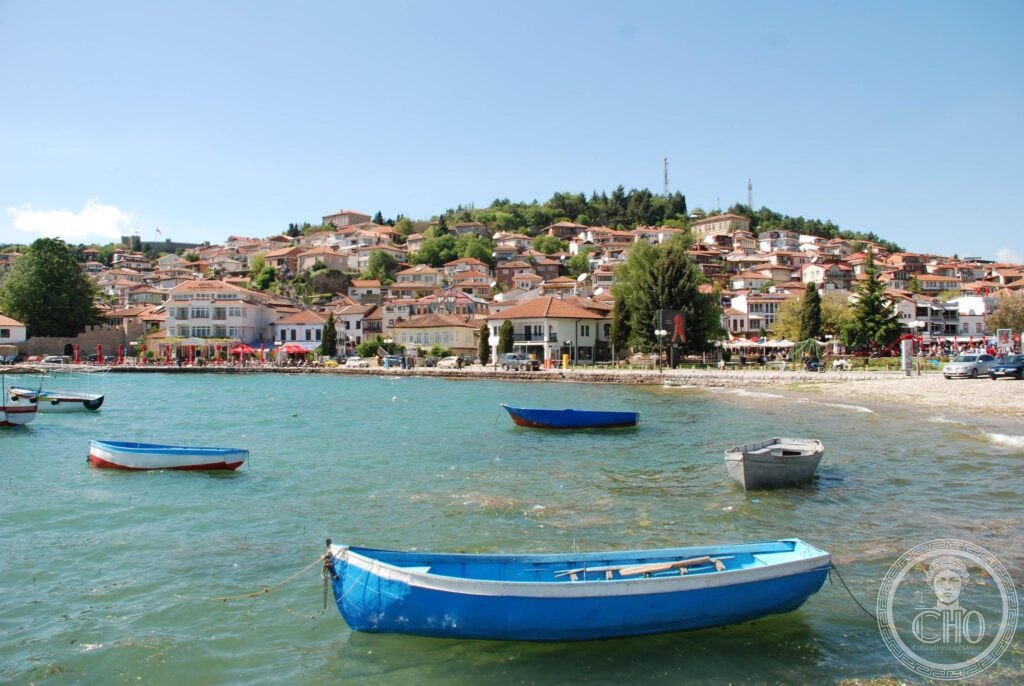
On the shore of one of the world’s oldest lakes, Ohrid combines an exceptional concentration of Byzantine churches with the place where the Cyrillic alphabet was refined by the disciples of Saints Cyril and Methodius, a combination recognised by UNESCO as a mixed cultural and natural site.
At a glance
Ohrid is a small town on the northeastern shore of Lake Ohrid, its old town rising from the water up to Samuil’s Fortress on the hilltop. The old town, inscribed by UNESCO as a mixed cultural and natural site in 1979 and 1980, is remembered for its density of Byzantine churches, said to have once numbered 365, one for each day of the year, though only a fraction still stand today.
The lake itself is one of the oldest bodies of water in the world, its long isolation having produced an unusually high number of species found nowhere else, including several fish and invertebrates unique to its waters.
Key facts
- UNESCO status: inscribed as a mixed cultural and natural World Heritage Site in 1979 and 1980.
- Lake age: Lake Ohrid is thought to be between two and three million years old, among the oldest lakes on Earth.
- Churches: historically as many as 365 churches stood in and around Ohrid; roughly 40 survive today, some in ruins.
- Cyrillic alphabet: developed at Ohrid in the 9th century CE by the scholars Kliment and Naum, disciples of Saints Cyril and Methodius, refining the earlier Glagolitic script.
- Endemic life: the lake supports numerous species found only here, including endemic fish, invertebrates and the freshwater Ohrid pearl made from the scales of the Ohrid bleak.
History
The site of Ohrid has been inhabited for thousands of years and was known in antiquity as Lychnidos, a name linked to the unusual clarity of light over the lake. Philip II of Macedonia took the city in 353 BCE, and it later lay on the Via Egnatia, the great Roman road linking Rome and Constantinople.
In 893 CE the Bulgarian Tsar Simeon I made Ohrid the seat of the Bulgarian Patriarchate, and in the following century Tsar Samuil, ruler of the First Bulgarian Empire, made it his capital, building the fortress that still crowns the hill above the old town. The Archbishopric of Ohrid, once one of the most important religious authorities in the Orthodox world with jurisdiction over Macedonia, Albania and parts of Greece, survived Ottoman conquest in 1394 CE but was abolished in 1766 at the request of the Ecumenical Patriarchate of Constantinople.
What you see
The Church of Saint John the Theologian at Kaneo stands on a promontory above the lake, its 13th-century Byzantine form built with the characteristic octagonal drum beneath the dome and partial surviving frescoes inside. In the old town, the Cathedral of Saint Sophia, an 11th-century basilica, holds the most complete surviving Byzantine fresco cycle in the country, its nave decorated with images of apostles and bishops.
Above the town, Samuel’s Fortress preserves stretches of medieval wall and several towers, and its ramparts give the widest view over the lake and the old town below. Nearby, a Hellenistic theatre dating from the 3rd or 2nd century BCE, rediscovered in 1980, is the best-preserved ancient theatre in the country and is still used for summer performances.
Boat trips run from Ohrid along the lake shore to the Monastery of Saint Naum, founded in 905 CE close to the springs of the Black Drim River near the Albanian border, its present church dating from the 16th and 17th centuries.
Practical information
- Old town: the streets are stone-paved and largely pedestrianised, with guesthouses and small hotels; those along the lake front offer the best views.
- Swimming: public beaches line the lake shore, and the water is noted for its clarity.
- Visas: travellers from the EU, US, UK and Canada do not require a visa; travellers should check current requirements with official channels before departure.
Getting there
Ohrid has its own airport with international connections. The town can also be reached from Skopje, the national capital, roughly 170 km away, by bus or by car along the E65 via the Kičevo mountain pass. Current schedules and routes are best checked with the airport or national transport operators directly.
Nearby
- Monastery of Saint Naum — about 29 km south of Ohrid, close to the Albanian border, reachable by lake boat trip.
Sources
- UNESCO
Find it on the map
See this place and what’s around it →📷 Become a Cultural Heritage Online photographer
Share your photos of places: they stay published under your name as the author. The more they're seen, the more you get noticed — and soon a contest will reward the most appreciated photos.
Log in or sign up free to add a photo