
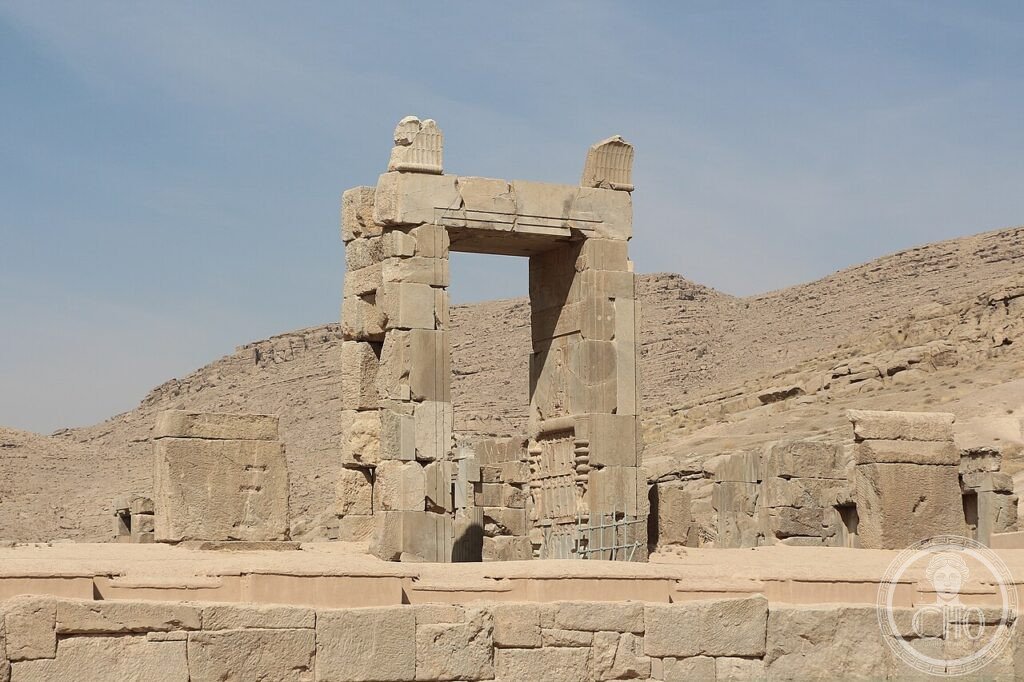
Persepolis was the ceremonial capital of the Achaemenid Persian Empire, raised by Darius I on a vast stone terrace and used chiefly for the Nowruz festival, when delegations from across the empire brought tribute to the Great King. Its surviving reliefs and columns remain the fullest visual record of that empire’s reach.
At a glance
Persepolis stands on an artificial stone terrace cut from the rock of Kuh-e Rahmat, roughly 450 metres long and 300 metres wide. Construction began around 518 BCE under Darius I, who raised the platform and built its earliest structures. The city was not a seat of everyday government or commerce; for most of the year it stood largely empty, populated mainly by the builders and craftsmen who worked on it. Its purpose was ceremonial: each Nowruz, representatives of the empire’s subject nations travelled to Persepolis to present tribute to the Great King.
The Apadana, the great audience hall completed by Darius’ son Xerxes I, was the largest building on the terrace. It originally held 72 columns some 20 metres tall, carrying double-bull or double-horse capitals and a cedar roof imported from Lebanon. Only 13 columns still stand, the rest lost when Alexander the Great burned the palace complex in 330 BCE.
Key facts
- Founded: around 518 BCE, under Darius I
- Completed and extended by: Xerxes I, then Artaxerxes I and II
- Destroyed: 330 BCE, burned by Alexander the Great after his defeat of Darius III
- Best-known feature: the Apadana staircase reliefs, showing delegations from 23 nations of the empire bringing tribute
- UNESCO status: inscribed as a World Heritage Site in 1979
History
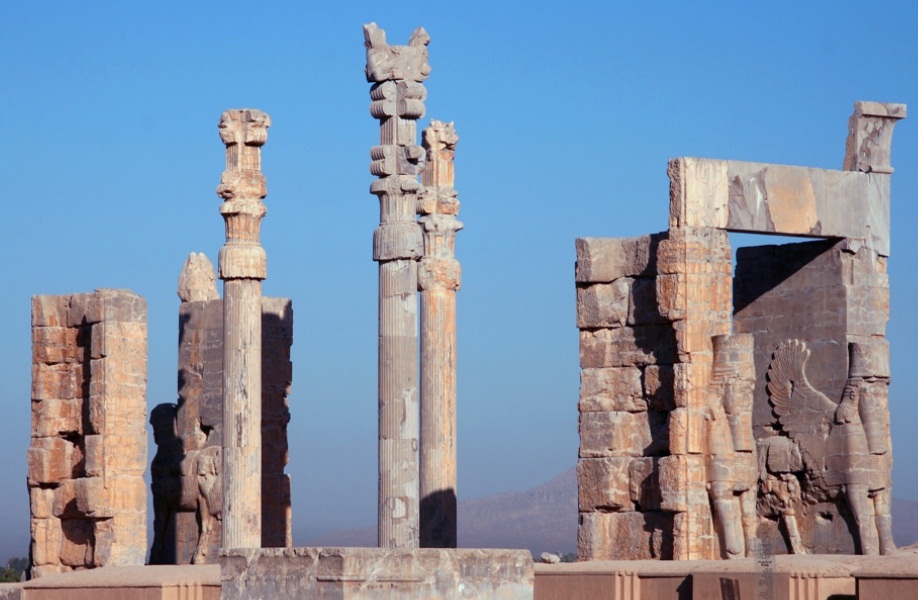
Darius I moved the Achaemenid ceremonial capital from Pasargadae, where Cyrus the Great is buried, to a new site on the Plain of Marvdasht. From about 518 BCE he raised the terrace and began the Apadana, the Council Hall known as the Tripylon, the Treasury and the royal apartments. His son Xerxes I completed the Apadana and added the Gate of All Nations, the ceremonial entrance guarded by winged bull-men. Later kings, Artaxerxes I and II, added further buildings, including the Hall of Hundred Columns, a second, larger but less refined throne hall.
In 330 BCE, after defeating Darius III and occupying the city, Alexander the Great burned the palace complex. Ancient writers disagree on why: Diodorus Siculus and Plutarch describe a drunken revel in which the courtesan Thais urged Alexander to avenge the Persian burning of Athens, while other accounts treat the fire as a deliberate political act marking the end of Achaemenid rule. The blaze fused column bases to the stone platform, but it also baked and so preserved the clay tablets of the Persepolis Fortification Archive, tens of thousands of administrative records that remain the principal source for how the Achaemenid palace economy was run.
After the Arab conquest of Persia in the seventh century, Persepolis was largely left alone as a symbol of a pre-Islamic, Zoroastrian past, and the site gradually silted over as its columns fell. It re-entered European awareness with the Italian traveller Pietro della Valle in 1620, and the first systematic excavations were carried out by the American archaeologist Ernst Herzfeld between 1930 and 1939, funded by the Oriental Institute of Chicago.
What you see
Visitors enter the terrace through the Gate of All Nations, built by Xerxes I and bearing his trilingual inscription in Old Persian, Elamite and Babylonian cuneiform. The gate is flanked by winged bull-men, guardian figures set to face those approaching. Beyond it stands the Apadana, its thirteen surviving columns reached by a double staircase carved with the empire’s most celebrated reliefs: processions of delegates from 23 nations, separated by cypress trees, each identified by dress, hairstyle and the tribute or animals they bring. Elamites lead a lion, Babylonians a Zebu bull, Lydians a horse with metal bowls, Ionian Greeks carry cloth and small vases, and other reliefs show Cappadocians, Armenians, Medes, Nubians, Egyptians, Bactrians, Scythians and Indians with their own gifts and animals.
At the centre of the terrace lies the Tripylon, the three-doored Council Hall, its reliefs showing the Great King attended by servants. The Hall of Hundred Columns, built under Xerxes and Artaxerxes I, was the largest hall of all, its hundred stone columns set in a ten-by-ten grid; only the column bases now survive, since the cedar roof is long gone. On the cliff behind the terrace stand the rock-cut cruciform tombs of Artaxerxes II, two completed and one left unfinished, each with a single accessible chamber.
Six kilometres north lies the necropolis of Naqsh-e Rostam, where four Achaemenid kings, Darius I, Xerxes I, Artaxerxes I and Darius II, are buried in cruciform tombs cut into the cliff face, alongside later Sassanid reliefs carved between them.
Practical information
- Location: Marvdasht, Fars Province, roughly 57 kilometres northeast of Shiraz along a well-maintained road
- Visas: most nationalities need a visa for Iran; an e-visa is available for many countries, though citizens of the United States, United Kingdom and Canada are required to travel with a guide throughout Iran
- Travel advisories: several Western governments maintain travel advisories for Iran, and it is worth checking the current situation with official sources before planning a visit
- Combine with: the Naqsh-e Rostam necropolis, often visited on the same day as Persepolis
Getting there
Persepolis lies northeast of Shiraz, whose international airport connects to destinations including Dubai, Istanbul and Tehran. From Shiraz the site is most commonly reached by hired taxi along a good road, with the option of combining the trip with a visit to nearby Naqsh-e Rostam.
Nearby
- Naqsh-e Rostam — 6 kilometres north of Persepolis, with four Achaemenid royal rock-cut tombs and Sassanid reliefs carved into the same cliff
- Shiraz — roughly 57 kilometres to the southwest, the usual base for visiting Persepolis
- Pasargadae — the original Achaemenid capital founded by Cyrus the Great, whose tomb stands there
Sources
- UNESCO
- Oriental Institute of Chicago
- Diodorus Siculus
- Plutarch
Gallery
Find it on the map
See this place and what’s around it →Events here — now on & upcoming
- Born 29/12/1550 — García de Silva Figueroa (476th anniversary)29 Dec 2026See the event →
Historical events at this place (1)
📷 Become a Cultural Heritage Online photographer
Share your photos of places: they stay published under your name as the author. The more they're seen, the more you get noticed — and soon a contest will reward the most appreciated photos.
Log in or sign up free to add a photoIs this page about you?
This page is read by travellers and heritage enthusiasts who find it on Google. Tell us how you are connected to this place and we will take it from there.