
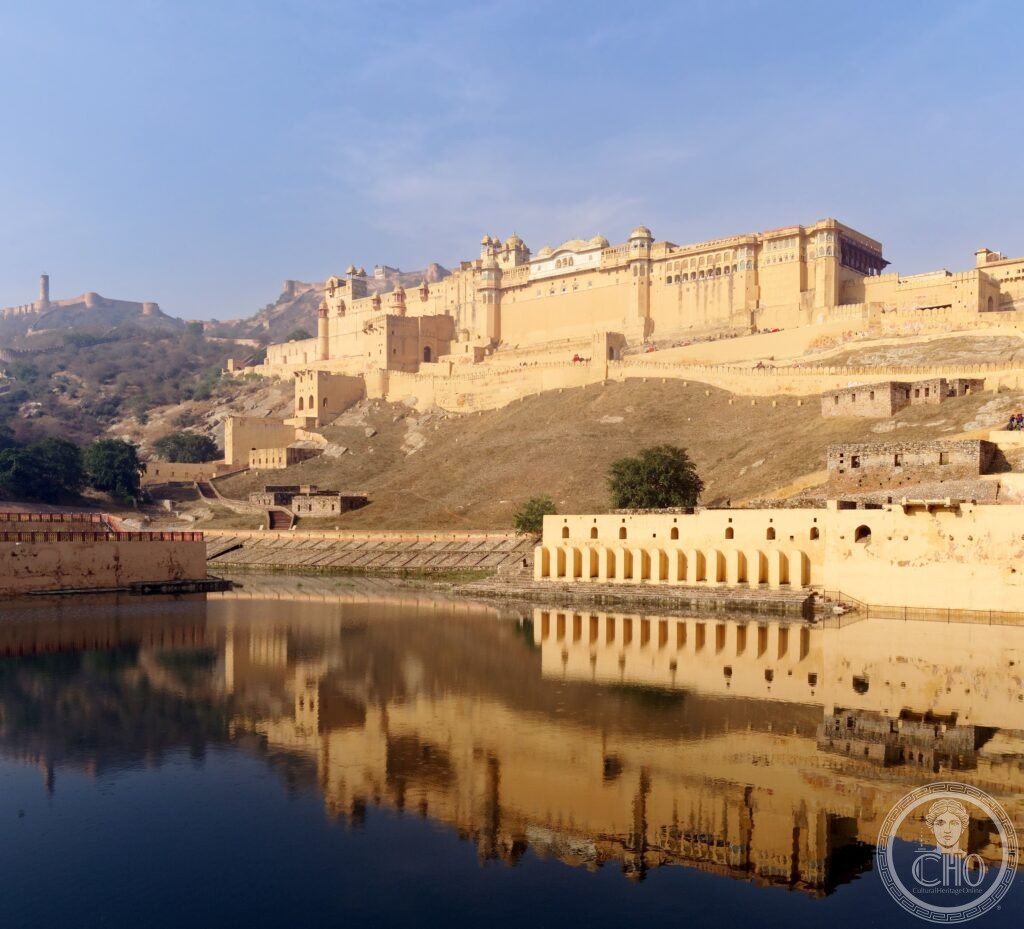
Rising on a ridge above the Maota Lake, Amber Fort was the seat of the Kachhawa Rajputs for two centuries. Its red sandstone courtyards climb the hillside towards the Sheesh Mahal, a chamber lined with thousands of hand-cut mirror fragments designed to glitter by a single candle flame rather than daylight.
At a glance
Amber Fort stands eleven kilometres north of Jaipur on the Aravalli ridge and forms part of the Hill Forts of Rajasthan, a serial UNESCO World Heritage Site inscribed in 2013 that groups six forts across the state, including Chittorgarh, Kumbhalgarh, Ranthambore, Gagron and Jaisalmer. The fort was the stronghold of the Kachhawa Rajputs, one of the thirty-six Rajput clans, whose alliance with the Mughal emperor Akbar transformed them into one of the most powerful noble houses of the empire.
Construction began under Man Singh I in the late sixteenth century and continued for generations. Mirza Raja Jai Singh I added the Sheesh Mahal in the mid-seventeenth century, and the complex reached its present form under Sawai Jai Singh II, who later founded Jaipur and moved the Kachhawa capital there, leaving Amber as a ceremonial seat.
Key facts
- Type: Rajput fort palace, part of the Hill Forts of Rajasthan serial UNESCO site
- Dynasty: Kachhawa Rajput, allied with the Mughal Empire from 1562
- Key feature: the Sheesh Mahal, a mirror-clad audience chamber built by Mirza Raja Jai Singh I
- Location: on the Aravalli ridge above the Maota Lake, north of Jaipur
- Coordinates: 26.9855° N, 75.8513° E
History
The ridge at Amber was settled from at least the tenth century by the Meena, an indigenous Adivasi people, before the Kachhawa Rajputs took the site from them in 967 CE. The decisive turn in the fort’s fortunes came in 1562, when the Kachhawa ruler Bharmal gave his daughter Harkha Bai, later known as Mariam-uz-Zamani, in marriage to the Mughal emperor Akbar. The alliance elevated the Kachhawa among the foremost Rajput clans, and later rulers such as Man Singh I served as trusted Mughal generals, funding an increasingly elaborate palace at Amber.
In 1727 Sawai Jai Singh II founded the new city of Jaipur and shifted the Kachhawa capital there. Jaipur later became known as the Pink City after its buildings were painted pink for a royal visit in the late nineteenth century, a colour scheme maintained ever since. Amber, meanwhile, was left as a symbolic rather than a lived-in seat of power.
What you see
Visitors enter through the Suraj Pol, the Sun Gate, into the Jaleb Chowk, a parade ground once large enough for elephant processions. Beyond it stands the Ganesh Pol, the most richly decorated of the fort’s gateways, its three storeys covered in frescoes of elephant processions, battle scenes and episodes from Hindu mythology, named for the carved figure of Ganesh above the arch.
The Diwan-i-Am, an open colonnaded hall, was where the maharaja received subjects and petitions. Further in lies the Jas Mandir and the adjoining Sheesh Mahal, the private audience chamber whose every surface is set with cut convex mirror fragments in geometric and floral patterns, an effect intended to be seen by a single flame rather than electric light. The Zenana Mahal, the women’s quarters, extends across the inner courtyard in tiered private apartments overlooking gardens.
A covered passage links Amber to Jaigarh Fort on the ridge above, which houses the Jai Ban, a wheeled cannon cast in 1720 and said to be the largest of its kind, though it was never fired in battle. Elephants have traditionally carried visitors up from the lake to the Suraj Pol, a practice that has become controversial on animal welfare grounds and whose status changes from time to time.
Practical information
- Tickets and hours: Amber Fort and the separate Jaigarh Fort each charge an entrance fee, with a combined ticket available; check the official Rajasthan tourism channels for current prices and opening times.
- Evening show: a son et lumière is staged in the evening in English and Hindi; booking ahead is advisable.
- Elephant rides: availability has varied due to animal welfare concerns, so confirm current policy before planning around them.
- Best season: the cooler months from October to March are more comfortable for the climb through the courtyards; the monsoon is atmospheric but paths can be slippery, and summer is very hot.
Getting there
Amber Fort lies north of Jaipur, which is served by Jaipur International Airport with connections to major Indian cities and some international routes. From central Jaipur the fort is reached by auto-rickshaw, taxi or tourist bus; visitors should confirm current fares and journey times locally rather than relying on fixed figures.
Nearby
- Jaipur’s walled Pink City — south of Amber; the City Palace holds royal textiles and paintings, the Jantar Mantar is a stone astronomical observatory inscribed as a UNESCO World Heritage Site in 2010, and the Hawa Mahal is a pink sandstone facade pierced with hundreds of small windows.
- Ranthambore National Park — southeast of Jaipur; part of the same Hill Forts of Rajasthan World Heritage listing and a Project Tiger reserve, where tigers roam around the ruined tenth-century Ranthambore Fort inside the park.
Sources
- UNESCO
- Project Tiger
Find it on the map
See this place and what’s around it →📷 Become a Cultural Heritage Online photographer
Share your photos of places: they stay published under your name as the author. The more they're seen, the more you get noticed — and soon a contest will reward the most appreciated photos.
Log in or sign up free to add a photoIs this page about you?
This page is read by travellers and heritage enthusiasts who find it on Google. Tell us how you are connected to this place and we will take it from there.