

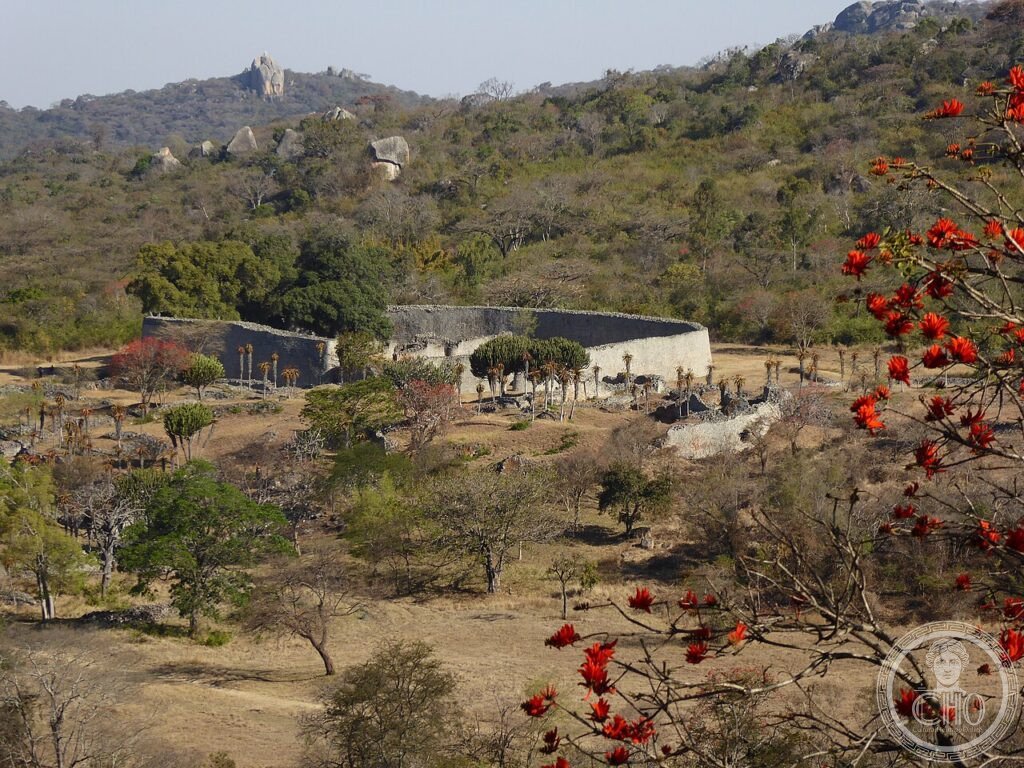
Great Zimbabwe is the largest stone construction in sub-Saharan Africa built without a single drop of mortar, the capital of a Shona kingdom that once controlled the gold trade to the Swahili coast, and the site that gave modern Zimbabwe its name.
At a glance
Great Zimbabwe covers roughly 7 square kilometres in Masvingo Province, southeastern Zimbabwe, and is built entirely in dry stone: granite blocks selected and stacked without mortar across some 900 hectares of walling. The complex has three main areas, the Hill Ruins, the Valley Ruins and the Great Enclosure, raised in stages by Shona builders between roughly the 11th and 15th centuries CE.
The name Zimbabwe comes from the Shona dzimba dza mabwe, houses of stone, or dzimba woye, venerated houses. It was first applied to this site and later given to the whole country at independence in 1980.
Key facts
- Location: Masvingo Province, southeastern Zimbabwe
- Built: by Bantu-speaking Shona builders, roughly 1100–1450 CE
- Great Enclosure: outer wall 255 metres in circumference, up to 11 metres high and 5 metres thick at the base, the longest ancient dry-stone wall in sub-Saharan Africa
- Conical Tower: around 9 metres high and 5 metres in diameter, solid granite with no known entrance; its purpose is still debated
- Zimbabwe Birds: eight carved soapstone birds, each about 40 centimetres tall, originally set on columns at the Hill Ruins and now the national symbol of Zimbabwe
- Status: UNESCO World Heritage Site, inscribed in 1986
History
From around 200 CE, ancestors of the Shona people settled the Zimbabwe Plateau, and early farming cultures such as Gokomere and Leopard’s Kopje developed cattle raising, grain farming and gold smelting, the skills that later underpinned the Kingdom of Zimbabwe. Between roughly 1100 and 1450 CE the kingdom grew rich on the gold trade, panning gold from the plateau’s streams and moving it south and east to Swahili coast ports, notably Sofala in modern Mozambique, from where it travelled on to Kilwa, Arabia and India. At its height, around 1420 CE, Great Zimbabwe is thought to have been the largest pre-colonial city in sub-Saharan Africa outside the great West African states.
The capital was abandoned between roughly 1420 and 1450 CE, most likely because the population had outgrown the surrounding environment, exhausting nearby forests and grazing land, with drought possibly hastening the collapse. The ruling dynasty then moved north to the Zambezi Valley and founded the Mutapa, or Monomotapa, Empire, which the Portuguese later encountered on the Mozambique coast and tried, without success, to bring under colonial control.
When European settlers arrived in the 1890s, colonial-era scholars refused to accept that Africans had built the stone structures, variously crediting Phoenicians, the people of the Queen of Sheba or Arab traders. Systematic archaeological work from the 1930s onwards disproved these theories, and the Shona origin of Great Zimbabwe is now accepted throughout academic archaeology.
What you see
A rocky path leads up the kopje to the Hill Ruins, the oldest part of the site, where stone walls are built directly into the natural boulders to form a single fortified mass. From the top the whole valley opens out, with the Great Enclosure visible below and, further off, the man-made Lake Mutirikwe, which supplies Masvingo with water, set among granite hill country.
The Great Enclosure is the principal structure and the main point of interest for most visitors. Its outer wall runs for 255 metres and shows considerable variety in the coursing of the granite blocks, including a 75-metre decorated section carrying a zigzag or herringbone pattern, the most elaborate stonework anywhere on the site. Inside stands the Conical Tower, a solid granite structure with no opening and no known function, widely thought to represent a grain store, a royal symbol or a sacred monument.
The Great Zimbabwe Museum stands beside the entrance and holds one original Zimbabwe bird sculpture along with replicas of the others, plus Chinese ceramics dating from the 13th to 15th centuries CE, excavated on site and evidence of the trade links running from Kilwa as far as China.
Practical information
- Access: Great Zimbabwe lies about 25 kilometres southeast of Masvingo, the nearest city; there is no direct public transport to the site, so a hire car or taxi from Masvingo is needed
- Accommodation: the Great Zimbabwe Hotel, a government-run property adjacent to the ruins, is the usual base for visitors
- Visiting: the site is extensive; guided tours are available, and current entry arrangements and opening times are best checked with the official monument authority before travelling
Getting there
Masvingo, roughly 290 kilometres south of Harare on the Harare–Beit Bridge highway, is the practical starting point for a visit. From Masvingo the site itself is about 25 kilometres away by road, reached by hire car or taxi rather than public transport. Harare’s Robert Gabriel Mugabe International Airport is the main international gateway, with connections from Johannesburg and further afield; current routings and schedules should be confirmed directly with the airlines.Nearby
- Masvingo — about 25 kilometres northwest, the nearest city, home to the Fort Victoria ruins, a British South Africa Company fort dating from 1890, and to the Robert Mugabe Museum near his birthplace village
- Mushandike National Park — a small wildlife reserve near Masvingo with kudu, zebra and impala
- Gonarezhou National Park — about 200 kilometres southeast, Zimbabwe’s second-largest national park after Hwange, known for its large-tusked elephant population and the red sandstone Chilojo Cliffs above the Runde River
Sources
- UNESCO
- Great Zimbabwe Museum
Find it on the map
See this place and what’s around it →📷 Become a Cultural Heritage Online photographer
Share your photos of places: they stay published under your name as the author. The more they're seen, the more you get noticed — and soon a contest will reward the most appreciated photos.
Log in or sign up free to add a photoIs this page about you?
This page is read by travellers and heritage enthusiasts who find it on Google. Tell us how you are connected to this place and we will take it from there.