
Chauvet Cave — The Oldest Paintings in the World

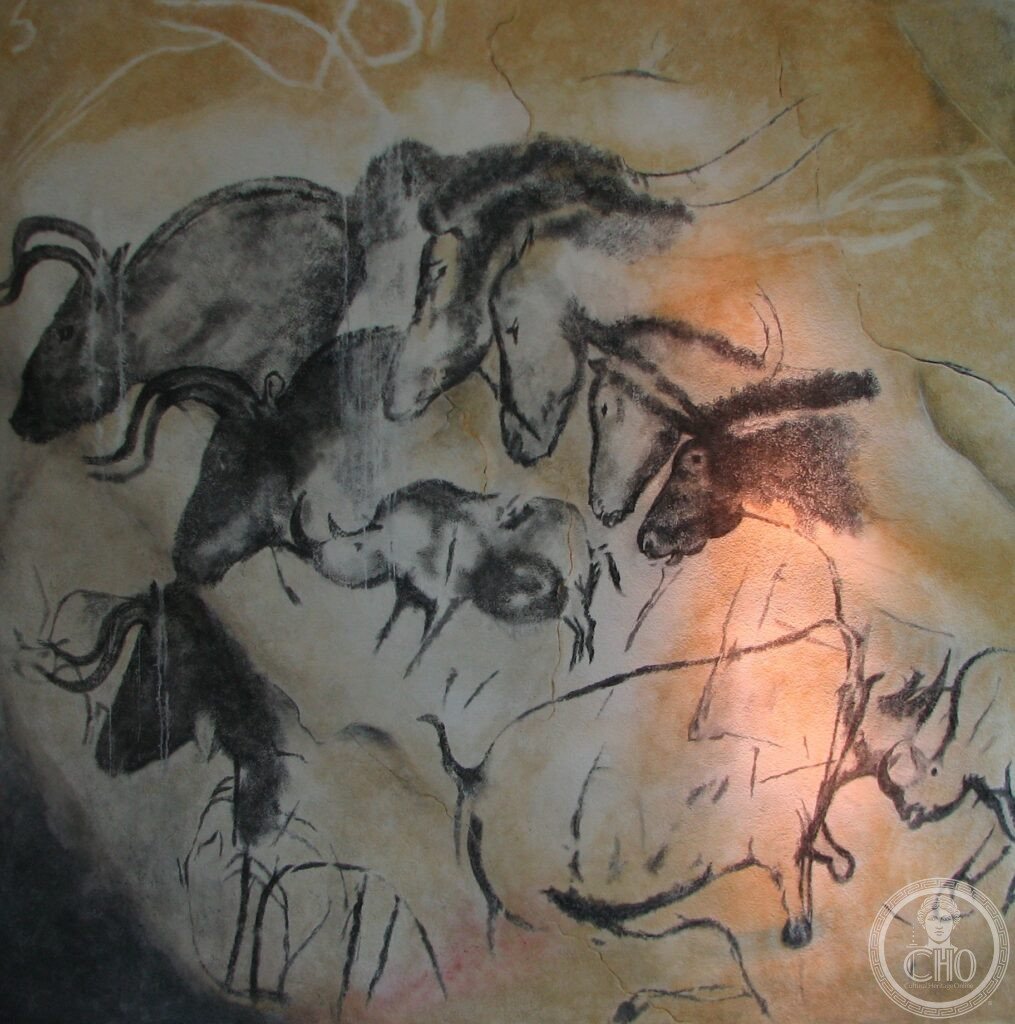
Chauvet Cave France Paleolithic rock art 36000 BCE lions rhinos mammoths Ardèche UNESCO Chauvet Cave (a reproduction of the wall paintings from the Chauvet Cave (Grotte Chauvet-Pont d’Arc); the Panel of the Lions (the most famous composition in the cave; a frieze of approximately 16 lions facing right; each lion painted with extraordinary naturalism and mastery of perspective — the overlapping manes, the turned heads, the sense of movement of a pride on the hunt; approximately 36,000 BCE); the Panel of the Rhinoceroses; the cave bear skull on a limestone altar; the charcoal lines of a wooly rhinoceros horn; the Pont d’Arc natural arch of the Ardèche visible from the replica cave entrance (Caverne du Pont d’Arc; the full-scale replica open to the public)), Vallon-Pont-d’Arc, Ardèche, France. UNESCO World Heritage Site 2014. Photo via Wikimedia Commons.
Vallon-Pont-d’Arc, Ardèche, France · 36,000-28,000 BCE; the oldest cave paintings in the world; lions, rhinos, mammoths, bears; discovered 1994 CE; permanently closed; Caverne du Pont d’Arc replica open; UNESCO WHS 2014

Chauvet Cave — The Oldest Paintings in the World

The oldest known representational paintings in the world and a revolutionary rethinking of human cognitive and artistic development — the Chauvet Cave (Grotte Chauvet-Pont d’Arc; discovered December 1994 CE; Vallon-Pont-d’Arc, Ardèche, southern France; permanently closed to the public) contains approximately 425 animal paintings dated to 36,000-28,000 BCE — nearly 20,000 years older than the Lascaux paintings — yet executed with a mastery and complexity that shattered the prevailing theory that Paleolithic art evolved from simple to complex over time.

At a glance

Chauvet Cave (the most precisely Chauvet single 36000-28000 BCE AMS radiocarbon oldest paintings world Ardèche Pont Arc lions rhinoceroses mammoths horses bears complex composition perspective UNESCO heritage: the Chauvet Cave was discovered on 18 December 1994 CE by three speleologists: Jean-Marie Chauvet, Éliette Brunel Deschamps, and Christian Hillaire; they found the cave entrance (a small opening in the cliff above the Ardèche river) and squeezed through; inside they found the most extraordinary assembly of Paleolithic paintings ever seen; the immediate impact on Paleolithic art research was seismic: the stylistic complexity and mastery of the Chauvet paintings was far beyond anything expected for paintings of this age; the conventional theory (proposed by the art historian Henri Breuil in the early 20th century CE) was that Paleolithic art evolved from simple to complex — the earliest paintings were crude and simple; later paintings were more sophisticated; Chauvet invalidated this theory completely: the 36,000-year-old paintings at Chauvet are among the most compositionally sophisticated Paleolithic paintings known — the Panel of the Lions is a masterpiece of composition, perspective, and naturalistic animal observation that would not be out of place in a medieval bestiary — the most precisely Chauvet single 36000-28000 BCE AMS radiocarbon oldest paintings world Ardèche Pont Arc lions rhinoceroses mammoths horses bears complex composition perspective UNESCO heritage in any UNESCO world heritage site)).

Key facts

  • The Panel of Lions: the most precisely Chauvet single Panel Lions 16 lions hunting charging pride rhinoceroses facing promenade composition movement mastery perspective charcoal Aurignacian heritage — the Panel of the Lions at Chauvet (the most celebrated composition in the cave; in the deepest part of the cave known as the “Hillaire Chamber”): approximately 16 lions are depicted in charcoal on a large white limestone panel; the composition is not random — the lions are arranged in a charging pride (the animals overlap; the heads turn; the manes are indicated by thick lines; a sense of mass movement is conveyed); facing the lions in the same panel are approximately 5-6 woolly rhinoceroses facing in the opposite direction; the confrontation of the two groups (lions and rhinos) is one of the most complex compositional structures in Paleolithic art; the lions are painted in charcoal with extraordinary naturalistic accuracy (the proportion of the body; the shape of the head; the size of the paws; the musculature of the shoulders)
  • Permanently Closed: the most precisely Chauvet single 1994 discovery Chauvet Brunel Hillaire permanently closed conservation Caverne Pont Arc 2015 replica Cro-Magnon Aurignacian visit alternative heritage — the Chauvet Cave has been permanently closed to the public since its discovery in 1994 CE: the French Ministry of Culture decided immediately after the discovery that the cave would not be opened to visitors — the experience of Lascaux (which deteriorated rapidly after visitor access began in 1948 CE; closed in 1963 CE due to algae and mould growth from visitor breath and body heat) and Altamira (similarly affected) demonstrated that cave art is incompatible with mass visitor access; the solution for Chauvet was a full-scale replica: the Caverne du Pont d’Arc (opened June 2015 CE; 3 km from the original cave; 8,500 m² of replica cave passages; the full-scale reproduction of all the major painted panels using the same charcoal and ochre pigments on a physical surface cast from the original; the most exact replica of a cave art site ever built; the UNESCO distinction (as replica rather than original) is explicitly acknowledged in the signage)
  • GPS: 44.3850° N, 4.4163° E

History

The Aurignacian painters (the most precisely Chauvet single Aurignacian culture 36000-28000 BCE Homo sapiens first European Cro-Magnon anatomically modern charcoal ochre technique shading perspective heritage: the painters of the Chauvet Cave belonged to the Aurignacian culture (the earliest Upper Paleolithic culture in Europe; 47,000-29,000 BCE; associated with the arrival of Homo sapiens (anatomically modern humans) in Europe); these were the first modern humans in Europe — arriving from the east approximately 45,000-40,000 BCE; replacing the Neanderthals who had occupied Europe for hundreds of thousands of years; the Chauvet paintings demonstrate that the very first European modern humans (Cro-Magnon, from the site in the Dordogne where the first skeleton was found) had the full cognitive and motor capabilities for representational art — the charcoal shading technique (blending and smudging to indicate volume and depth), the perspective (the animals overlap; the animal in front obscures the one behind), and the composition (animals grouped by species, grouped by movement) are all elements of mature artistic tradition, not a beginner’s exploration — the most precisely Chauvet single Aurignacian culture 36000-28000 BCE Homo sapiens first European Cro-Magnon anatomically modern charcoal ochre technique shading perspective heritage in any UNESCO world heritage site)).

What you see

Visiting the Caverne du Pont d’Arc (the most precisely Chauvet single Caverne Pont Arc 2015 replica 3km valley Ardèche gorge guided tour 75 minutes booking essential heritage: the only way to experience the Chauvet paintings is through the Caverne du Pont d’Arc (the official replica; D290 road between Vallon-Pont-d’Arc and Pont d’Arc; open daily February-November; €18 adult; €12 child; guided tour 75 minutes (French or English); group size maximum 35; booking essential (cavernedupontdarc.fr)); the experience of the Caverne is designed to approximate the original: the entry tunnel is dark and narrows; the temperature drops to 13°C (the cave environment); the guide uses lighting that replicates the original lamplight of the Paleolithic; the Panel of Lions, the Panel of Rhinoceroses, the Horse Panel, the Bear Panel, and the Great Chamber with the altar of bear skulls are all reproduced at exact scale and with the exact pigments; note: the Pont d’Arc natural arch (3 km east; the largest natural stone arch in Europe; accessible by kayak or by foot; the canonical landscape of the Ardèche gorge) can be combined in the same day as a visit to the Caverne — the most precisely Chauvet single Caverne Pont Arc 2015 replica 3km valley Ardèche gorge guided tour 75 minutes booking essential heritage in any UNESCO world heritage site)).

Practical information

  • Getting there: Vallon-Pont-d’Arc is in the Ardèche department of southern France; the nearest major city is Lyon (TGV from Paris Gare de Lyon; 2h; then by road 130 km south; 1h30); or from Montpellier (100 km east; 1h30 by car); by road: the D290 between Vallon-Pont-d’Arc and Pont d’Arc; no public transport to the Caverne (hire car essential for this area); the nearby Ardèche Gorges (the 30 km gorge from Pont d’Arc to St-Martin-d’Ardèche; kayak hire available at multiple points; the most popular outdoor activity in the Ardèche); the best months are April-June and September-October (July-August: the gorge is extremely crowded with holidaymakers; temperatures 35°C+; advance booking for the Caverne 4-6 weeks ahead in July-August)

Getting there

Lyon TGV from Paris 2h, then 130 km by car. Caverne du Pont d’Arc (replica): €18, guided 75 min, book online. Pont d’Arc natural arch kayak nearby. GPS: 44.3850, 4.4163.

Nearby

  • Pont d’Arc — 3 km east; the largest natural stone arch in Europe (36m high; 60m wide; formed by the Ardèche river cutting through the limestone plateau over 100,000 years; the river once looped around the headland; the arch is the remnant of the former river cliff; the view from the Serre de Tourre belvedere above the arch; the kayak route from Pont d’Arc to St-Martin-d’Ardèche passes through the 30 km gorge below the arch)
  • Lascaux IV — 250 km northwest (Dordogne); the other great prehistoric art replica (Lascaux Cave, discovered 1940 CE, closed 1963 CE; Lascaux IV is the fourth-generation replica opened 2016 CE; the International Cave Art Center (CIAP); €20; the companion UNESCO site to Chauvet for the understanding of Magdalenian art (17,000-12,000 BCE))

Sources

  • Wikipedia, Chauvet Cave; Aurignacian; Caverne du Pont d’Arc, accessed June 2026
  • UNESCO, Decorated Cave of Pont d’Arc, known as Grotte Chauvet-Pont d’Arc, WHS reference 1426, inscribed 2014

Hero image: Chauvet Cave, Ardèche, France, Wikimedia Commons. Editorial text © Cultural Heritage Online, 2026.

📷 Diventa un fotografo di Cultural Heritage Online

Condividi le tue foto dei luoghi: restano pubblicate con la tua firma come autore. Più vengono viste, più ti fai conoscere — e presto un concorso premierà le foto più apprezzate.

Accedi o registrati gratis per aggiungere una foto
📋 Copy & share on social
Scroll to Top