
Curated Itinerary
The City That Made Modern: A Glasgow Mackintosh RoadBook (1895–1909)
Travel tips from CHOThe national collections cost nothingFifteen national museums and galleries have charged nothing for their permanent collections since […]
Get this route — explore at your own pace
The walk and the notes are open to everyone, right here. To take the route with you — the GPX and KML tracks for your phone — you need a CHO account, and a free one is enough. We do not sell these routes: we build them ourselves and give them to the people who read us.
Create a free accountAlready have one? Log in.
This route was built with the tools we give operators.
Guides, associations and cultural operators build their own routes here: pick the stops from the archive, add your notes, and the map, the GPX and the printable version come out on their own. Your programme gets a permanent page, your events go on the city pages people read while planning — and if you sell your route as a road-book or a virtual tour, you receive 80% of the price net of tax.
See how an operator account worksBefore you go
A word from your host
Mackintosh spent most of his working life in Glasgow, was largely ignored by its establishment, took his Tea Room furniture apart in 1914 when the lease expired and never recovered professionally from the experience, and moved to London and then to Suffolk and then to Spain to paint watercolours in the last decade of his life. He died in 1928, aged sixty. The buildings you are about to walk were produced between his twenty-seventh and forty-first years, which is to say that they represent one specific and relatively short period of an architect who spent the rest of his career unable to build. The School of Art, the only major commission he ever received from an institution, was built in two phases separated by eight years during which he produced almost nothing at that scale. The Tea Rooms and the church were produced by a man who was simultaneously one of the most admired designers in Europe — the Germans and Austrians took him seriously when the English did not — and effectively unemployed at the level he was capable of. This context does not change the buildings, but it does change how you look at them: they are the work of someone who had very few opportunities and made them count. The fires at the School of Art in 2014 and 2018 destroyed what many considered his greatest single room. That loss is also part of the story.
Getting around
The walk divides into three zones. Zone 1 — city centre — covers the City Chambers, the Lighthouse and the Glasgow School of Art, all within fifteen minutes on foot of each other; the Willow Tea Rooms are a further eight minutes east on Sauchiehall Street. Zone 2 — north: Queen's Cross Church is 2.5 kilometres from Sauchiehall Street; take bus 20 northbound from Bath Street or a taxi (10 minutes). Zone 3 — south: Scotland Street School is best reached by the Glasgow Subway (Buchanan Street to Shields Road, three stops, the station exit opens directly opposite the building). The House for an Art Lover is in Bellahouston Park, approximately 15 minutes west of Scotland Street by bus 34. One-day SPT subway and bus passes cover all the transit. The city centre zone is entirely walkable and mostly flat, with a short uphill section to the School of Art on Renfrew Street. Flat shoes are adequate; the weather in Glasgow is reliably Scottish regardless of the season.
Step by step
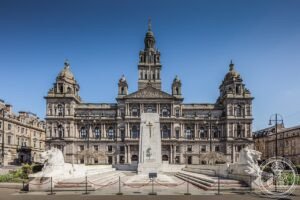
Glasgow City Chambers
Begin in George Square under the full rhetoric of imperial Glasgow: three storeys of Carrara marble, a staircase that reportedly exceeds the Vatican's, and a building commissioned by a city that called itself "Second City of the Empire" without irony. This is what the city built in 1888. Mackintosh was twenty years old.
The storyWilliam Young's City Chambers opened in 1888, when Glasgow was at the absolute peak of its Victorian industrial confidence. The shipyards of the Clyde were building a third of the world's tonnage; the tobacco lords' money had long since been converted into municipal institutions; the city had built parks, libraries, art galleries, and now a seat of government proportioned to an empire. The marble staircase — Carrara, alabaster, Numidian red, three storeys of it — was the boast of a city that genuinely believed it was the second most important place in the world. Charles Rennie Mackintosh was born in the city that year, 1868. He was already twenty when this building opened, already studying at the Glasgow School of Art, already absorbing the Japanese design principles and the Whistlerian aesthetics that would give him a language completely unlike the one on display here.
Insider tipThe free guided tours at 10:30 and 14:30 on weekdays are the only way to see the interior properly: the banqueting hall upstairs, with its murals by the Glasgow Boys and its mahogany and leaded glass, is one of the finest Victorian civic interiors in Britain and is not visible from the public ground-floor areas. The George Square facade rewards a slow circumnavigation: notice how the building attempts to close and define the square architecturally, and then look at what the square actually contains — Victorian statuary of varying quality in a layout that never quite resolved itself. The contrast with Mackintosh's handling of space is instructive from the very first stop.
A fitting stopThe Merchant City neighbourhood directly east of George Square — Hutcheson Street, Virginia Street, Candleriggs — has Glasgow's best concentration of independent cafes, delis and brunch spots. Café Gandolfi on Albion Street has been a Glasgow institution since 1979, with stained glass and furniture by Tim Stead: not Mackintosh, but the same impulse toward craft in the everyday.

The Lighthouse (Glasgow Herald Building)
Mitchell Lane, off Buchanan Street. The Glasgow Herald Building of 1895 was Mackintosh's first major public commission, won while he was still a draughtsman at Honeyman & Keppie. The corner tower and the facade above the newspaper's ground-floor frontage already speak a different language from George Square. Now the Lighthouse — Scotland's national centre for architecture and design.
The storyMackintosh designed the Glasgow Herald Building in 1895 while still employed as a draughtsman at the established architectural firm of Honeyman & Keppie. He was twenty-seven. The corner tower — with its decorative metalwork and the way it handles the acute angle of the lane — was his, and it announced a sensibility that the firm's established partners had not produced and could not quite account for. The building became the newspaper's offices and printing works; the tower carried a water tank for the in-house fire protection system, which is why it rises above the roofline in that particular way. When the Herald moved out, the building was adapted as Scotland's centre for architecture and design, and renamed the Lighthouse in 1999. The name is apt: the tower still dominates Mitchell Lane, and the building still functions as a point of reference.
Insider tipThe Mackintosh Interpretation Centre on the top floor gives a compact biography and a selection of drawings and photographs; it is the best single overview of his career if you are starting here rather than at the School of Art. The rooftop terrace has one of the better views of central Glasgow — the grid of the Victorian city laid out below, with the GSA visible uphill to the north-west, which is your next stop. The lane itself, Mitchell Lane, is worth the time: the back of the building, with its brick and iron construction, is very different from the dressed stone of the street facade.
A fitting stopPaesano Pizza on Miller Street, two minutes from the Lighthouse, makes wood-fired Neapolitan pizza in a long room with simple tiled walls and no distractions: it is one of the best places to eat in the city centre, fully licensed, open from noon. The alternative: Platform, the market food hall in the arches under Central Station, five minutes south.
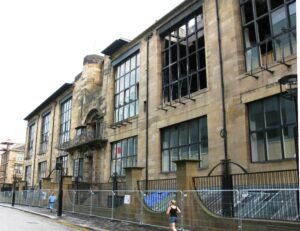
Glasgow School of Art
Renfrew Street, Garnethill. The Glasgow School of Art is the building by which Mackintosh is judged and which fire has twice struck: the Mackintosh Library was damaged in 2014 and largely destroyed in 2018. The east wing (1897–1899) and west wing (1907–1909) are in ongoing restoration; check current access before visiting. See as much as you can from the exterior: the building's relationship to its steep hillside site is an argument in itself.
The storyMackintosh won the competition for the Glasgow School of Art in 1897 and delivered it in two phases separated by a decade: the east wing and main entrance in 1897–1899; the west wing, including the famous library, in 1907–1909. The library was the building's masterwork — a double-height room of hanging timber galleries, pendant light fittings and carved vertical timbers that many critics considered the finest interior space produced by the Arts and Crafts generation anywhere. In June 2014 a fire damaged it severely. In June 2018 a second fire destroyed it almost entirely. The building remains in ongoing restoration; the library may not be rebuilt in any form that Mackintosh would have recognised. What you see from Renfrew Street today is the east wing and the main entrance, which survived. The west wing façade — also visible from the street — shows the change in Mackintosh's language over the decade between the two phases: more austere, more sure of itself, less eager to explain.
Insider tipThe exterior of the east wing repays close examination of the ironwork at the ground-floor studio windows: Mackintosh designed these brackets and inserts as functional elements — they held the cleaners' equipment — and gave them a form that is partly organic, partly heraldic, and wholly unlike anything produced by the mainstream Arts and Crafts movement. The main entrance, with its deep recessed arch, was designed to face the sun at a specific angle in the late afternoon, which is the best time to see it. Check the GSA website for the current state of access and any public events: the school has used temporary spaces and sometimes allows exterior guided tours.
A fitting stopThe Tchin Tchin wine bar on Renfrew Street is a short walk from the school and opens from noon; it has one of the better selections of natural wine in the city and simple charcuterie and cheese boards. The Kelvingrove café in the park, thirty minutes' walk west, is worth the detour if you are ending early: the museum itself is free and the café opens until the museum closes.
Sauchiehall Street. Kate Cranston commissioned Mackintosh to design every interior of these tea rooms in 1903 — walls, ceilings, furniture, cutlery. The Room de Luxe on the first floor, with its mirrored frieze and high-backed chairs, is the most complete surviving Mackintosh interior in Glasgow. Book ahead for afternoon tea if you intend to eat; walk-ins are also welcomed at quieter times.
The storyKate Cranston was Mackintosh's most consistent patron, commissioning him to design — and redesign — a series of tea rooms across Glasgow between 1896 and 1917. The Willow Tea Rooms on Sauchiehall Street, designed in 1903, were the commission where she gave him complete control: the building facade, the furniture, the textiles, the cutlery, the menus. The name "Sauchiehall" derives from the Scots Gaelic for "avenue of willows," and Mackintosh used the willow as the decorative programme throughout: abstracted willow forms appear in the stencilling, the metalwork, the leaded glass panels, the high-backed chairs. The Room de Luxe on the first floor — with its mirrored frieze, purple and silver palette, and the signature chairs with their tall latticed backs — is the most complete surviving Mackintosh interior in the city. The building deteriorated badly in the late twentieth century and was restored from 2014 to 2018; it reopened as a working tea room and museum in 2018.
Insider tipBook the Room de Luxe for afternoon tea if you want the full experience: the restoration brought back the 1903 colour scheme and reinstated furniture made to Mackintosh's original specifications. If you are visiting without a reservation, the ground floor and the museum areas are freely accessible during opening hours, and the Room de Luxe can be seen on a self-guided tour. Look at the door to the Room de Luxe specifically: the leaded glass panels and the ironwork of the handle are among the most precisely realised pieces of decorative design in the building.
A fitting stopYou are already in a tea room: this is the most atmospheric place to eat on the walk, and the menu — Scots afternoon tea, soup, sandwiches — is straightforward and well done. It is also one of the few surviving places in Glasgow where you can sit in a Mackintosh room and eat, which is a different kind of experience from museum-going.
Queen’s Cross Church, Glasgow
Maryhill Road, north Glasgow. The only surviving church designed by Mackintosh, built 1897–1899 while he was working simultaneously on the School of Art. Take the No. 20 bus from Bath Street or a taxi from Sauchiehall Street: the church is about 2.5 kilometres north. It is a working congregation. The tower and the interior — particularly the stencilled nave and the handling of natural light — are the key experiences.
The storyQueen's Cross Church was built between 1897 and 1899, during exactly the same period as the first phase of the School of Art — two buildings with almost nothing in common except their author. Where the School of Art is a secular and modernist argument, Queen's Cross is a church that draws on Gothic structure, medieval Scottish parish architecture, and a kind of Arts and Crafts naturalism that Mackintosh brought from his study of Japanese design and his reading of Ruskin. The tower is the key: its profile changes as you move around it, presenting a different silhouette from every angle. The congregation moved out in 1975, and the building has been owned by the Charles Rennie Mackintosh Society since 1977, which maintains it as a heritage site and meeting space. It is the only church Mackintosh designed that was built.
Insider tipArrive at the north side of the building first, where the tower meets the nave: the transition between the two elements — the way the tower seems to grow from the corner of the building rather than being attached to it — is the most characteristically Mackintosh moment on the exterior. The interior nave, with its stencilled walls and the way the light is filtered through the clerestory windows, is best seen on a day of moderate overcast light rather than full sunshine: the diffused light brings out the pale cream of the walls and the subtle colouring of the stencil work without the harsh contrasts of direct sunlight. The Mackintosh Society sometimes runs guided tours; check their website before visiting.
A fitting stopThe Maryhill neighbourhood around Queen's Cross is not a restaurant district; plan to eat before arriving or after returning to the centre. The Bothy on Byres Road in the West End — about 15 minutes by bus from Queen's Cross — does dependable Scottish food and is close to the Kelvingrove Museum if you want to extend the day.

Scotland Street School, Glasgow
Scotland Street, south Glasgow. The school of 1903–1906 is most famous for its twin glass staircase towers, which function both as structural supports and as light-catchers that illuminate the interior throughout the day. Now a museum of education. Reach it on the Glasgow Subway from Hillhead or St George's Cross to Shields Road; the school is directly across the street.
The storyScotland Street School, completed in 1906, is sometimes described as Mackintosh's most joyful building — an unlikely description for an Edwardian elementary school, but not an inaccurate one. The twin glass staircase towers on the north elevation are the defining element: full-height semicircular oriels in glass and stone that pull daylight into the interior and, from the street, present a facade of unusual lightness for a school of this period and type. Mackintosh was given a larger budget here than for many of his earlier commissions and used it to develop the structural logic of glazed towers that he had been moving toward since the West Wing of the School of Art. The school closed in 1979 and was converted into a museum of education in 1990; the original classrooms, cloakrooms and gymnasium have been preserved at different periods of the twentieth century, which makes the building function as a social as well as an architectural document.
Insider tipThe interior is free to visit and straightforward to explore: the school is now a museum of Scottish education, and the rooms show classroom furniture and materials from different decades of the twentieth century. The staircase towers are the primary architectural experience — the light inside the glazed halls, particularly in the morning, is unlike anything else in Glasgow. Walk the full north elevation from east to west before entering: the relationship between the two towers, the central entrance block, and the flat wall surfaces between them is a composition that needs to be read as a whole before the detail becomes apparent.
A fitting stopThe Tramway arts centre is five minutes' walk west on Albert Drive, and its café is open on event days. Otherwise, head back to the West End by subway (one stop north from Shields Road to Kinning Park, then change at Buchanan Street for Hillhead): Ashton Lane in Hillhead is Glasgow's most concentrated strip of bars, restaurants and cafes, and a natural end-of-afternoon stop.

House for an Art Lover, Glasgow
Bellahouston Park. The House for an Art Lover was designed by Mackintosh in 1901 as an entry in a competition set by the German publisher Alexander Koch — the brief asked for "a highly individual country house in a thoroughly modern style." Mackintosh did not win. The house was built posthumously between 1989 and 1996, working from his surviving competition drawings. It is therefore the only Mackintosh building never touched by Mackintosh, and the most complete possible answer to the question of what he might have built had he been allowed to.
The storyThe story of the House for an Art Lover begins with a competition brief published in 1901 by the German publisher Alexander Koch, who asked architects to design "a highly individual country house in a thoroughly modern style for a man of cosmopolitan views." Mackintosh and his wife and collaborator Margaret Macdonald entered the competition with a design of unusual clarity: a horizontal house set in a landscape, its interiors given to the art of living rather than to display. They did not win — Mackintosh was disqualified on a technicality, and the prize went to a German entrant. The drawings were published in Koch's journal Meister der Innen-Kunst, where they influenced a generation of European designers including Josef Hoffmann and the Wiener Werkstätte. The house itself was not built until 1989–1996, based on the original competition drawings supplemented by the work of Graham Roxburgh and Graeme Robertson, who completed the details that Mackintosh left unresolved. It is the only building in the city designed by Mackintosh never touched by his hand, and the most complete surviving argument for what he might have produced at full scale had Scotland given him the opportunity.
Insider tipThe main hall and the music room are the key interiors: the music room in particular, with its oval room structure, its rose-pattern panels by Margaret Macdonald Mackintosh, and the way it handles natural light from the south, shows the collaboration between the two as something closer to equal than the history of architecture has usually acknowledged. Margaret Macdonald's contribution — the gesso panels, the textile designs, the colour sense — is inseparable from what the building feels like, and the House for an Art Lover is one of the few places where this is fully visible. Admission is charged; check opening days before visiting, as the house is also used as a private events venue.
A fitting stopEnd the day at the Pollock Shaws neighbourhood or return by bus to the West End. Specifically: Ox and Finch on Sauchiehall Street — small plates, open kitchen, fully licensed, one of the better restaurants in the city for an evening meal after a day on foot. Book ahead.
Download for tour navigation
PDF is the stop list with GPS, to print or keep on the phone. GPX for Garmin / Komoot / OsmAnd. KML for Google Earth and Maps.