

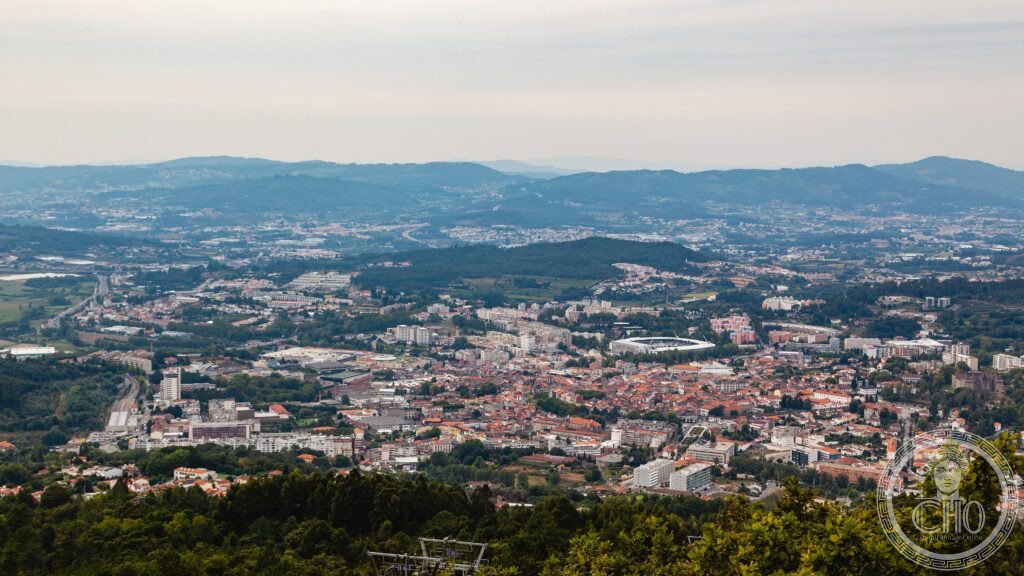
Guimarães is where the kingdom of Portugal began. Afonso Henriques was born in its castle and used the city as his base to fight for independence from Galicia. The medieval centre that grew up around him survives largely intact, its narrow lanes and stone houses unbroken by the earthquake and rebuilding that reshaped so much of the country.
At a glance
Guimarães is known in Portugal as the place where the nation was born. Afonso Henriques was born here in 1109, made the city his capital, and went on to defeat his own mother’s forces at the nearby Battle of São Mamede before eventually declaring himself the first King of Portugal. The castle still carries the inscription ‘Aqui nasceu Portugal’, here Portugal was born, a phrase that carries enormous weight in Portuguese national memory.
What makes the city unusual is how much of its medieval fabric has survived. The historic centre keeps its old street plan and houses dating from the twelfth to the fifteenth centuries. Guimarães lies far enough from Lisbon to have escaped the 1755 earthquake that flattened so much of the capital, and it has largely avoided heavy modern redevelopment too.
Key facts
- Castle of Guimarães: first built around 950 CE by Countess Mumadona Dias as defence against Viking and Saracen raids, later extended by Count Henrique of Burgundy, Afonso Henriques’s father, in the early twelfth century; its keep, with seven square towers, is the oldest surviving part.
- Palace of the Dukes of Braganza: built between 1420 and 1422 for Dom Afonso I, first Duke of Braganza, with thirty-nine Gothic windows and eighteen conical chimneys; it is regarded as the most significant example of fifteenth-century civil architecture in Portugal and was restored under the Estado Novo in the 1930s. It now houses a museum with Flemish tapestries, French porcelain and Portuguese furniture.
- Monte da Penha: a hill above the city, reached by cable car, giving views over Guimarães and the surrounding Minho countryside; the baroque Sanctuary of Our Lady of the Penha, dating from the seventeenth century, stands among large granite boulders at the summit.
- Coordinates: 41.4425° N, 8.2915° W.
History
The Battle of São Mamede, fought close to Guimarães in 1128, was the decisive clash in which Afonso Henriques defeated forces loyal to his own mother, Teresa of León, who wanted Portugal reunited with Galicia. The victory established Portuguese independence and set Guimarães at the centre of the founding story of the kingdom.
The city also gave its name to the House of Braganza, the dynasty whose palace stands in Guimarães and which went on to rule Portugal from 1640 to 1910 and Brazil from 1822 to 1889. Both the last king of Portugal, Manuel II, and the last emperor of Brazil, Dom Pedro II, belonged to this line.
In 2012 Guimarães was European Capital of Culture, sharing the title with Maribor in Slovenia. The year is remembered in Portugal as one of the largest cultural events the country has staged since the Lisbon World Expo of 1998.
What you see
The Largo da Oliveira, the central medieval square, is dominated by the Collegiate Church of Nossa Senhora da Oliveira, founded in the twelfth century and rebuilt in the fourteenth. Tradition holds that the church stands where the Visigoth king Wamba planted an olive staff that took root and flowered. Beside it stands the Gothic shrine known as the Padrão do Salado, built in 1342 by King Afonso IV to mark the Portuguese victory at the Battle of Rio Salado.
The strongest visual impression the city leaves is of its fifteenth-century houses, their upper floors carried on wooden balconies that lean out over the lanes below, narrowing the strip of sky visible from the street.
Practical information
- Visiting the monuments: the castle and the Palace of the Dukes of Braganza can both be visited; current admission arrangements are best checked on the official tourism or monument website before travelling.
- Layout: the historic centre is compact and best explored on foot; seeing the castle, the palace, the old town and Monte da Penha together makes for a full day out.
- Season: the drier, warmer months from May to September are considered the best time to visit, and the city is noticeably quieter than Lisbon or Porto.
- Combining with Braga: Braga lies close by and is often visited on the same trip.
Getting there
The nearest airport is Porto, from where Guimarães can be reached by train, changing at Lousado, or by direct bus from Campanhã station. Once in the city, the historic centre itself is walkable.
Nearby
- Braga — 18 km west; founded by the Romans as Bracara Augusta, it is the seat of the Archbishop of Braga, Primate of Portugal, and has more than twenty baroque churches, including the Bom Jesus do Monte sanctuary with its monumental baroque staircase; the sanctuary appears on the UNESCO tentative list but is not itself inscribed as a World Heritage Site.
- Peneda-Gerês National Park — 60 km north; Portugal’s only national park, with granite mountains rising to around 1,500 metres, a stretch of well-preserved Roman military road, and stone-stilted granaries known as espigueiros in villages of Celtic origin.
Sources
- Wikipedia, Guimarães
- Wikipedia, Castle of Guimarães
- Wikipedia, Palace of the Dukes of Braganza
- UNESCO, Historic Centre of Guimarães
Find it on the map
See this place and what’s around it →📷 Become a Cultural Heritage Online photographer
Share your photos of places: they stay published under your name as the author. The more they're seen, the more you get noticed — and soon a contest will reward the most appreciated photos.
Log in or sign up free to add a photo