

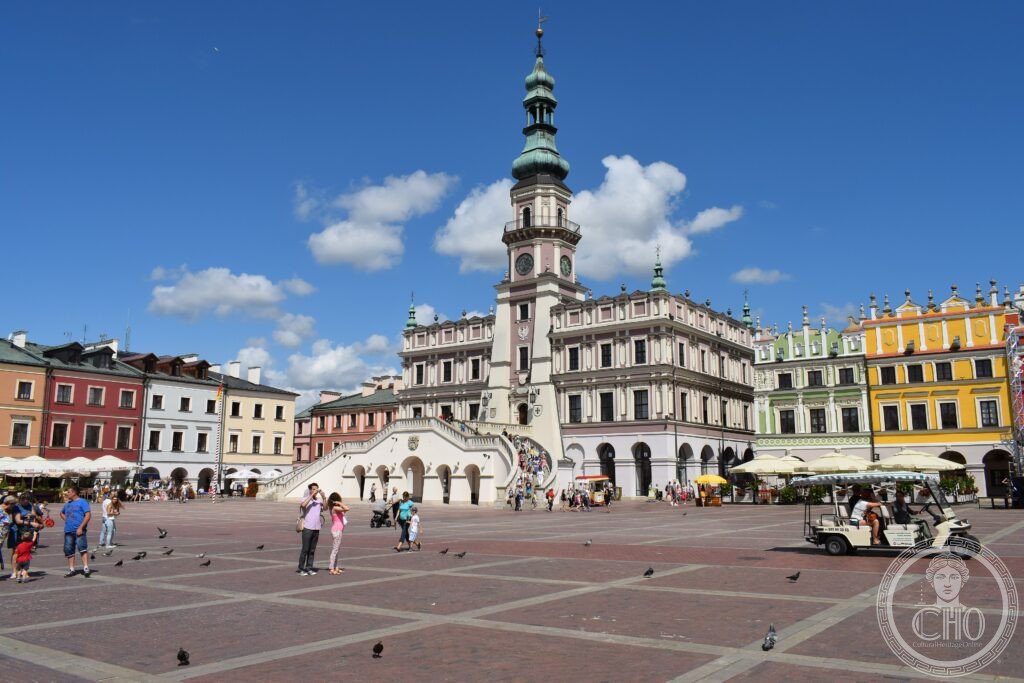
Zamość is a Renaissance town built in one stroke rather than grown over centuries. Jan Zamoyski, Chancellor of Poland, commissioned the Italian architect Bernardo Morando to lay out an entire fortified city on humanist principles, and much of that single, coherent plan still stands, arcaded square, bastions and all.
At a glance
Jan Zamoyski founded Zamość in 1580, modelling it on the Italian ideal of the città ideale. He brought in the architect Bernardo Morando, trained in Padua, to design the town from the ground up, and the whole project was substantially complete within Zamoyski’s own lifetime. He also founded the Zamość Academy in 1594, styled on the University of Padua, which became Poland’s third university after Kraków and Vilnius and earned the town its nickname, the Padua of the North.
Zamoyski conceived the city as a deliberately multicultural trading centre, inviting Armenian, Greek and Jewish merchants to settle in their own quarters, each with its own place of worship. The Sephardic Jewish community, descended from those expelled from Spain in 1492, was especially active in the town’s early commercial life.
Key facts
- Founder: Jan Zamoyski, Chancellor and Grand Hetman of Poland
- Architect: Bernardo Morando, of Padua
- Built: from 1580, largely within Zamoyski’s lifetime
- Layout: a fortified ideal city with a regular street grid and seven bastions
- Status: inscribed as a UNESCO World Heritage Site in 1992
History
Bernardo Morando, born in Padua around 1540, came to Poland at Zamoyski’s invitation and stayed for the rest of his career, dying in Zamość in 1600. His loyalty to the project is reflected in his burial in the town’s cathedral, alongside his patron.
The fortifications he helped design withstood sieges by Cossacks in 1648, by Swedes in 1656 and by Transylvanian forces, and the town was never taken by force until the Austrians accepted a formal surrender in 1809. A far darker chapter followed in the twentieth century: between 1942 and 1943 the Nazi occupiers expelled a very large number of Polish inhabitants from the surrounding Zamojszczyzna region to make way for German settlers, treating the area as a test case for Germanisation. Many of those deported were sent to death camps, making this one of the most brutal episodes of the occupation in Poland.
What you see
The Great Market Place, or Rynek Wielki, remains the heart of the town: a square arcaded on three sides, with Morando’s Town Hall closing the fourth. The arcaded merchants’ houses that line it are original structures dating from the late sixteenth and early seventeenth centuries, and the Armenian houses on the northeast side, with their painted and carved façades, are usually singled out as the most striking.
The Cathedral of the Resurrection and St Thomas the Apostle, designed by Morando as a three-aisled Italian Mannerist basilica, holds the tombs of both Zamoyski and Morando himself, and is considered the finest building of its kind in Poland. Nearby, the Arsenal, built in 1580 to store weapons for the Zamoyski family’s private army, now houses a museum of arms and is one of the best-preserved Renaissance arsenals in the country. Just outside the old walls stands the Rotunda, a nineteenth-century ammunition store that the Nazi occupiers turned into an execution site during the Second World War; it now serves as a sombre memorial to the thousands of Polish intellectuals, Jews and political prisoners killed there.
Practical information
- Season: the milder months from spring to autumn are generally the most comfortable for exploring the town on foot.
- Entry: tickets for the Cathedral and the Arsenal Museum are sold locally; check current prices and hours through the official tourism channels before visiting.
- Getting around: the historic centre is compact and best explored on foot.
Getting there
The nearest airport is Rzeszów-Jasionka, from which Zamość is reached by road. It is also accessible by train from Warsaw via Lublin, followed by a bus connection, and by direct coach services from Kraków and from Lviv in Ukraine. Travellers should confirm current timetables directly with the relevant carriers.
Nearby
- Roztocze National Park — around 20 km south; a highland plateau of forested hills and narrow river valleys straddling the Polish-Ukrainian border, with areas of old-growth forest.
- Janów Podlaski stud — around 90 km north; the oldest horse-breeding establishment in Poland, founded in the early nineteenth century and long associated with fine Arabian bloodstock.
- Lublin — around 100 km northwest; a Renaissance and Gothic old town, home to Lublin Castle with its Romanesque chapel and to the site of the 1569 Union of Lublin, which created the Polish-Lithuanian Commonwealth.
- Majdanek — a few kilometres from central Lublin; a well-preserved former Nazi concentration camp and one of the most sobering Holocaust memorial sites in Poland.
Sources
- Wikipedia, Zamość
- Wikipedia, Jan Zamoyski
- Wikipedia, Bernardo Morando
- UNESCO, Old City of Zamość, WHS reference 564
Find it on the map
See this place and what’s around it →
📷 Become a Cultural Heritage Online photographer
Share your photos of places: they stay published under your name as the author. The more they're seen, the more you get noticed — and soon a contest will reward the most appreciated photos.
Log in or sign up free to add a photo