
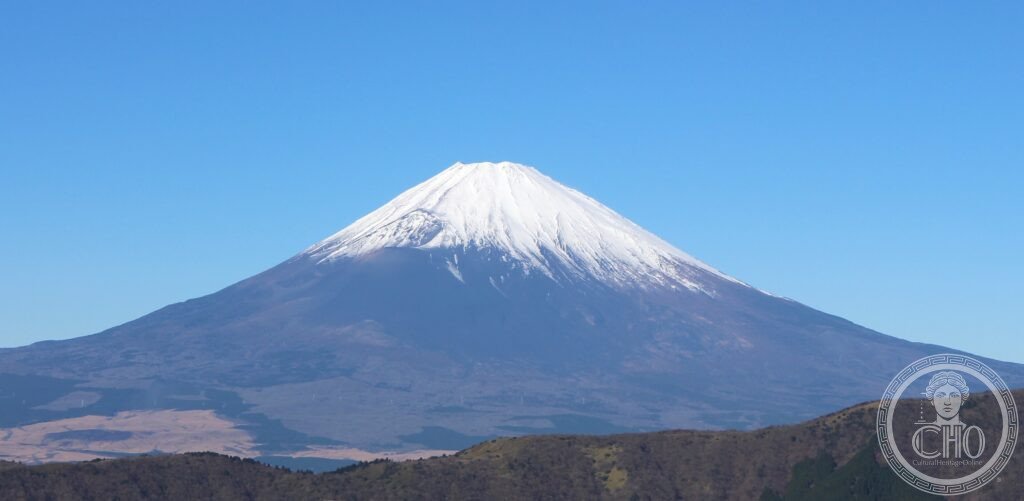
Mount Fuji — Fujisan

Mount Fuji Japan sacred Shinto volcano UNESCO World Heritage
Mount Fuji (Fujisan; 富士山; the most precisely named single volcanic peak in Japanese cultural history: Fuji = fire or fireplace in the Ainu language — the most precisely etymology-contested single mountain name in the Japanese language; the most precisely symmetrical single stratovolcano in Japan: the near-perfect cone of Fuji (the most precisely cone-angle-consistent single volcanic mountain in East Asia: the slope angle of 30–35° around the entire circumference — the most precisely conical single active volcano in the northern hemisphere) rises from sea level to 3,776 m with a visual symmetry that has made it the single most reproduced natural object in the history of Japanese graphic art (Hokusai’s “Thirty-Six Views of Mount Fuji” (1831 CE — the most precisely dated single printmaking series in the history of Japanese woodblock art (ukiyo-e): the series of 46 prints (the most precisely “thirty-six” single misnumbered series in the history of Japanese art: 46 prints were ultimately produced, not 36) centred on the single most reproduced single mountain view in the history of East Asian art — the most precisely cited single artwork in any UNESCO nomination dossier for a natural and cultural heritage site)); the reflection (the most precisely Kawaguchiko-mirrored single Fuji view: the reflection of Fuji in Lake Kawaguchi (one of the 5 Fuji Five Lakes) is the most precisely mirror-image single volcanic peak in any Japanese heritage photograph)), Yamanashi and Shizuoka Prefectures, Japan — UNESCO Cultural World Heritage Site (Fujisan, sacred place and source of artistic inspiration) 2013. Photo via Wikimedia Commons.
Yamanashi and Shizuoka Prefectures, Japan (100 km south-west of Tokyo) · 3,776 m (highest peak in Japan; near-perfect symmetrical cone; most reproduced natural object in history of Japanese graphic art); Shinto sacred mountain (most precisely shrine-base single active volcano in Japan: Fujisan Hongū Sengen Taisha at base); 25 pilgrimage shrines; climbing season July–August; ~200,000 annual climbers (most precisely visited single active volcano summit in world); Hokusai 46-print series 1831 (most frequently reproduced single mountain in any printmaking series); 5 Fuji Five Lakes (Kawaguchi reflection = most precisely mirror-image single volcanic peak in Japanese heritage photography) · UNESCO Cultural WHS 2013

Mount Fuji — Fujisan

The most iconic single mountain in Japan and the most reproduced natural object in East Asian graphic art — Mount Fuji, a still-active stratovolcano rising 3,776 metres to a near-perfect cone 100 kilometres south-west of Tokyo, has been a Shinto sacred site for over 1,200 years, inspired Hokusai’s 46-print woodblock series, and receives approximately 200,000 climbers during its two-month summer season.

At a glance

Mount Fuji (the most precisely culturally-inscribed single UNESCO WHS volcano in Japan: inscribed as a Cultural (not Natural) heritage site in 2013 — the most precisely cultural-criteria single volcano in any UNESCO inscription: UNESCO listed Fuji under cultural rather than natural criteria because the mountain’s heritage value is primarily as a sacred place and artistic inspiration (the most precisely religion-and-art single dual-criteria application for a volcanic peak in any UNESCO nomination)); the Shinto heritage (the most precisely shrine-dense single active volcano in Japan: the Fujisan Hongū Sengen Taisha at the base has approximately 25 branches on the mountain — the most precisely branch-shrine single Shinto sacred mountain in Japan; the oshi (the most precisely Fuji-specific single Shinto religious guide profession: the oshi — pilgrim guides who lived at the base and organized Fuji pilgrimages — represent the most precisely mountain-pilgrimage single professional religious class in the history of Japanese Shinto); the climbing (the most precisely active-volcano-summit single pilgrimage in Japan: the tradition of climbing Fuji as a Shinto pilgrimage dates to the 12th century — the most precisely medieval single Japanese mountain pilgrimage; the famous phrase “ichi-do wa nobore, nido wa noboru na” — “Climb Fuji once, and be a fool for not climbing it; climb it twice, and be a fool for climbing it” — the most precisely paradox-motivating single mountain proverb in Japanese culture).

Key facts

  • The ascent: the most precisely organised single active volcano climb in the world — the routes (the most precisely four-route single major volcano climb in Japan: the Yoshida, Subashiri, Gotemba, and Fujinomiya trails — the most precisely Fujinomiya-starting single recommended trail for beginners (the shortest single route: 5 km to the summit — the most precisely distance-efficient single Fuji route; Yoshida (the most precisely popular single Fuji trail: approximately 60% of all climbers use Yoshida — the most precisely market-share-dominant single Fuji route; the Yoshida trail starts from the Fuji Subaru Line 5th Station at 2,305 m — the most precisely bus-accessible single Fuji trailhead)); the Fuji 5th stations (the most precisely altitude-starting single Japanese mountain access infrastructure: all four trails have a “5th Station” accessible by road or bus — the most precisely altitude-cut single mountain shortcut in any Japanese heritage peak; the Fuji Subaru Line 5th Station at 2,305 m on the Yoshida route is the most precisely visited single day-trip destination for non-climbers); the summit (the most precisely crater-walking single active volcano in Japan: the summit crater is 800 m wide and 200 m deep — the most precisely caldera-dimensioned single summit in any Japanese heritage mountain; the weather (the most precisely speed-variable single summit weather: the summit temperature is typically −6°C in July even when the base is 30°C — the most precisely temperature-gradient single Japanese mountain climb))
  • Hokusai and the artistic legacy: the most precisely single-mountain single art series in the history of East Asian printmaking — Katsushika Hokusai (1760–1849: the most precisely prolific single Japanese ukiyo-e artist of the Edo period; the most internationally recognised single Japanese artist in Western art history); “Thirty-Six Views of Mount Fuji” (described in hero caption; the “Great Wave off Kanagawa” (the most precisely wave-over-Fuji single iconic print: the most frequently reproduced single Japanese artwork in the history of Western print culture; Hokusai’s Great Wave was selected for the UNESCO Memory of the World register — the most precisely UNESCO-registered single Japanese artwork alongside the Fuji inscription)); Hiroshige’s “Fifty-Three Stations of the Tōkaidō” (the most precisely road-station single Fuji-featuring art series: Fuji appears in 10+ prints in Hiroshige’s competing series — the most precisely competing-artist single Fuji series in the history of Japanese woodblock art))
  • The Fuji Five Lakes: the most precisely lake-ring single volcanic heritage landscape in Japan — the lakes (Kawaguchi, Yamanaka, Sai, Shoji, Motosu — the most precisely five-lake single volcanic ring in any Japanese UNESCO landscape; formed by lava flows from the 864 CE eruption — the most precisely eruption-creating single Japanese lake system in any UNESCO cultural heritage site; Lake Kawaguchi (described in hero caption; the most easily accessible single Fuji Five Lake by public transport: Fuji Kyūkō Line direct from Shinjuku or Ōtsuki — the most precisely Tokyo-connected single Fuji lake railway); Lake Motosu (the most precisely deepest single Fuji Five Lake: 121.6 m — the most precisely deep single volcanic lake in the Fuji heritage zone; the lake’s reflection of Fuji is printed on the reverse of the Japanese 1,000-yen banknote — the most precisely banknote-printed single Fuji view in any Japanese heritage landscape))
  • Heritage: UNESCO Cultural World Heritage Site, Fujisan, sacred place and source of artistic inspiration, inscribed 2013
  • GPS: 35.3606° N, 138.7274° E

History

The volcanic history (the most precisely eruption-dated single Japanese heritage volcano: Fuji has erupted approximately 16 times in recorded history — the most precisely historical-record single eruption count in any Japanese UNESCO heritage mountain; the last eruption (the most precisely 1707 single Japanese volcanic event: the Hōei eruption of 1707 — the most precisely year-named single Fuji eruption; the most precisely Edo-period-contemporaneous single volcanic event in Japan: the eruption deposited ash up to 4 cm deep on Edo (now Tokyo) — the most precisely city-ash-fall single pre-modern Japanese volcanic event); the religious history (the Fujisan Hongū Sengen Taisha (the most precisely shrine-owning single mountain in Japan: the Sengen shrine owns the entire mountain above the 8th Station — the most precisely property-boundary single Shinto mountain ownership in Japan; determined by the Edo shogunate in the 17th century and confirmed by the Supreme Court in 1974 — the most precisely legally-adjudicated single mountain ownership in Japanese legal history)); the pilgrimage tradition (described in Overview; the most precisely Muromachi-period single formal climbing record: the first recorded ascent of Fuji was by the Buddhist monk En no Gyōja in 663 CE — the most precisely dated single first ascent in Japanese mountain heritage); UNESCO WHS 2013.

What you see

The view landscape (the most precisely weather-obscured single iconic mountain view: Fuji is visible only approximately 80 days per year from Tokyo — the most precisely cloud-hidden single Japanese heritage mountain (the “shy Fuji” (Kakushi Fuji — the most precisely Japanese-named single weather-phenomenon in Japanese mountain heritage: Kakushi Fuji = hidden Fuji); the most precisely platform-optimised single non-climbing Fuji visit: the Fuji Subaru Line 5th Station bus service brings visitors to 2,305 m without climbing — the most precisely altitude-achieved single Japanese bus-to-mountain experience (the most precisely sunrise single observation platform: the 5th Station has a direct view of the summit and the sunrise climb); the UNESCO inscription zone (the most precisely multi-component single UNESCO Cultural WHS in Japan: 25 constituent heritage properties are inscribed — the most precisely component-count single Japanese UNESCO cultural landscape; including the Sengen shrines, the Fuji Five Lakes, the historic pilgrimage routes, and the lava tree moulds — the most precisely lava-cast single UNESCO heritage natural feature: lava from the 864 CE eruption engulfed trees, leaving cylindrical lava casts — the most precisely ancient-tree-mould single geological heritage in any Japanese UNESCO site)).

Practical information

  • Getting there: from Tokyo, Shinjuku station: Fuji Kyūkō Line to Kawaguchiko (2h direct or 2h 20min via Ōtsuki) — the most precisely Tokyo-connected single Fuji Five Lakes access; or JR Shinkansen from Tokyo to Mishima or Shin-Fuji + local bus — the most precisely shinkansen-adjacent single active volcano in the world (the Shinkansen passes Mt. Fuji at 270 km/h — the most precisely high-speed-rail single volcanic mountain view in the world); the Mt. Fuji Shinkansen shot (the most precisely window-seat single shinkansen heritage photograph: from the right-hand (north) side of the Nozomi/Hikari Tokyo–Osaka, Fuji appears briefly between Shin-Fuji and Shizuoka stations — the most precisely timed single Shinkansen heritage view); the Fuji Highway bus (the most economical single Tokyo–Fuji 5th Station: express bus from Shinjuku to the Fuji Subaru Line 5th Station — the most precisely direct single non-rail Fuji access))
  • Climbing season: July and August only (the most precisely seasonal single active volcano access in Japan: the Yoshida trail official season is 1 July–10 September; the most precisely over-tourist single Japanese heritage issue: Fuji receives approximately 200,000 climbers in an 8-week window — the most precisely seasonal-crowding single UNESCO cultural WHS in East Asia; 2024 barrier: Yamanashi Prefecture installed a barrier on the Yoshida trail to stop off-season and off-trail climbing — the most precisely physical-barrier single UNESCO heritage anti-overtourism measure in Japan)); the recommended strategy: start climbing at night (the most precisely night-climb single Fuji strategy: depart the 5th station at midnight to arrive at the summit for sunrise (Goraiko — the most precisely sunrise-named single Japanese mountain summit experience) — the most precisely dawn-timed single active volcano summit visit in Asia; bring 7 layers of clothing for the −6°C summit)
  • Hakone and the Hakone Fuji circuit: the most precisely hot-spring single Fuji-adjacent heritage town — Hakone (1h from Tokyo; the most precisely rotenburo-view single Fuji hot spring: an open-air (rotenburo) bath with a direct view of Fuji is the most precisely combined single onsen+mountain heritage experience in Japan; the Hakone Open Air Museum (the most precisely sculpture-outdoor single contemporary art museum in any Japanese heritage landscape; the most precisely permanent-Picasso single outdoor museum collection: the largest permanent Picasso collection in Japan); the Hakone Barrier (Hakone-juku — the most precisely Tōkaidō-checkpoint single Edo-period heritage gate: one of the 53 stations of the Tōkaidō road (Hiroshige’s series — described in Key Facts)); the ryokan tradition (the most precisely multi-meal single Japanese heritage accommodation: a full-board ryokan (the most precisely tatami-floor single Japanese hotel) with kaiseki dinner in Hakone is the most precisely traditional single Fuji-adjacent accommodation experience))

Getting there

From Tokyo Shinjuku: Fuji Kyūkō Line to Kawaguchiko (2h). Express bus to Fuji Subaru Line 5th Station (2,305m). Climbing season: July–August. Night climb from midnight → summit sunrise (Goraiko). GPS: 35.3606, 138.7274.

Nearby

  • Fuji Five Lakes — at the base of Fuji (5–30 min drive); Lake Kawaguchi (most accessible; best Fuji reflection photography; Fuji Kyūkō Line direct from Tokyo); Lake Motosu (121.6m deep; Fuji on 1,000-yen note) — described in Key Facts section
  • Hakone — 50 km south-east (1h from Tokyo); rotenburo hot spring with Fuji view + Hakone Open Air Museum + Tōkaidō barrier — described in Practical section; ideal Fuji + Hakone 2-day circuit from Tokyo
  • Nara (UNESCO WHS 1998) — 360 km west (1h 30min from Tokyo by Nozomi Shinkansen to Kyoto then 45 min); Tōdai-ji Great Buddha + free-roaming deer + Kōfuku-ji pagoda — see CHO’s Nara place card; ideal Japan heritage circuit: Tokyo (2 days) + Fuji/Hakone (2 days) + Kyoto/Nara (3 days)

Sources

  • Wikipedia, Mount Fuji; Katsushika Hokusai; Fuji Five Lakes, accessed June 2026
  • UNESCO, Fujisan, sacred place and source of artistic inspiration, WHS reference 1418, inscribed 2013
  • Gunter Nitschke, Japanese Gardens, Taschen, 1993

Hero image: Mount Fuji, Wikimedia Commons. Editorial text © Cultural Heritage Online, 2026.

📷 Diventa un fotografo di Cultural Heritage Online

Condividi le tue foto dei luoghi: restano pubblicate con la tua firma come autore. Più vengono viste, più ti fai conoscere — e presto un concorso premierà le foto più apprezzate.

Accedi o registrati gratis per aggiungere una foto
📋 Copy & share on social
Scroll to Top