
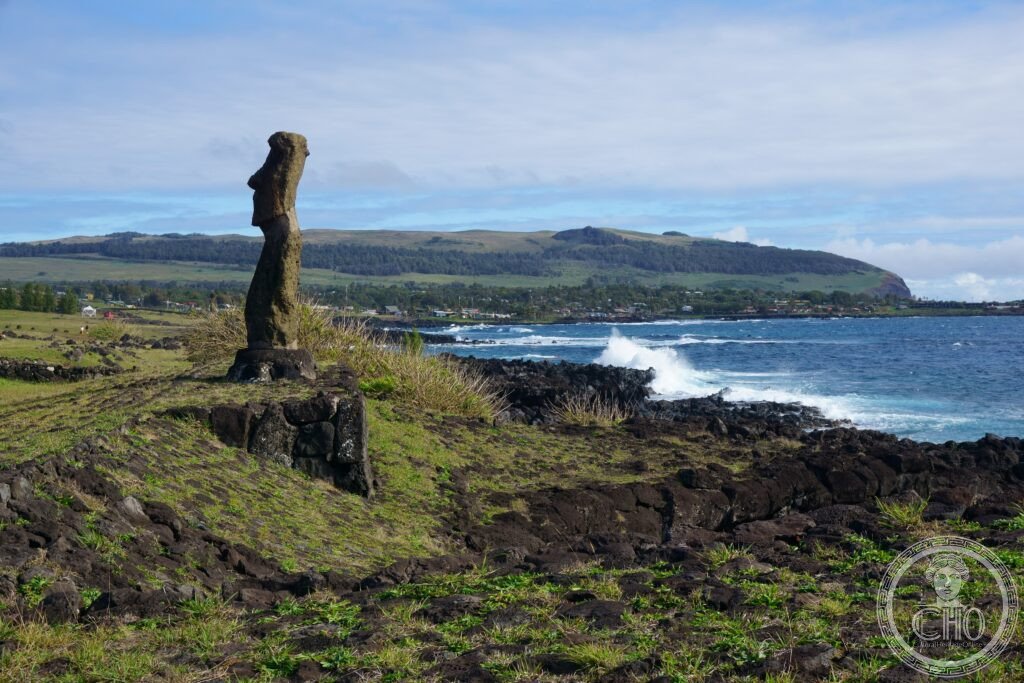
Easter Island, or Rapa Nui, lies further from another inhabited landmass than almost anywhere on Earth. Its Polynesian settlers carved more than a thousand monumental moai from volcanic stone, then vanished into a population collapse whose cause is still argued over. The island’s quarry, platforms and crater-rim ceremonial site remain largely as they were left.
At a glance
Rapa Nui sits some 3,512 kilometres west of continental Chile and 2,075 kilometres from Pitcairn Island, its nearest inhabited neighbour, making it one of the most isolated permanently settled places on Earth. The island is known above all for its moai, the carved stone figures that stand or once stood on ceremonial platforms called ahu. The moai themselves are only part of the monument: the ahu beneath them were the sacred structures, and many moai originally wore a separate cylindrical red-stone topknot, or pukao, whose placement at height is still not fully understood.
At its height the Rapa Nui population is thought to have reached between fifteen and twenty thousand people. What happened afterwards, whether ecological collapse through deforestation, inter-clan warfare, European slave raids or some combination of the three, remains one of the most argued questions in Pacific archaeology.
Key facts
- The moai: carved by hand with basalt chisels, an average figure stands about four metres tall and weighs some twelve and a half tonnes; the tallest ever raised, Paro at Ahu Te Pito Kura, reached 9.8 metres and 82 tonnes before it toppled.
- Rano Raraku quarry: the source of roughly 95% of all moai; 397 remain in and around it, several unfinished, including the largest known moai, El Gigante, still attached to the rock face at 21.6 metres.
- Ahu Tongariki: the largest single platform on the island, carrying fifteen re-erected moai.
- Orongo and the Birdman cult: a ceremonial village built on the rim of the Rano Kau crater, associated with an annual competition in which a clan leader’s representative swam to the islet of Motu Nui to retrieve the season’s first sooty tern egg.
- Heritage status: the island is inscribed as a UNESCO World Heritage Site under the name Rapa Nui National Park, listed in 1995.
- Coordinates: -27.1264° S, -109.3661° W.
History
Polynesian settlers reached Easter Island at some point between 300 and 1200 CE, according to current archaeological evidence. The main period of moai carving is placed roughly between 1200 and 1500 CE, after which the practice stopped. The population subsequently declined, and the causes remain disputed: Jared Diamond’s 2005 study Collapse argued that deforestation was the principal driver, while more recent research, including a 2021 study, has challenged the idea that the population collapsed before Europeans arrived.
The first recorded European contact came on Easter Sunday, 5 April 1722, when the Dutch navigator Jacob Roggeveen sighted the island, which was named after the day of that encounter. Chile annexed the island in 1888, and Rapa Nui National Park was added to the UNESCO World Heritage List in 1995.
What you see
At Rano Raraku, moai stand in every stage of completion, some fully carved and half-buried, others still attached to the rock they were cut from, a scene that gives a direct sense of how the carving process worked before it stopped. Ahu Tongariki, with its fifteen restored moai, faces inland rather than out to sea; visiting around sunrise places the figures in silhouette against the ocean behind them. The platform’s moai were thrown from their platform by the tsunami that followed the 1960 Chilean earthquake and were later restored with the sponsorship of the Japanese company Tadano.
Anakena, a sand beach on the island’s north coast, is held by oral tradition to be the landing place of Hotu Matu’a, the first Polynesian king said to have settled Rapa Nui.
Practical information
- Length of stay: since 2018, non-resident visitors have been restricted to a maximum stay of thirty days; current rules should be checked with the relevant Chilean authority before travel.
- Accommodation: the island has a modest number of small hotels and guesthouses; booking ahead is advisable, particularly in the high season from December to February.
- Getting around: a car or all-terrain vehicle is effectively necessary, as the main road is paved but most others are dirt tracks, and the key archaeological sites lie some way from Hanga Roa.
- Guides: signage at the sites is minimal, so an archaeological guide is strongly recommended to make sense of the ahu and moai.
Getting there
LATAM operates the only regular commercial flights to Easter Island, from Santiago de Chile, along with a weekly connection from Papeete in French Polynesia. Both routes should be booked well ahead during the high season. Once on the island, a hire car or ATV is needed to reach the main sites.Nearby
- Pitcairn Island — around 2,075 kilometres west, the nearest inhabited island, a British Overseas Territory with a small population descended from the Bounty mutineers of 1790; it has no regular flight or ferry connection.
- Machu Picchu, Peru — roughly 3,700 kilometres east, a UNESCO World Heritage Site inscribed in 1983.
- Galápagos Islands, Ecuador — around 3,800 kilometres north-east, a UNESCO World Heritage Site inscribed in 1978 and known for its role in the study of evolution.
Sources
- Wikipedia, Easter Island
- Wikipedia, Moai
- Wikipedia, Rongorongo
- Wikipedia, Ahu Tongariki
- UNESCO, Rapa Nui National Park, WHS reference 715
- Jared Diamond, Collapse: How Societies Choose to Fail or Succeed, Viking, 2005
Find it on the map
See this place and what’s around it →📷 Become a Cultural Heritage Online photographer
Share your photos of places: they stay published under your name as the author. The more they're seen, the more you get noticed — and soon a contest will reward the most appreciated photos.
Log in or sign up free to add a photo