
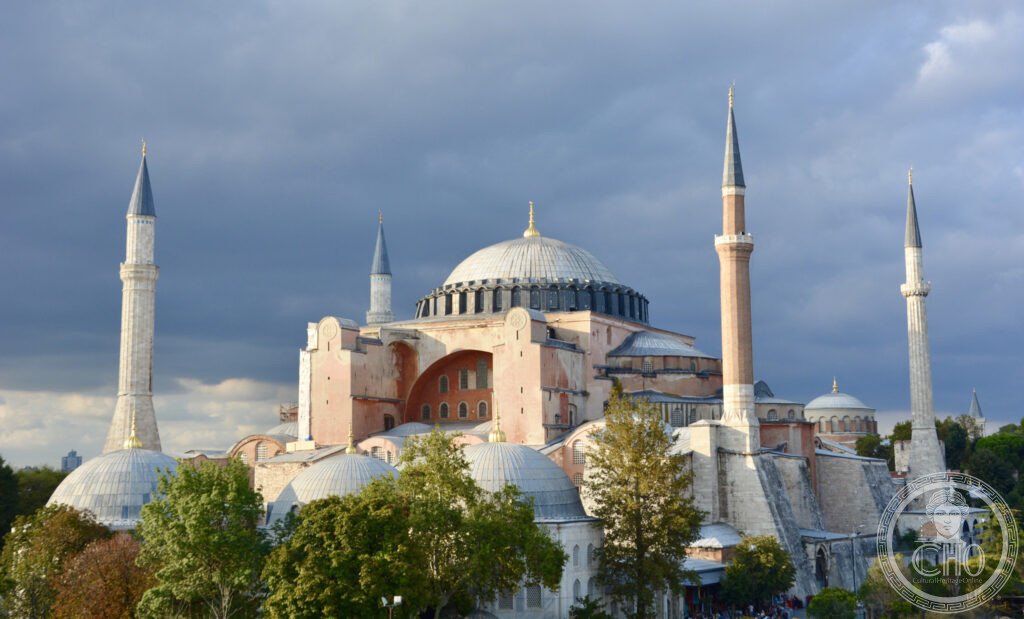
Hagia Sophia
The most structurally innovative building of Late Antiquity and the building that held the world record for the largest dome for 899 years — Hagia Sophia in Istanbul, completed in 537 CE, pioneered the use of pendentives to place a circular dome over a square base, solving the central problem of Byzantine architecture and directly influencing every domed building from the Ottoman Empire to Renaissance Italy to Washington DC.
At a glance
Hagia Sophia (Holy Wisdom; Ayasofya; UNESCO WHS as part of the Historic Areas of Istanbul, inscribed 1985; the most multi-religiously significant single building in the world: the most important single Christian cathedral for 916 years (537–1453); the most important single Ottoman mosque in Istanbul for 481 years (1453–1934); the most symbolically neutral single secular museum in Turkey for 86 years (1934–2020); reconverted to a mosque in July 2020; 3.7 million visits per year — the most visited single building in Turkey; the most frequented heritage site in the eastern Mediterranean after the Pyramids); the structural innovation (the most consequential single engineering innovation in the history of domed architecture: the pendentive — a curved triangular section that transitions from a square base to a circular dome — was perfected at Hagia Sophia (537 CE) and became the defining structural element of all subsequent domed architecture in the Byzantine, Islamic, and Renaissance traditions: the most universally adopted single structural invention in the history of world architecture)).
Key facts
- The dome and the structural revolution: the most structurally consequential single building in the history of world architecture — the dome (the most continuously record-breaking single dome in history: 31.87 m diameter; 55.6 m above the floor; the largest dome in the world from 537 CE until 1436 CE (when Brunelleschi completed the dome of Florence Cathedral at 45.5 m inner span — the most precisely quantified architectural world-record transfer in the history of construction); 899 years as the world’s largest dome — the most continuously held structural record in the history of pre-modern architecture; the perception (the 6th-century historian Procopius of Caesarea wrote that the dome appeared to be “suspended from heaven by a golden chain” — the most precisely described optical illusion in any ancient description of a building; the effect (the circle of 40 windows at the base of the dome creates a band of light that detaches the dome visually from its supporting walls — the most precisely designed single daylighting effect in any ancient interior)); the pendentives (described in overview section; the first large-scale use of this structural solution (a pendentive allows a circular dome to be placed on a square base by transitioning the geometry via curved triangular sections) — the most consequentially adopted single architectural detail in the history of world architecture: the Sultanahmet / Blue Mosque (1616) and the Süleymaniye (1558) in Istanbul; the Selimiye Mosque in Edirne (1575 — the most perfectionist deployment of the pendentive in Ottoman architecture: Sinan’s masterwork); the Pantheon in Rome’s influence on the pendentive; the Capitol dome in Washington (1866) are all the children of this one building))
- The mosaics and the art: the most extensively documented single Byzantine mosaic programme — the mosaics (the most valuable single collection of Byzantine pictorial art in the world: the Hagia Sophia mosaics span 4 centuries (9th–14th CE) — the most extensive single site of Byzantine mosaic production in Turkey; the Deësis mosaic (the most humanistic single face in Byzantine art: the mosaic in the upper gallery showing Christ flanked by the Virgin Mary and John the Baptist; the Christ face is the most naturalistically rendered single human face in any Byzantine mosaic — the most individually expressive single image in the entire Byzantine iconographic tradition; the most precisely dated early example of the shift toward naturalism in Byzantine art (c. 1261) that anticipates the Italian Renaissance)); the seraphim (the most precisely identified single theological image in the building: the four giant seraphim faces at the base of the dome — the largest pre-modern figurative mosaics in the world; the two faces that had been covered by Ottoman medallions were revealed in restoration (2009–2010) — the most consequentially unveiled single Byzantine artwork in modern Turkish heritage conservation))
- The four religious phases and the 2020 conversion: the most politically consequential single building in the history of world heritage — the Cathedral (532–537 construction; the most expensive single building project of the reign of Justinian I — the most ambitious Emperor in the history of the Eastern Roman Empire; the building was consecrated on 27 December 537 CE); the Mosque (1453: Sultan Mehmed II entered Constantinople on 29 May 1453 — the most precisely dated single fall of a Christian imperial capital in history; the same afternoon he walked to Hagia Sophia and ordered it converted to a mosque — the most rapidly executed single religious conversion of a major building in the history of the Ottoman Empire; the minarets were added (1453–1574); the Islamic medallions with the names of Allah, Muhammad, and the first four Caliphs were hung in the nave (1847) — the most artistically incongruous single addition to a Byzantine interior); the Museum (1934: Atatürk signed the decree making Hagia Sophia a secular museum (the most politically significant single use of a heritage building in the history of Turkish nationalism: the conversion to museum status was a founding act of Turkish secular modernism — the most symbolically definitive single gesture of the Kemalist revolution)); the 2020 reconversion (the most internationally debated single heritage decision of the 21st century: a Turkish presidential decree of July 2020 reconverted Hagia Sophia to a mosque — the most condemned single national heritage decision by UNESCO and international religious bodies in the 21st century))
- Heritage: UNESCO World Heritage Site, Historic Areas of Istanbul, inscribed 1985
- GPS: 41.0086° N, 28.9802° E
History
The first and second churches (the first church on the site was built under Constantius II (r. 337–361) and burned in 404 CE; the second burned in the Nika Riots of January 532 CE — the most destructive single urban uprising in Constantinople’s history: 30,000–35,000 people killed; half the city destroyed — the most precisely deadly single civil riot in any Roman imperial capital); the third and present building (Justinian I commissioned the present building from two architects: Anthemius of Tralles (the most mathematically sophisticated single architect in Late Antiquity: Anthemius was also a mathematician and physicist; the most precisely physics-informed architectural design process in ancient construction) and Isidore of Miletus; built in 5 years and 10 months (532–537 CE) — the most rapidly completed single large domed building in antiquity; the original dome collapsed in an earthquake in 558 CE and was rebuilt with a steeper pitch by Isidore the Younger (the most precisely corrected structural failure in Byzantine construction history)); the mosaics (the original 6th-century mosaics were destroyed during the Byzantine Iconoclasm (726–843 CE) — the most precisely motivated single act of systematic art destruction in Byzantine history; replaced by the 9th–14th-century mosaics (described in Key Facts)); UNESCO WHS 1985.
What you see
The visit (free entry as a mosque since 2020; visitors during prayer times are directed to side sections — the most consistently managed single heritage-mosque access in Turkey; the key experience: the nave (the most vertically overwhelming single interior in any Byzantine building: standing at the nave centre and looking up at the dome — the experience Procopius described as “suspended from heaven”; the light from the 40 windows floating the dome apparently unsupported); the upper gallery (the best viewing level for the mosaics — the Deësis mosaic is in the south gallery; the most important single Byzantine artwork accessible in Turkey; accessible via a ramp (the most wheelchair-accessible single large Byzantine gallery ramp in Istanbul)); the exterior (the most compositionally complex single Ottoman-Byzantine silhouette in Istanbul: the central dome flanked by two semi-domes, the four minarets (all four are slightly different heights and widths — the most precisely irregular single minaret group in any Istanbul mosque)); the Baptistery (the most complete single Late Antique baptistery in Istanbul: now open as a supplementary exhibition).
Practical information
- Getting there: Istanbul (the most historically stratified single city in the world: 3 imperial capitals (Greek Byzantium (657 BCE) → Roman Constantinople (330 CE) → Ottoman Istanbul (1453 CE)) — the most precisely capital-status-changing single city in European history); Istanbul Airport (IST) + Sabiha Gökçen Airport (SAW; for budget flights); to Hagia Sophia: Tram T1 (the most useful single tram line in heritage Istanbul: Kabataş → Sultanahmet; Sultanahmet stop = 200 m from Hagia Sophia — the most precisely positioned tram stop for any UNESCO heritage site in Turkey); the Sultanahmet district (the most heritage-dense single square kilometre in the world: Hagia Sophia + Topkapi Palace + Blue Mosque + Hippodrome + Basilica Cistern + Arkeoloji Müzesi — all within 700 m; the most precisely concentrated single heritage cluster in any city in the world; the most frequently cited single heritage-tourism argument for Istanbul being the most heritage-rich city in the world))
- The Sultanahmet heritage cluster: the most heritage-dense neighbourhood in the world — Topkapi Palace (250 m from Hagia Sophia; the residence of Ottoman Sultans 1465–1856; UNESCO WHS as part of the Historic Areas of Istanbul; the Treasury (the most frequently visited single room in Topkapi: the Topkapi Dagger, the Spoonmaker’s Diamond (86 carats — the fifth-largest diamond in the world — the most frequently misidentified largest diamond in Turkish guidebooks), the throne of Nadir Shah (the most elaborately jewel-encrusted single throne in the Topkapi collection))); the Blue Mosque / Sultan Ahmed Mosque (the only mosque in Istanbul with 6 minarets (the most precisely counted single architectural scandal in Ottoman history: the Sultan was accused of building 6 minarets to equal the number at the Masjid al-Haram in Mecca — the most religiously sensitive single architectural decision in Ottoman imperial history)); the Basilica Cistern (the most atmospherically underground single heritage space in Istanbul: 336 columns; Medusa heads; the most precisely atmospheric single subterranean experience in Istanbul))
- Ephesus and the Library of Celsus: the finest Roman city in Turkey and the third-richest library in the ancient world — Ephesus (700 km south of Istanbul; 1h flight + 1h bus to Selçuk; the most extensively excavated single Roman city in Turkey; the Library of Celsus (the most photographically famous single building in Ephesus: the 2nd-century CE library façade — the most precisely restored single Roman library façade in the world; one of the three largest libraries in the ancient world (after Alexandria and Pergamon): approximately 12,000 scrolls — the most precisely capacitated single ancient library that has been physically recovered); the Theatre of Ephesus (25,000 seats — the largest single theatre in the ancient world at the time of its construction)); UNESCO WHS (Ephesus) 2015
Getting there
Tram T1 to Sultanahmet stop (200m walk). Free entry (mosque since 2020). Dress code required: head covering for women, remove shoes at entrance. Avoid Friday noon prayer period. GPS: 41.0086, 28.9802.
Nearby
- Topkapi Palace (UNESCO WHS 1985) — 250 m east; most important Ottoman palace in the world — described in Practical section; essential full-day Sultanahmet sequence: Hagia Sophia (morning, 1h 30min) + Topkapi Palace (afternoon, 2h 30min) + Basilica Cistern (evening, 45min)
- Cappadocia — 700 km south-east (1h flight or 9h overnight bus from Istanbul); the most surreal volcanic landscape in Turkey — Cappadocia (the UNESCO WHS Göreme National Park and the Rock Sites of Cappadocia (1985); the most precisely photogenic sunrise destination in Turkey: the hot-air balloon flights over the tuff-rock fairy chimneys at sunrise — the most instagrammed single morning activity in Turkey; the Göreme Open Air Museum (the most accessible single collection of Byzantine rock-cut churches in Turkey: painted frescoes (10th–13th CE) — the most precisely preserved Byzantine paintings in any volcanic rock in the world); the underground cities of Derinkuyu and Kaymaklı (the most extensive single underground city systems in the world: Derinkuyu reaches 85 m deep across 8 levels — the most precisely measured underground city in Cappadocia))
- Ephesus (UNESCO WHS 2015) — 700 km south (1h flight from Istanbul; 1h from İzmir airport to Selçuk); most extensively excavated Roman city in Turkey — described in Practical section
Sources
- Wikipedia, Hagia Sophia; Pendentive; Deësis mosaic; Byzantine Iconoclasm, accessed June 2026
- UNESCO, Historic Areas of Istanbul, WHS reference 356, inscribed 1985
- Robert Mark & Ahmet Çakmak (eds.), Hagia Sophia from the Age of Justinian to the Present, Cambridge University Press, 1992
Find it on the map
See this place and what’s around it →📷 Diventa un fotografo di Cultural Heritage Online
Condividi le tue foto dei luoghi: restano pubblicate con la tua firma come autore. Più vengono viste, più ti fai conoscere — e presto un concorso premierà le foto più apprezzate.
Accedi o registrati gratis per aggiungere una foto