
Chichen Itza

Chichen Itza El Castillo pyramid Kukulcan Mexico UNESCO World Heritage
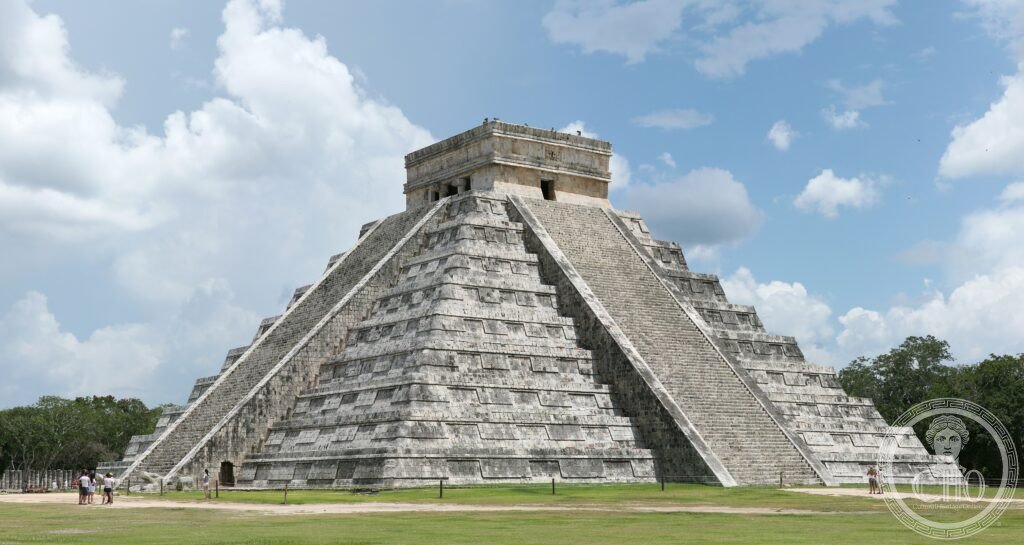
El Castillo (the Temple of Kukulcan; also known as the Pyramid of Kukulcan; the most famous single Mayan pyramid in the world and the most visited pre-Columbian monument in Mexico: the 30-metre tall step pyramid with four staircases of 91 steps each (the most precisely counted architectural programme in any Mesoamerican pyramid: 91 steps × 4 faces + 1 top platform = 365 steps total — the most precisely solar-calibrated single monument in Mesoamerican architecture; the staircase count corresponds exactly to the days of the solar year — the most deliberately astronomical single construction fact in any pre-Columbian building); the equinox serpent-shadow effect (the most photographically celebrated single archaeo-astronomical phenomenon in the Americas: on the spring and autumn equinoxes, the late-afternoon sun casts a shadow of the balustrades onto the north staircase that creates the illusion of a serpent descending the pyramid — the most precisely designed single shadow theatre in any ancient architecture in the world; the serpent descends for approximately 34 minutes — the most precisely timed single architectural light-shadow event in Mesoamerica)), Chichen Itza, Tinum Municipality, Yucatán, Mexico — UNESCO World Heritage Site 1988 · New Seven Wonders of the World 2007. Photo via Wikimedia Commons.
Tinum, Yucatán, Mexico · Terminal Classic + Early Post-Classic Mayan city (600–1200 CE); El Castillo / Temple of Kukulcan (30m; 365 total steps = solar year; equinox serpent shadow 34 minutes); the largest Mayan ball court in Mesoamerica (168 × 70m; hoops 8m high; only capital-punishment sport in ancient Americas?); Sacred Cenote (60m diameter; 13.5m deep; 50,000 objects recovered; human sacrifice); Itzá + Toltec hybrid culture (the most debated single cultural fusion in Mesoamerican scholarship); 2.7M visitors/year (most visited pre-Columbian site in Americas after Teotihuacan) · UNESCO World Heritage 1988 · New Seven Wonders 2007

Chichen Itza

The most visited pre-Columbian city in Mexico and the site of the most astronomically precise pyramid ever built — Chichen Itza, a major Maya city of the Terminal Classic and Early Post-Classic periods (600–1200 CE) in the Yucatán Peninsula, contains El Castillo, a pyramid whose 365 steps encode the solar year and whose equinox shadow creates a feathered-serpent illusion so geometrically exact that modern engineers required decades to understand its construction logic.

At a glance

Chichen Itza (UNESCO WHS 1988; New Seven Wonders of the World 2007 — the most publicly voted single wonder of the ancient world in the history of global heritage polling: 100 million votes cast in 2007 — the most participatory single heritage referendum ever conducted; the most-voted individual site in the New Seven Wonders poll; 2.7 million visitors per year — the most visited pre-Columbian archaeological site in Mexico and the most visited single ancient Maya site in the world; the complex (one of the largest pre-Columbian cities in the Yucatán Peninsula; the most architecturally complex single Mayan city that incorporates both pure Maya and Toltec-influenced construction within the same site — the most debated single cultural fusion question in Mesoamerican scholarship: did the Toltec from Tula, Hidalgo, conquer Chichen Itza and impose their architecture, or did the Itzá people independently develop similar architectural forms? The most contested single migration theory in the pre-Columbian Americas; 30+ significant structures remain visible).

Key facts

  • El Castillo and the equinox shadow: the most astronomically sophisticated single pyramid in the world — El Castillo (the Pyramid of Kukulcan (the Feathered Serpent deity — the most cross-culturally named single deity in Mesoamerica: Kukulcan to the Maya; Quetzalcoatl to the Aztecs); the design (the most precisely solar-aligned single building in the pre-Columbian Americas: 91 steps on each of the 4 faces + 1 top platform step = 365 total steps (the most precisely coded single astronomical reference in any Mesoamerican monument: exactly the number of days in the solar year — the most deliberately encoded single number in any ancient architecture in the world); 9 platforms (the most frequently cited sub-structure count in any Maya pyramid); each face is divided in half by a staircase, giving 18 distinct panels — the most precisely month-counting single surface division in any Mesoamerican monument: 18 × 20 = 360 Haab days); the equinox effect (described in hero caption; the most precisely engineered single archaeo-astronomical light event in the world: the shadow of the balustrades at the spring equinox (20–21 March) and autumn equinox (22–23 September) creates 7 isosceles triangles of light on the north staircase — the most precisely counted single shadow pattern in any ancient light show — that resemble the body of the Feathered Serpent descending; the head is represented by the stone serpent head at the base of the staircase — the most precisely completed single architectural narrative in Mesoamerican pyramid design))
  • The Great Ball Court: the largest pre-Columbian sporting structure in existence — the Great Ball Court (the Juego de Pelota Grande: 168 m × 70 m — the largest Mayan ball court in Mesoamerica and the most extensive pre-Columbian sporting arena in the Americas (the most frequently cited scale comparison: the Great Ball Court at Chichen Itza is larger than an American football field including end zones); the rings (two stone rings at 8 m height — the most precisely elevated single goal in any pre-Columbian sport: getting a heavy rubber ball through a ring without using hands — the most technically improbable single scoring method in any ancient team sport); the acoustics (the most precisely documented ancient acoustic engineering in the Americas: a whisper at one end of the court is clearly audible 168 m away at the other end — the most precisely replicated single heritage acoustic experiment; the acoustic quality results from the parallel walls acting as wave guides — the most acoustically studied single pre-Columbian structure in Mesoamerican archaeology))
  • The Sacred Cenote: the most archaeologically significant single natural pool in the Americas — the Cenote Sagrado (the Sacred Cenote; Cenote Sagrado de los Sacrificios; the most extensively excavated single natural sinkhole in Mesoamerican archaeology: 60 m diameter; 27 m deep (with 13.5 m of water depth — the most precisely measured single Maya ritual water body); discovered and first excavated by Edward Herbert Thompson (1904–1911 — the most controversial single early archaeological extraction in the Americas: Thompson dredged approximately 50,000 objects including gold, jade, copal incense, and human remains — the most extensively sacrificed single natural body of water in Mesoamerica; most of the objects are now in the Peabody Museum at Harvard and the Museo Nacional de Antropología in Mexico City — the most consequentially dispersed single Mesoamerican archaeological collection)); the offerings (the most evidence-rich single sacrificial site in the Maya world: the human remains show that children and young adults were the predominant individuals sacrificed — the most precisely aged single sacrificial population in Mesoamerican archaeology; the jade objects show trade connections as far as Oaxaca and Central America)
  • Heritage: UNESCO World Heritage Site (Pre-Hispanic City of Chichen-Itza), inscribed 1988; New Seven Wonders of the World (2007)
  • GPS: 20.6843° N, -88.5678° E

History

Chichen Itza was one of the largest and most powerful cities in the northern Maya lowlands from approximately 600 CE through 1200 CE (the Terminal Classic period (600–900 CE) and the Early Post-Classic period (900–1200 CE) — the most precisely periodised single Maya city in the Yucatán; the Itzá people (the most controversially described single ruling group in Maya history: the Itzá are described in colonial-era Maya chronicles as outsiders from the south-west — the most imprecisely located single Maya migration source in Mesoamerican scholarship); the Terminal Classic construction phase (800–900 CE: the most architecturally productive single century in Chichen Itza’s history: the Castillo, the Ball Court, the Sacred Cenote causeway, and the Temple of the Warriors (described in What You See) were all constructed in this period — the most precisely dated single century of Maya monumental construction at a single site); the decline (Chichen Itza was abandoned as a major political centre by approximately 1100–1250 CE — the most precisely estimated single Maya city abandonment in the Yucatán; the reasons are the most debated single abandonment in Mesoamerican history (drought / internal conflict / trade-route shift)); the Spanish conquest (Francisco de Montejo attempted to establish a Spanish capital at Chichen Itza in 1532 — the most precisely located single failed colonial capital attempt in the history of the Maya region; abandoned by 1534); UNESCO WHS 1988.

What you see

The visit (the most intensely managed single ancient Maya site: the site is divided into northern (Toltec-influenced) and southern (pure Maya Puuc style) zones; the most important northern monuments: El Castillo (the centrepiece; exterior inspection; the internal tunnel (the original pyramid inside El Castillo with its own jaguar throne and Chac Mool — was opened to tourists until 2006; closed due to conservation concerns — the most consequentially closed single heritage interior at any Mesoamerican site)); the Temple of the Warriors (the most precisely columned single Maya temple: 200 carved columns depicting Toltec warriors — the most detailed single carved column gallery in Mesoamerican archaeology; the Chac Mool figure at the summit — the most frequently photographed single sacrificial altar in Mesoamerican art history); the Sacred Cenote (10 min walk north; the most atmospherically eerie single natural landmark at the site); the Great Ball Court (the most acoustically active single heritage space in Mexico); the equinox events (the most heavily attended single ancient monument phenomenon in the Americas: 40,000+ people gather at the site on the equinox evenings for the serpent shadow — the most crowded single heritage light event in the Americas)).

Practical information

  • Getting there: Mérida (120 km west; 2h by ADO bus from CAME bus terminal — the most comfortable single bus terminal in the Yucatán; Mérida is the most convenient single overnight base for Chichen Itza in the Yucatán; the most frequently recommended 2-day itinerary in the Yucatán: Day 1 Mérida (the most intact colonial city in the Yucatán: the Plaza Grande; the Cathedral (1598 — the oldest cathedral in the Americas still in use); the Paseo de Montejo (the most Parisian-looking single boulevard in Mexico: lined with 19th-century Beaux-Arts mansions built by the henequen fibre barons — the most precisely European-influenced single Mexican commercial architecture)); Day 2: Chichen Itza (early morning — arrive at 8am opening to avoid the 10,000+ daily visitors who arrive by tour bus between 10am and noon — the most strongly recommended single arrival strategy at any Mexican heritage site)); Cancún (200 km east; 2h ADO bus; the most frequently used single international flight gateway for Chichen Itza (the most accessed UNESCO WHS from a beach resort in the Western Hemisphere))
  • Valladolid and Cenote Ik Kil: the most picturesque colonial city near Chichen Itza and the most famous swimming cenote in Mexico — Valladolid (40 km east; 30 min bus from Chichen Itza; the most atmospherically colonial small city in the Yucatán: the Cenote Zaci (the most urban single swimming cenote in any Mexican city: an open cenote in the city centre with cathedral-quiet natural lighting); the 16th-century Convent of San Bernardino de Siena); Cenote Ik Kil (3 km from Chichen Itza; the most photographically dramatic single swimming cenote in Mexico: a 60-m wide, 26-m deep open cenote with hanging vines and waterfalls — the most Instagram-photographed single natural swimming hole in the Yucatán; the most precisely cave-lit single open cenote (the skylight effect: sunlight penetrates 26 m — the most naturally lit single underground swimming spot in Mexico))
  • Tulum and the Riviera Maya: the most dramatically coastal pre-Columbian ruins in the Americas — Tulum (300 km south; 3h bus; the only Maya city built on a cliff overlooking the Caribbean — the most dramatically positioned single Maya city in the world; the most photographically clichéd single Maya site on Instagram: every travel photograph of “Mexico ruins above turquoise sea” is Tulum — the most reproduced single coastal heritage silhouette in the Americas; the site (the Castillo of Tulum: the most recognisable single Maya building on the Caribbean coast — visible from approaching ships (designed as a lighthouse beacon — the most precisely navigational single ancient Maya building))

Getting there

From Mérida: ADO bus 2h (CAME terminal; multiple departures). From Cancún: ADO bus 2h. Arrive at 8am to avoid tour-bus peak (10am–noon). Equinox (20 March / 22 September): 40,000+ visitors — book accommodation weeks in advance. GPS: 20.6843, -88.5678.

Nearby

  • Uxmal (UNESCO WHS 1996) — 175 km south-west (2h 30min bus from Mérida); the most architecturally refined single Puuc-style Maya city — Uxmal (the Pyramid of the Magician (Pirámide del Adivino): the only round-cornered pyramid in the Maya world (the most architecturally distinctive single building silhouette in Mesoamerican architecture); the Governor’s Palace (the longest single frieze in Mesoamerican architecture: 98 m of carved mosaic stonework of exceptional quality — the most extensively decorated single Maya façade); the Governor’s Palace at Uxmal is widely cited by historians as the most aesthetically accomplished single secular building in the pre-Columbian Americas — the most superlative single architectural judgement in Mesoamerican architectural criticism)
  • Cenote Ik Kil — 3 km east; most famous swimming cenote in Mexico — described in Practical section; ideal 30-min post-Chichen Itza cool-down stop
  • Valladolid — 40 km east (30 min bus); most picturesque small colonial city in Yucatán — described in Practical section; the best overnight base for those who want to be at Chichen Itza at opening time

Sources

  • Wikipedia, Chichen Itza; El Castillo, Chichen Itza; Cenote Sagrado; Great Ball Court, Chichen Itza, accessed June 2026
  • UNESCO, Pre-Hispanic City of Chichen-Itza, WHS reference 483, inscribed 1988
  • Jeff Karl Kowalski & Cynthia Kristan-Graham (eds.), Twin Tollans: Chichén Itzá, Tula, and the Epiclassic to Early Postclassic Mesoamerican World, Dumbarton Oaks, 2007

Hero image: El Castillo, Chichen Itza, Wikimedia Commons. Editorial text © Cultural Heritage Online, 2026.

📷 Diventa un fotografo di Cultural Heritage Online

Condividi le tue foto dei luoghi: restano pubblicate con la tua firma come autore. Più vengono viste, più ti fai conoscere — e presto un concorso premierà le foto più apprezzate.

Accedi o registrati gratis per aggiungere una foto
📋 Copy & share on social
Scroll to Top