
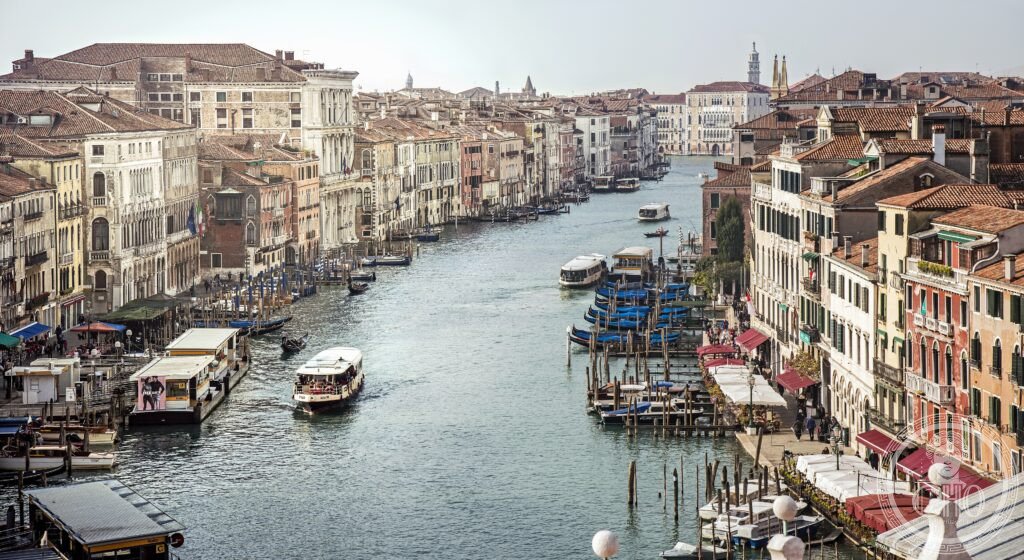
Venice (La Serenissima)
The most improbably constructed city in the history of human settlement and the capital of the longest-surviving republic in European history — Venice, built on 118 islands connected by 391 bridges in a lagoon in the northern Adriatic, was the most powerful maritime trading empire in the Mediterranean for over 700 years and produced a concentration of Gothic and Byzantine art that no lagoon city has any right to contain.
At a glance
Venice (La Serenissima — “the Most Serene”; UNESCO WHS 1987 as “Venice and its Lagoon” — the largest single cultural landscape inscribed in the first batch of UNESCO WHS in Italy; 25 million tourists per year — the most over-touristed city per resident in Europe: 50,000 residents vs 260,000 peak-day tourists — the most disproportionate single visitor-to-resident ratio in any major European heritage city; the most discussed single city in European heritage management: Venice has been at the centre of UNESCO tourism debates since 1988); the engineering (the most audaciously sited single large city in European history: built on wooden piles driven into the mudflat of the Venetian Lagoon (the piles have been preserved for centuries in the anaerobic mud — the most perfectly preserved single pile foundation material in European engineering; the Rialto market area alone stands on 20 million wooden piles); the current sinking rate (1–4 mm per year — the most precisely measured single city subsidence in Europe); the acqua alta (the high water events: the most precisely tidal single urban flooding phenomenon in the world — the Piazza San Marco floods approximately 100 times per year; the 2019 flood (1.87 m — the highest single acqua alta since 1966: the most precisely recorded single Venetian flood in modern history)).
Key facts
- The Republic of Venice: the most durable single republic in European history — the Serenissima (the Republic of Venice: 697–1797 CE — 1,100 years as a republic (the most continuously independent single city-state republic in the history of Europe; only ended by Napoleon Bonaparte’s conquest on 12 May 1797 — the most precisely dated single death of a millennium-old republic); the Doge (the most precisely elected single head of state in any pre-modern republic: the Doge was elected through a 10-round process involving lots and elections (the most deliberately randomised single election procedure in European political history: the process involved alternating rounds of random selection and voting to prevent family-group domination — the most precisely anti-oligarchic single electoral mechanism in medieval European governance); the Doge served for life but could not leave Venice without the Senate’s permission — the most precisely restricted single lifetime appointment in any European republic); the trade empire (the most commercially consequential single city in medieval European history: Venice controlled the Adriatic, the Eastern Mediterranean trade routes, and the spice trade from Asia (the most profitably located single medieval entrepôt); the Fourth Crusade (1204) and the sack of Constantinople — the most commercially motivated single crusade in the history of the Crusades — gave Venice dominion over three-eighths of the Byzantine Empire (the most precisely quantified single territorial gain from a crusade)))
- St Mark’s Basilica: the most golden building in Western Christianity — the Basilica di San Marco (the most elaborately decorated single church in the history of Western architecture: the exterior and interior are entirely covered by approximately 8,000 m² of gold mosaic (the most extensive single gold mosaic surface in any Christian building in the world; the most precisely illuminated single sacred interior on a cloudy day in Italy — the gold mosaics glow without direct sunlight); the building was begun in 828 CE to house the relics of St Mark the Evangelist (the most audaciously stolen single set of sacred relics in the history of Christianity: Venetian merchants smuggled the saint’s body from Alexandria by concealing it under pork and cabbage to deter Muslim inspection — the most precisely described single relic smuggling operation in Christian history); the 4 Bronze Horses (the most travelled single set of ancient bronze sculptures in the world: taken from the Hippodrome of Constantinople in 1204 (during the Fourth Crusade — the most consequentially looted single treasure of any crusade), displayed on the Basilica’s facade until 1797, taken by Napoleon to Paris (1797–1815 — the most precisely Paris-retained single looted sculpture outside of the Elgin Marbles debate), returned to Venice 1815; now copies are on the facade, originals inside in the museum))
- The Doge’s Palace and the Bridge of Sighs: the most theatrically named bridge in the world — the Palazzo Ducale (the most politically concentrated single building in Venetian history: the seat of government, the courts, and the prison of the Republic for over 500 years; the Bridge of Sighs (Ponte dei Sospiri: the most romantically named single bridge in the history of European architecture: built 1600; connects the Doge’s Palace to the New Prison — the last view of Venice that condemned prisoners would see through its small limestone-grated windows before imprisonment — the most precisely described single architectural sorrow in the history of bridge nomenclature; named by Lord Byron in the early 19th century — the most poetically motivated single bridge name in European heritage)); the Giants’ Staircase (the most precisely ceremonial single staircase in the Doge’s Palace: Doges were crowned at the top of this staircase — the most precisely located single Venetian coronation site))
- Heritage: UNESCO World Heritage Site, Venice and its Lagoon, inscribed 1987
- GPS: 45.4340° N, 12.3388° E
History
The founding (the most precisely mythology-confirmed single city founding date in Italy: tradition says Venice was founded at noon on 25 March 421 CE — the most precisely timed single mythological founding in the history of Italian cities; the actual refugee settlement (the most precisely motivated single urban construction in Late Antiquity: refugees from the Hunnic invasions of northern Italy in the 5th and 6th centuries settled on the lagoon islands as a defensive strategy — the most militarily logical single choice of building site in Italian history); the first Doge (697 CE: the most precisely dated single first appointment in the history of any European republic)); the Byzantine connection (the most consequentially Byzantine single Italian city: Venice was initially under Byzantine suzerainty and received trading rights in Constantinople in 992 CE — the most commercially significant single trading concession in Byzantine history; the city’s architecture, its mosaics, and its religious imagery are the most Byzantine single visual legacy in any western Italian city); the decline (the Portuguese opening of the Cape of Good Hope route in 1498 (the most economically devastating single navigational discovery for Venice — it bypassed Venice entirely from the spice trade); the Ottoman wars; the fall of Cyprus (1571); the Battle of Lepanto (1571 — the most consequential single naval battle in the history of the Mediterranean: the Christian League fleet defeated the Ottoman navy, with Venice’s galley fleet as the most decisive single element)); UNESCO WHS 1987.
What you see
The Venice visit (the most anti-car single heritage experience in Italy: no roads, no cars, no bicycles within the historic island city — the most precisely traffic-free single UNESCO inscribed urban area in Europe; the essential sequence: a vaporetto (water bus) from the train station (Santa Lucia) to Piazza San Marco along the Grand Canal (the most scenically informative single water bus journey in Italy: Line 1, slow boat, 35 min from the station to San Marco — the most panoramically effective single approach to any city in the world — the entire Grand Canal lined with palaces, churches, and markets passes as a moving architectural exhibition); the Piazza San Marco (the most precisely described public space in European architecture: Napoleon called it “the drawing room of Europe” — the most precisely complimentary single remark by a conqueror to his conquest; the Campanile (the most precisely collapsed single campanile in Italian history: fell on 14 July 1902 — the most precisely dated single major Italian architectural collapse that killed nobody (a cat); rebuilt 1912); the Doge’s Palace; the Bridge of Sighs); the Gallerie dell’Accademia (the most important single collection of Venetian Renaissance painting in the world: Titian, Tintoretto, Veronese, Bellini — the most comprehensive single exhibition of Venetian painting in any gallery in Venice)).
Practical information
- Getting there: Venice Marco Polo Airport (VCE; 12 km north-east; water taxi (most expensive single airport transfer in Italy: €100–130 for 40 min; the most cinematically appropriate single airport arrival in any Italian city) or ACTV bus + people mover to Piazzale Roma (20 min; €15 — the most cost-effective single airport transfer in Venice)); by train (Venice Santa Lucia is the most architecturally surprising single train station terminus in Italy: the train arrives directly at the Grand Canal — the most dramatically waterfront single railway terminus in Europe); accommodation strategy (the most strongly stratified single hotel market in Italy by price vs. location: accommodation on the island is the most expensive relative to mainland equivalents in any Italian city; 3 tiers: on-island (the most atmospherically correct but most expensive; book 6+ months for summer); Lido di Venezia (reachable by vaporetto; the most beach-adjacent single Venice accommodation option); Mestre (mainland; the most economical single Venice base; 10 min by train or bus))
- The Venetian islands: the most distinctly specialised group of islands in any European lagoon — Murano (the most famous single glassblowing tradition in Europe: glass production moved to Murano from Venice in 1291 (the most precisely fire-safety-motivated single industrial relocation in Venetian history: Venetian authorities feared the glassblowers’ furnaces would burn down the city) — the most continuously practised single traditional craft in any Italian island); Burano (the most colourfully painted single island in the Venetian Lagoon: the fishermen painted their houses in saturated colours so they could see their homes through the lagoon fog — the most practically motivated single architectural colour scheme in Italian heritage; the most photogenic single canal in any small Italian island; Burano lace (the most precisely crafted single textile tradition in the Venetian Lagoon: Burano lace-making has been UNESCO-listed as Intangible Cultural Heritage since 2023 — the most recently Intangible-Heritage-listed single craft in the Venetian area)); Torcello (the most anciently settled single island in the Venetian Lagoon: the first major settlement in the lagoon (5th century CE); the Santa Maria Assunta Cathedral (the oldest building in the Venetian Lagoon still standing: the Byzantine mosaics are the most archaically beautiful single mosaic ensemble in the lagoon — older and less restored than St Mark’s))
- Verona and the Arena di Verona: the finest Roman amphitheatre still in use and the setting of Romeo and Juliet — Verona (UNESCO WHS 2000; 115 km west of Venice by train (1h 10min Frecciabianca); the Arena di Verona (the most atmospherically intact single Roman amphitheatre in the world still used for live performance: 22,000-seat open-air opera venue — the most dramatically appropriate single opera setting in the world; the verona opera season (June–August) — the most consistently attended single summer opera festival in Italy: Aida, Nabucco, and Turandot are the most frequently performed operas in any amphitheatre setting); the “balcony of Juliet” (the most mythologically contested single architectural feature in Verona: the balcony at Via Cappello 23 was added to the building in 1936 specifically to satisfy Shakespeare tourist demand — the most precisely commercial single heritage fabrication in Italian tourism; Juliet Capulet never existed — the most precisely fictional single person commemorated by a UNESCO heritage city))
Getting there
Venice Santa Lucia station: train from Milan (2h 15min Frecciarossa), from Rome (3h 45min), from Florence (2h). Airport VCE: ACTV bus to Piazzale Roma (20 min, €15) or water taxi (40 min, €100+). Vaporetto Line 1 from Piazzale Roma to San Marco 35 min. GPS: 45.4340, 12.3388.
Nearby
- Murano, Burano, Torcello — 40 min–1h by vaporetto; the Venetian islands cluster — described in Practical section; essential half-day or full-day island excursion from Venice
- Verona (UNESCO WHS 2000) — 115 km west (1h 10min train); finest Roman amphitheatre in use + Romeo and Juliet — described in Practical section
- Padua / Padova — the Scrovegni Chapel — 40 km west (25 min train; Frecciarossa or Regional); the most important single fresco cycle in the history of Western art — the Cappella degli Scrovegni (1305; Giotto di Bondone — the most consequential single fresco commission in the history of Western art: the 38-scene fresco cycle covering the Life of the Virgin and the Life of Christ is the first cycle in Western art to depict human emotion naturalistically (grief, tenderness, fear) — the most revolutionary single departure from Byzantine formalism in the history of Italian painting; the foundation of the entire Western tradition of naturalistic pictorial representation from Masaccio to Michelangelo; visitors are admitted in groups of 15–25 for 20-minute timed visits (the most precisely managed single viewing experience in any Italian fresco site — the most climatically controlled small chapel in Italy); UNESCO WHS (Padua’s 14th-century fresco cycles) 2021)
Sources
- Wikipedia, Venice; Basilica di San Marco; Doge of Venice; Bridge of Sighs; Grand Canal, Venice, accessed June 2026
- UNESCO, Venice and its Lagoon, WHS reference 394, inscribed 1987
- John Julius Norwich, A History of Venice, Allen Lane, 1982
Find it on the map
See this place and what’s around it →📷 Diventa un fotografo di Cultural Heritage Online
Condividi le tue foto dei luoghi: restano pubblicate con la tua firma come autore. Più vengono viste, più ti fai conoscere — e presto un concorso premierà le foto più apprezzate.
Accedi o registrati gratis per aggiungere una foto