
Curated Itinerary
Concrete, Marble and Speed: A Milan Rationalism RoadBook (1928–1942)
Between the wars, Milan rebuilt itself in marble, concrete and glass — a hard new architecture caught between the avant-garde and a dictatorship that wanted monuments. This is a day spent reading that tense, brilliant, uncomfortable decade on foot.
In the 1920s and 1930s a generation of young Milanese architects went to war on the past. They called their movement Rationalism, and they wanted buildings stripped to structure, light and proportion — Italy’s answer to the Bauhaus. But they built under Fascism, and the regime wanted grandeur and marble to match. The architecture of Milan between the wars is the record of that argument, and it is everywhere once you know how to see it.
This walk crosses the city to read it honestly: the avant-garde apartment blocks and the regime’s monuments side by side, because they were built by the same people in the same years. It is a long route best done with the metro and an unhurried afternoon. Milan invented the modern aperitivo, so end it with one.
Read the full story behind this walk: Milan Between the Wars.
Read the full story behind this walk: Milan Between the Wars.
Read the full story behind this walk: Milan Between the Wars.
Before you go
A word from your host
A word before you go, because this walk needs it. Almost everything here was built under Fascism, and some of it was built for Fascism. I have not tidied that away: an honest visitor looks at the marble courthouse and the propaganda palace as clearly as at the brilliant apartment blocks, because the same talented people made both. Hold the contradiction rather than resolving it. And treat the day as the Milanese do — slowly, well-dressed, ending with an aperitivo. Milan invented that ritual in these very years, and it remains the best way to close an afternoon spent thinking hard about a difficult, dazzling decade.
Getting around
Milan’s 1930s landmarks are scattered across the city, so this route leans on the excellent metro and tram network — buy a daily ticket and validate it. The central stretch from the Triennale to the Duomo is a pleasant walk through Parco Sempione; use the metro for the longer hops out to Sant’Ambrogio and Bocconi. BikeMi city bikes and e-scooters fill the gaps; ride in the lanes and park them tidily. Many of these are working buildings — a university, a courthouse, an office block — so be discreet and respect opening hours.
Step by step
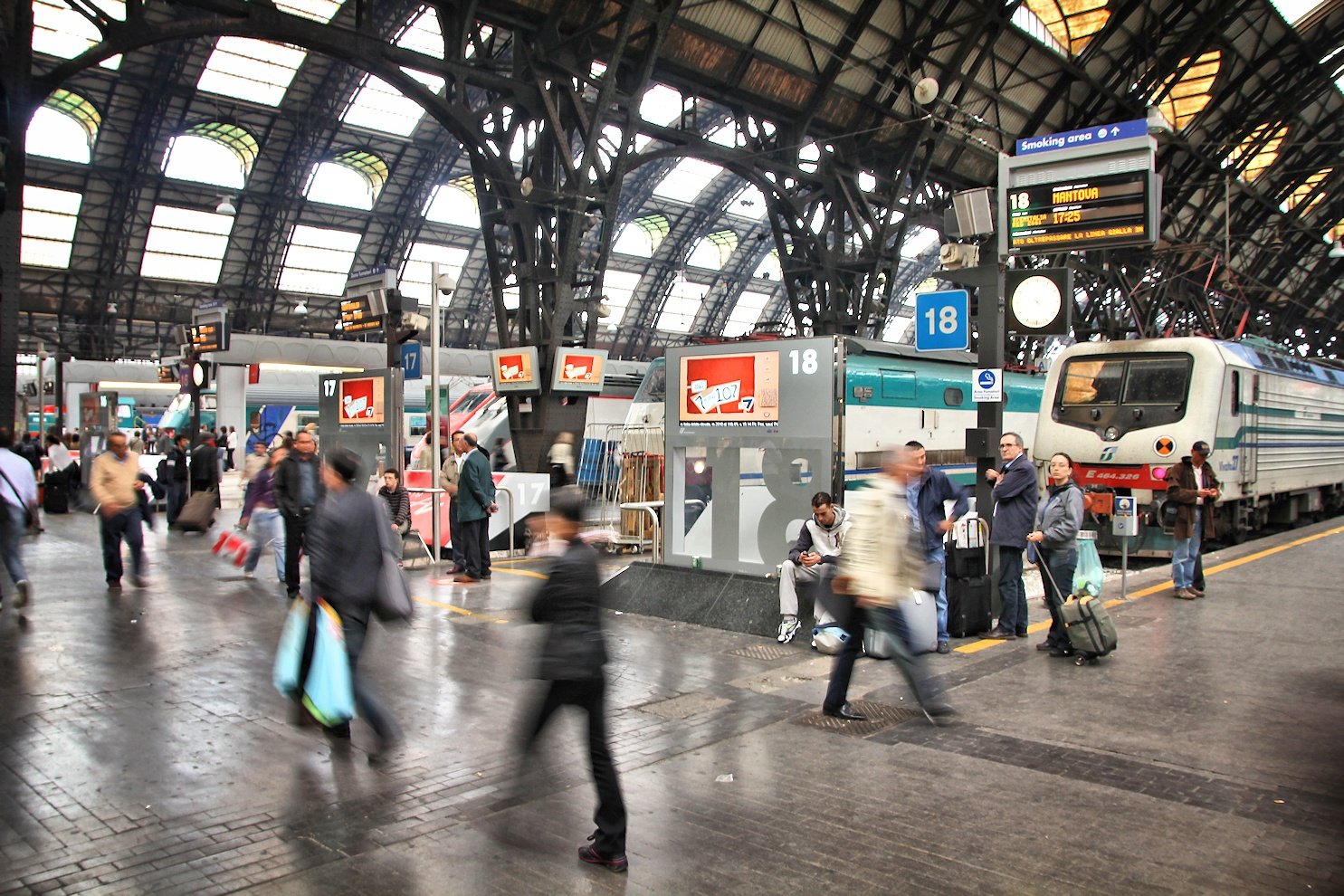
Milano Centrale Station — Art Deco Monumental Terminal by Ulisse Stacchini
Start where most people arrive: a station so vast and theatrical it feels less like transport than a monument to travel itself, finished in 1931.
The storyUlisse Stacchini won the competition for Milano Centrale in 1912, but the building that opened in 1931 was far bigger and harder than his original design — the regime had inflated it into a statement of national power. The result is a strange, magnificent hybrid: Art Déco, Liberty and Assyrian monumentality under five great steel-and-glass train sheds.
Insider tipWalk the upper concourse slowly and look up at the winged horses and the stone reliefs. The scale is deliberately overwhelming. The historic bars on the gallery level are a fine first coffee before you set out.
A fitting stopMilan runs on coffee taken standing at the bar; do as the locals do here — order an espresso, drink it in two minutes, and move on.

Casa Rustici — Terragni & Lingeri’s Razionalist Manifesto on Corso Sempione
The clearest statement of Milanese Rationalism: two apartment blocks of 1935 held apart by a cage of open balconies, by Giuseppe Terragni and Pietro Lingeri.
The storyTerragni was the brightest talent of Italian Rationalism, and the Casa Rustici on Corso Sempione is his manifesto in Milan: two slabs pulled apart to let light and air into the centre, linked only by horizontal balcony bridges. In 1935 nothing in the city looked like it. It still reads as startlingly modern.
Insider tipIt is a private apartment building, so read it from the Corso Sempione pavement opposite. The magic is the void up the middle — stand where you can see straight through the building to the sky.
Velodromo Vigorelli — Milano’s Razionalist Cycling Cathedral
The “cycling cathedral” of 1935: a Rationalist stadium whose fast wooden track made it a temple of speed for half a century.
The storyThe Vigorelli velodrome opened in 1935 with a wooden track so fast that for decades the world hour record was set here again and again. The clean concrete lines are pure 1930s; the obsession with speed they housed was the era’s favourite metaphor for modernity itself.
Insider tipCheck whether an event or open day lets you see the track; otherwise the exterior and the setting near Parco Sempione tell the story. The park between here and the Triennale is the green lung of this walk.
A fitting stopParco Sempione has kiosks and a café or two — a good place to sit before the next stretch.

Palazzo dell’Arte — Triennale di Milano by Giovanni Muzio
Giovanni Muzio’s Palazzo dell’Arte of 1933, purpose-built for the Triennale — the exhibition that made Milan the world capital of design.
The storyMuzio designed this brick-and-stone hall in 1933 to host the Triennale, the recurring show of architecture and the decorative arts that turned Milan into the design city it still is. It is calmer and more classical than Terragni’s work — Rationalism in its establishment register, and still a working museum.
Insider tipThere is almost always an exhibition on; even between shows the building and its café in the park are worth the stop. This is the heart of why Milan and design became the same word.
A fitting stopThe Triennale’s own café-terrace looks out over Parco Sempione — a fitting design-world pause.

Palazzo dell’Informazione — Muzio’s Razionalist Headquarters in Piazza Cavour
A severe stone-clad office block on Piazza Cavour, built by Muzio in 1942 for the regime’s press — propaganda given an austere modern face.
The storyThe Palazzo dell’Informazione was built in 1942 to house the Fascist newspaper, and its façade carries a mosaic by the painter Mario Sironi. It is one of the clearest places to feel the uncomfortable truth of this walk: the same designers who made the avant-garde apartment blocks also built the machinery of the dictatorship.
Insider tipLook up for the Sironi mosaic above the entrance — Sironi was the great artist of the regime, and his work here is hard to separate from what it served. Read it with that in mind.
Arengario di Milano – Virtual Tour 360°
Two stern stone pavilions on Piazza del Duomo, finished after the war but begun in 1936 — and now, pointedly, the Museum of the Twentieth Century.
The storyThe Arengario was designed in the 1930s as a ceremonial backdrop on the cathedral square, its name taken from the medieval word for a speaker’s platform — it was built for the regime’s rallies. Today one pavilion is the entrance to the Museo del Novecento, Milan’s museum of twentieth-century art: a building made for propaganda turned into a place that examines the century that produced it.
Insider tipGo up into the Museo del Novecento even briefly — the Futurist rooms and the view from the top, framing the Duomo through the glass, are among the best in the city.
A fitting stopYou are on the Duomo square: step into the Galleria for Camparino in Galleria, the Liberty-era bar open since 1915, and have the Milanese aperitivo where it was effectively invented.
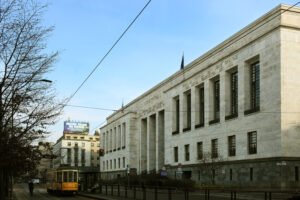
Palazzo di Giustizia di Milano — Marcello Piacentini’s Monumental Courthouse
Marcello Piacentini’s vast courthouse of 1940 — the regime’s monumental classicism at full, heavy volume.
The storyPiacentini was the most powerful architect of Fascist Italy, the man who tamed Rationalism into the stripped, marble-clad monumentality the regime preferred. His Palazzo di Giustizia, finished in 1940, is enormous, lined with regime-era reliefs and murals, and impossible to love easily — which is exactly why it belongs on an honest walk.
Insider tipThe exterior and the entrance halls (it is a working courthouse, so be discreet) show the scale. Compare it in your mind with Terragni’s light balconies from earlier — same decade, opposite faith.

Università Cattolica del Sacro Cuore — Muzio’s Adaptation of Bramante’s Cloisters
Muzio’s reworking of an ancient monastery beside the basilica of Sant’Ambrogio — Rationalism in quiet conversation with Bramante.
The storyFor the Catholic University, Giovanni Muzio rebuilt and extended the Renaissance cloisters attributed to Bramante next to Sant’Ambrogio, weaving his own sober 1930s brickwork into the old fabric rather than overpowering it. It is the gentlest building on this walk, and a lesson in how the era could also be tactful.
Insider tipThe cloisters are usually open during university hours — step into the courtyards for the calm. The basilica of Sant’Ambrogio next door is one of the oldest churches in Milan and worth the detour.
A fitting stopThe Sant’Ambrogio quarter has old trattorie where you can try a proper risotto alla milanese or a cotoletta among locals rather than tourists.

Università Bocconi — Pagano’s Razionalist Campus (1937-1942)
End at Giuseppe Pagano’s Bocconi campus of 1941 — austere, rational, humane, and built by a man whose own story is the era’s hardest.
The storyPagano was a leading Rationalist and, for a time, a believer in the regime. By the end he had broken with it entirely, joined the Resistance, and was arrested and deported. He died in the Mauthausen concentration camp in 1945. His Bocconi, calm and disciplined, is a fitting and sobering place to end a walk through the architecture of these years.
Insider tipThe campus is open to walk through; its restraint is the point after Piacentini’s marble. Pagano’s fate is the note to carry home — the architecture of these years was made by real people who paid, in some cases, with their lives.
A fitting stopYou have earned the Milanese ritual: find a bar in the Porta Romana or Navigli area south of here and order an aperitivo — a Campari-based Negroni or spritz with the snacks that come free — as the evening starts.
Download for tour navigation
GPX for Garmin / Komoot / OsmAnd. KML for Google Earth and Maps.