
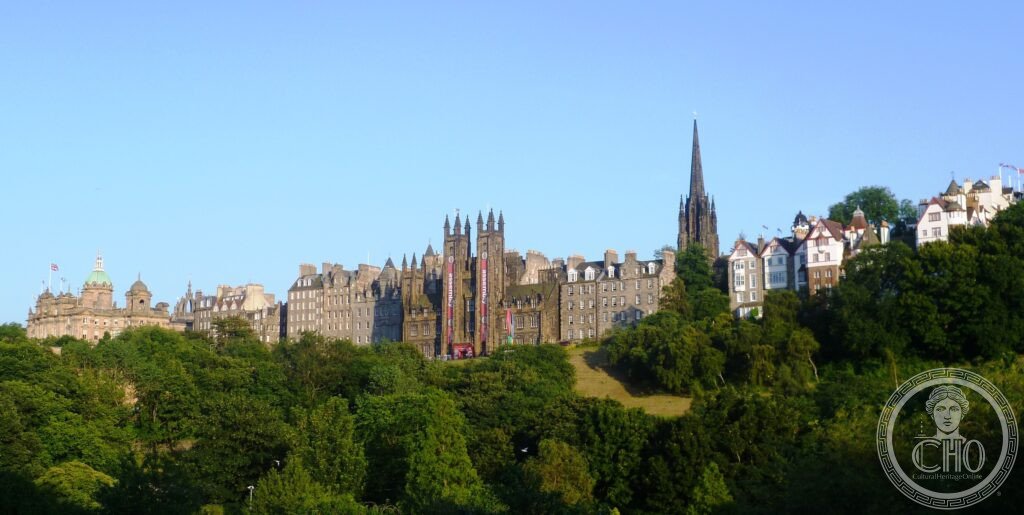
The most distinctive urban skyline in Britain and one of the great contrasts in European urbanism. Edinburgh presents medieval and Georgian cities in immediate adjacency, the volcanic geology and medieval tenements of the Old Town separated from the serene rational grid of the Georgian New Town by a valley garden, and both dominated by a castle on a volcanic plug that has been continuously fortified for at least 900 years.
At a glance
The Old and New Towns of Edinburgh (UNESCO WHS 1995) encompasses two distinct urban environments built back-to-back. The Old Town is the medieval city, raised from the 12th century onward along the volcanic ridge that runs from Edinburgh Castle at the top to the Palace of Holyroodhouse at the bottom. Its backbone is the Royal Mile, the name given to the series of streets — Castlehill, Lawnmarket, High Street, Canongate, Abbey Strand — that descend 1 mile from the Castle Esplanade to the palace gate, flanked on both sides by tenement buildings up to 11 storeys tall, with approximately 100 narrow alleys called closes dropping from each side into the valley below. The New Town is the Georgian planned extension, built from 1767 onward on the north side of the valley, where the Nor’ Loch, a defensive lake, had been drained. The young architect James Craig (1744–1795) designed it, winning a competition judged by the City of Edinburgh Corporation: a grid of three parallel streets — Princes Street, George Street, Queen Street — tied together by perpendicular cross-streets. Charlotte Square, by Robert Adam, 1791, is the most accomplished piece of Georgian townscape design in Scotland, and its north side, where Bute House at No. 6 is the official residence of the First Minister of Scotland, is the finest Georgian terrace in Britain. Around it the whole Georgian fabric survives as a remarkably intact ensemble of New Town streets.
Key facts
- Edinburgh Castle: the most visited paid attraction in Scotland. Edinburgh Castle stands on the volcanic plug of Castle Rock, a basalt intrusion formed approximately 340 million years ago, a natural fortification platform defended since at least the 6th century AD. The present buildings date mainly from the 12th to the 16th centuries, and the oldest survivor is the tiny St. Margaret’s Chapel of about 1130, the oldest building in Edinburgh. Inside are the Honours of Scotland, the Scottish Crown Jewels — the Crown, the Sceptre and the Sword of State — all older than the English regalia: the Crown was last used for the coronation of Charles II in 1651, and the Honours were hidden in 1707 at the union with England, then rediscovered in 1818 by Sir Walter Scott. Beside them lies the Stone of Destiny, the coronation stone of Scottish kings, used from at least the 9th century, taken to England by Edward I in 1296 as a war trophy, set into the coronation chair at Westminster for 700 years, and returned in 1996. From the Half Moon Battery the One O’Clock Gun has fired every day except Sunday since 1861, originally a time signal for ships in the Forth: the tradition continues, and hearing it without warning is startling.
- The closes of the Old Town: the most atmospheric surviving medieval urban fabric in northern Europe. The closes (narrow alleys; the word derived from the French “clos”, meaning enclosed space; approximately 100 on each side of the Royal Mile; each named for the merchant, craftsman, or noble who originally owned the tenement at the entrance: Mary King’s Close (a 17th-century close sealed beneath the Royal Exchange building in 1753 and preserved intact; one of the most popular underground tours in Edinburgh; the close has a significant ghost tourism industry), Victoria Street (the curved Victorian street descending from the Grassmarket; one of the most photographed streets in Edinburgh; believed by some to be the inspiration for Diagon Alley in J.K. Rowling’s Harry Potter series), Fleshmarket Close (the inspiration for Ian Rankin’s Rebus novel), and the Vennel (a close descending from the Grassmarket to the Flodden Wall (1513); the most direct panoramic view of the Castle from the city level)).
- The Scottish Enlightenment and the New Town: Edinburgh as the intellectual capital of 18th-century Europe. The building of the New Town coincided with the golden age of Scottish Enlightenment thought (1740–1800; David Hume (philosophy; lived in St. David Street, New Town), Adam Smith (economics; The Wealth of Nations published 1776; lived in Panmure House, Canongate, Old Town), James Hutton (geology; invented the concept of “deep time” by studying the unconformity at Siccar Point in 1788), William Robertson (history), Adam Ferguson (sociology), Joseph Black (chemistry)), making Edinburgh in the 1770s–1790s what Voltaire called “a hotbed of genius”. The largest concentration of original intellectual talent per capita in European history.
- Heritage: UNESCO World Heritage Site, Old and New Towns of Edinburgh, inscribed 1995.
- GPS: 55.9500° N, 3.1883° W.
History
Early medieval settlement on Castle Rock (6th century AD). The medieval town grew along the Royal Mile ridge (from the 12th century). Edinburgh became the capital of the Kingdom of Scotland (c. 1437). The main period of Old Town tenement construction (15th–17th centuries). The founding of the New Town (James Craig’s competition design approved 1766; construction began 1767; the New Town expanded through the early 19th century to include multiple planned extensions to the north and west). The Scottish Enlightenment (1740–1800; Edinburgh as intellectual capital of Europe). The Romantic period and Walter Scott (who more than anyone else shaped the modern global image of Scotland — kilts, castles, Highlands romanticism). Edinburgh Fringe Festival founded 1947 (now the largest arts festival in the world). UNESCO WHS 1995. Devolution and the Scottish Parliament (1999; the Scottish Parliament building by Enric Miralles (1999–2004) at the foot of the Royal Mile, adjacent to Holyroodhouse).
What you see
The walk from Edinburgh Castle to Holyroodhouse runs the Royal Mile, 1 mile in 2–3h with stops. It begins at the Castle Esplanade, where the Military Tattoo is staged in August, and passes the Lawnmarket, with its antique and craft shops in the original medieval market. St. Giles’ Cathedral, the High Kirk of Scotland, was founded about 854 and is largely 14th–16th century in its present form; inside it the Thistle Chapel of 1910, designed by Robert Lorimer for the Order of the Thistle, Scotland’s highest order of chivalry, is the most elaborate small interior in the country, its heraldic stonework carved around 16 stalls, each assigned to a Knight of the Thistle. Further down stands the Scottish Parliament Building by Enric Miralles, 2004, the most controversial public building in Scotland after a budget overrun from GBP 40M to GBP 414M: its design draws on Miralles’ idea of “land in the land”, on the upturned boats of Scottish fishing villages and on the paintings of Charles Rennie Mackintosh, and the public gallery is open for PMQs on Thursdays. The walk ends at the Palace of Holyroodhouse, the official Scottish residence of the British monarch, beside the ruins of Holyrood Abbey, founded in 1128 by David I and partly ruined in 1688 — the most atmospheric ruin in Edinburgh.
Practical information
- When to go: August (the Edinburgh Festival season — the Edinburgh International Festival (high culture: opera, classical music, theatre); the Edinburgh Fringe (the world’s largest arts festival; 3,000+ shows in 300+ venues; everything from stand-up comedy to experimental theatre to student productions; tickets for popular acts sell out months in advance; the “flyering” on the Royal Mile reaches fever pitch; the Fringe is simultaneously the best and most overwhelming cultural event in Britain)). Any other month has much smaller crowds. The city is strikingly grey and atmospheric in November and February. The New Year celebrations (Hogmanay; December 31 – January 1; the largest New Year celebration in Britain; the street party on Princes Street has a ticketed capacity of approximately 100,000).
- Getting there: Edinburgh Airport (EDI; 14 km west; direct flights from most European cities, New York, Dubai, Toronto; tram from the airport to the city centre (Princes Street/York Place; 30 min; approximately GBP 9 single; runs every 8 min 6am–midnight); from London: 1h by plane or 4h 30 min by LNER train from King’s Cross to Edinburgh Waverley (the station in the valley between the Old and New Towns; the most dramatically sited railway station in Britain); Waverley is walking distance from virtually everything in both the Old and New Towns).
- Edinburgh Castle: entry approximately GBP 18 (Historic Scotland members free; book online to avoid queues; the Crown Room (Stone of Destiny + Honours of Scotland) is the most popular section and can have long queues even with timed entry; the One O’Clock Gun is visible (and audible) from the castle at 1pm daily except Sunday; the view from the Castle Esplanade (the Arthur’s Seat panorama, the Firth of Forth visible on clear days) is one of the finest urban views in Britain).
Getting there
Edinburgh Airport tram (30 min). London LNER train to Edinburgh Waverley (4h 30 min). Waverley station is within the WHS, walking distance from everything. GPS: 55.9500, -3.1883.
Nearby
- Rosslyn Chapel. 11 km south of Edinburgh (25 min by Borders Railway from Edinburgh Waverley to Roslin Glen or 35 min by bus from the Royal Mile). The most intricately carved Gothic chapel in Scotland. Rosslyn Chapel, the Collegiate Church of St. Matthew, was founded in 1446 by William Sinclair, 1st Earl of Orkney. Carved stone covers the interior from floor to vaulted ceiling at a density no other Gothic interior in Scotland approaches: Green Men, angels, knights, foliage, biblical scenes, and the famous Apprentice Pillar, a spiral column of extraordinary complexity. Legend says an apprentice carved it while the master mason was away, and that the master, on seeing the work, killed him in a fit of jealousy; the apprentice’s face is visible in a corbel near the pillar with a gash across the forehead, and the master’s looks down in guilt from across the chapel. The chapel’s association with the Knights Templar and Freemasonry is mostly legend, amplified by Dan Brown’s The Da Vinci Code (2003), which ends at Rosslyn and tripled visitor numbers after publication; the historical connections to the Order of the Thistle and the Sinclair family, however, are real.
- St. Andrews. 56 km north-east of Edinburgh (1h by road or 1h by train from Edinburgh to Leuchars then bus). The most important historic town in Scotland after Edinburgh. St. Andrews (the site of Scotland’s oldest university (1413; the medieval buildings around North and South Street); the ruins of St. Andrews Cathedral (once the largest building in Scotland; founded 1158; largely destroyed in the Reformation of 1559; the ruins are the most evocative medieval remains in Scotland); St. Andrews Castle (12th–17th century; partially ruined; the battle-mine and counter-mine tunnels under the castle — dug by besieging forces and defenders during the 1546 siege — are the best-preserved siege tunnels of the 16th century in Europe); the Old Course (the most famous golf course in the world; the birthplace of golf (golf was played on the Links at St. Andrews from at least 1457; the first recorded set of golf rules was established at St. Andrews in 1744); free to walk across the Old Course on Sundays; the St. Andrews Links Trust offers public ballot and booking for the Old Course year-round)).
- Stirling Castle. 56 km north-west of Edinburgh (1h by road or 50 min by ScotRail train from Edinburgh Waverley to Stirling). The most historically important castle in Scotland. Stirling Castle (on a volcanic plug like Edinburgh Castle, and with an equally commanding position; the site of the Battle of Stirling Bridge (1297; William Wallace defeated the English army here; the Wallace Monument (1869; a tall Victorian tower on the Abbey Craig hill above the castle) commemorates the victory); the Royal Palace (James V, 1538–1542; the finest example of French Renaissance architecture in Scotland; the sequence of royal rooms includes the Stirling Heads (oak medallions carved for the ceiling of the King’s Presence Chamber; the most important surviving collection of 16th-century carved woodwork in Scotland)); the Great Hall (James IV, 1503; the largest medieval hall in Scotland)).
Sources
- Wikipedia, Edinburgh Old Town. Edinburgh New Town. Edinburgh Castle, accessed June 2026.
- UNESCO, Old and New Towns of Edinburgh, WHS reference 728, inscribed 1995.
- Alistair Moffat, Edinburgh: A History of the City, Mainstream Publishing, 2012.
Find it on the map
See this place and what’s around it →📷 Become a Cultural Heritage Online photographer
Share your photos of places: they stay published under your name as the author. The more they're seen, the more you get noticed — and soon a contest will reward the most appreciated photos.
Log in or sign up free to add a photo